Oncogenic driver mutations, treatment, and EGFR-TKI resistance in a Caucasian population with non-small cell lung cancer: survival in clinical practice
- PMID: 29100434
- PMCID: PMC5652823
- DOI: 10.18632/oncotarget.20857
Oncogenic driver mutations, treatment, and EGFR-TKI resistance in a Caucasian population with non-small cell lung cancer: survival in clinical practice
Abstract
Introduction: Oncogenic driver mutations activating EGFR, ALK, or BRAF in NSCLC predict sensitivity to specific tyrosine-kinase inhibitors (TKIs). We provide data on prevalence, treatment and survival of driver-mutation positive NSCLC in a predominantly Caucasian population in routine clinical practice.
Patients and methods: NSCLC patients diagnosed from 2006-2015 with an EGFR-test result were included (n=265). Testing for EGFR, ALK, or BRAF was performed if specific TKI therapy was considered. Case-control analyses of overall survival (OS) comparing driver-mutation positive and negative patients were performed.
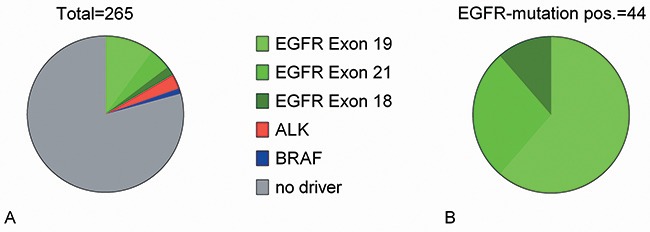
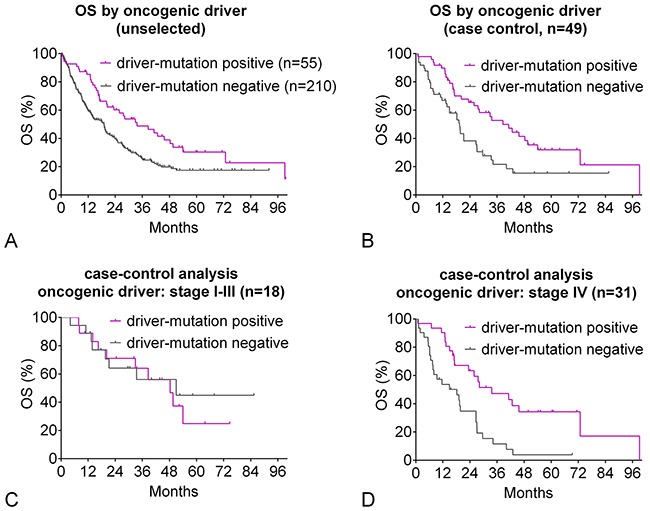
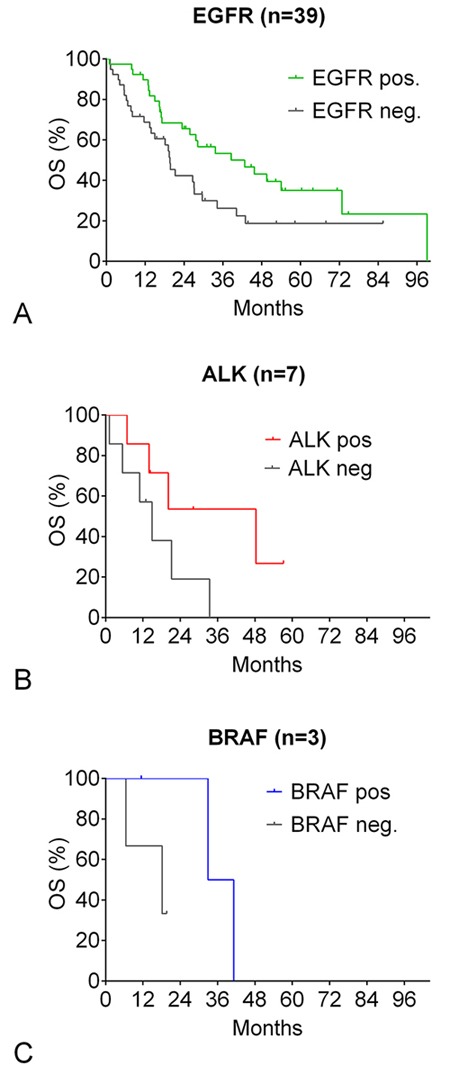
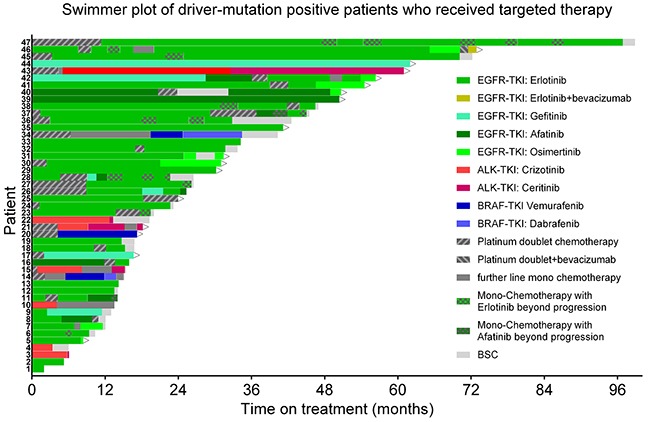
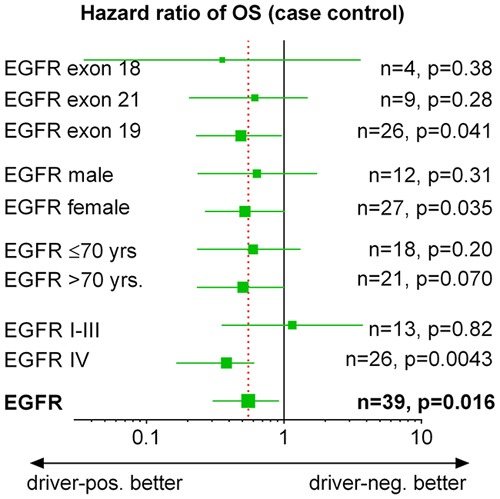
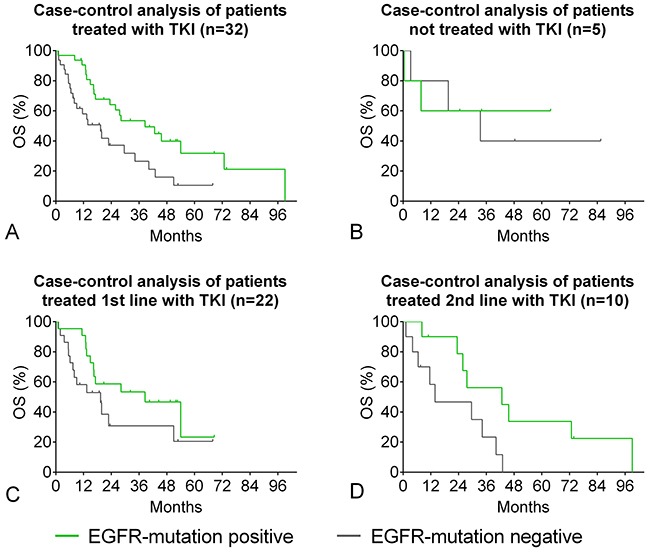
Results: 44 sensitizing EGFR mutations (17%), 8 ALK translocations (7%, n=111) and 3 BRAF mutations (8%, n=39) were detected in adenocarcinoma or adenosquamous carcinoma. We did not find mutations in tumors without an adenocarcinoma-component. More than 90% of inoperable driver-mutation positive patients received TKI-therapy. Case-control analysis revealed improved OS of driver-mutation positive patients (39.6 vs. 19.4 months, HR 0.51). OS was improved in stage IV patients but not in stage I-III patients.OS of EGFR-TKI treated patients was similar for 1st and 2nd-line EGFR-TKI treatment. Patients not treated with EGFR-TKI had no benefit in OS. Re-biopsies obtained at progression revealed an EGFR-T790M mutation in 73% (n=11). These patients responded to the 3rd-generation EGFR-TKI osimertinib.
Discussion: Testing guided by predictive clinical parameters resulted in twice as high rates of mutation-positive patients than expected, and TKI treatment resulted in a strong long-term OS advantage.
Conclusion: Testing for driver mutations is feasible in routine clinical practice, and identifies patients who benefit from TKI-therapy. OS compares favorably with OS in clinical studies.
Keywords: ALK; BRAF; EGFR; NSCLC; overall survival.
Conflict of interest statement
CONFLICTS OF INTEREST None of the authors has declared a conflict of interest.
Figures
References
-
- Paez JG, Jänne PA, Lee JC, Tracy S, Greulich H, Gabriel S, Herman P, Kaye FJ, Lindeman N, Boggon TJ, Naoki K, Sasaki H, Fujii Y, et al. EGFR mutations in lung cancer: correlation with clinical response to gefitinib therapy. Science. 2004;304:1497–500. https://doi.org/10.1126/science.1099314. - DOI - PubMed
-
- Lynch TJ, Bell DW, Sordella R, Gurubhagavatula S, Okimoto RA, Brannigan BW, Harris PL, Haserlat SM, Supko JG, Haluska FG, Louis DN, Christiani DC, Settleman J, Haber DA. Activating mutations in the epidermal growth factor receptor underlying responsiveness of non-small-cell lung cancer to gefitinib. N Engl J Med. 2004;350:2129–39. https://doi.org/10.1056/NEJMoa040938. - DOI - PubMed
-
- Mok TS, Wu YL, Thongprasert S, Yang CH, Chu DT, Saijo N, Sunpaweravong P, Han B, Margono B, Ichinose Y, Nishiwaki Y, Ohe Y, Yang JJ, et al. Gefitinib or carboplatin-paclitaxel in pulmonary adenocarcinoma. N Engl J Med. 2009;361:947–57. https://doi.org/10.1056/NEJMoa0810699. - DOI - PubMed
-
- Maemondo M, Inoue A, Kobayashi K, Sugawara S, Oizumi S, Isobe H, Gemma A, Harada M, Yoshizawa H, Kinoshita I, Fujita Y, Okinaga S, Hirano H, et al. Gefitinib or chemotherapy for non-small-cell lung cancer with mutated EGFR. N Engl J Med. 2010;362:2380–8. https://doi.org/10.1056/NEJMoa0909530. - DOI - PubMed
-
- Rosell R, Carcereny E, Gervais R, Vergnenegre A, Massuti B, Felip E, Palmero R, Garcia-Gomez R, Pallares C, Sanchez JM, Porta R, Cobo M, Garrido P, et al. Erlotinib versus standard chemotherapy as first-line treatment for European patients with advanced EGFR mutation-positive non-small-cell lung cancer (EURTAC): a multicentre, open-label, randomized phase 3 trial. Lancet Oncol. 2012;13:239–46. https://doi.org/10.1016/S1470-2045(11)70393-X. - DOI - PubMed
LinkOut - more resources
Full Text Sources
Other Literature Sources
Research Materials
Miscellaneous