


An evaluation of the potential consequences of drilling titanium and tantalum implants during surgery - a pilot study
- PMID: 29100511
- PMCID: PMC5670512
- DOI: 10.1186/s12891-017-1784-x
An evaluation of the potential consequences of drilling titanium and tantalum implants during surgery - a pilot study
Retraction in
-
Retraction Note: An evaluation of the potential consequences of drilling titanium and tantalum implants during surgery - a pilot study.BMC Musculoskelet Disord. 2019 Oct 24;20(1):469. doi: 10.1186/s12891-019-2824-5. BMC Musculoskelet Disord. 2019. PMID: 31651295 Free PMC article.
Abstract
Background: The aim of the study was to evaluate the potential consequences of drilling titanium alloy (Ti) and tantalum (Ta) implants.
Methods: During an in vitro study, four holes were made in each of two spatially porous trabecular implants: one Ta and the other Ti alloy (Ti-6Al-7Nb). The weight and the volume of particles produced during the drilling were then measured using a Radwag XA 110/2X (USA) laboratory balance.
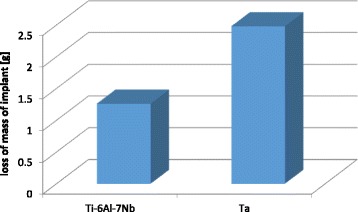
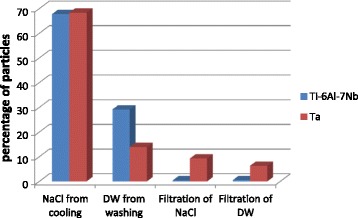
Results: The loss of mass of the Ti and Ta implants was respectively 1.26 g and 2.48 g, and the volume of free particles was respectively 280 mm3 and 149 mm3. The particles were recovered after each stage. Despite the use of 5 μm filters, around 0.6% of the total implant mass from both implants was not recovered after drilling (roughly 2% of the mass of the particles created).
Conclusion: It is technically difficult to make holes in Ti and Ta implants using standard surgical tools, and the process creates a significant amount of metal particles which cannot be removed, despite intensive flushing. This may have a potentially adverse influence on the survival of the implant and result in negative systemic consequences.
Keywords: Augments; Drilling; Hip arthroplasty; Knee arthroplasty; Loosening; Revision.
Conflict of interest statement
Ethics approval and consent to participate
The protocol of the study was accepted by Bioethics Committee of our institution (resolution RNN/43/13/KE dated 12 March 2013).
Consent for publication
Not applicable
Competing interests
The authors declare that they have no competing interests.
Publisher’s Note
Springer Nature remains neutral with regard to jurisdictional claims in published maps and institutional affiliations.
Figures

References
-
- Papadelis EA, Karampinas PK, Kavroudakis E, Vlamis J, Polizois VD, Pneumaticos SG. Isolated Subtalar distraction Arthrodesis using porous tantalum: a pilot study. Foot Ankle Int. 2015; [Epub ahead of print] - PubMed
Publication types
MeSH terms
Substances
LinkOut - more resources
Full Text Sources
Other Literature Sources
