. 2018 Jan 2;84(2):e01772-17.
doi: 10.1128/AEM.01772-17. Print 2018 Jan 15.

Tinkering with Osmotically Controlled Transcription Allows Enhanced Production and Excretion of Ectoine and Hydroxyectoine from a Microbial Cell Factory

Affiliations

Tinkering with Osmotically Controlled Transcription Allows Enhanced Production and Excretion of Ectoine and Hydroxyectoine from a Microbial Cell Factory

Laura Czech et al. Appl Environ Microbiol. .

Abstract

Ectoine and hydroxyectoine are widely synthesized by members of the Bacteria and a few members of the Archaea as potent osmostress protectants. We have studied the salient features of the osmostress-responsive promoter directing the transcription of the ectoine/hydroxyectoine biosynthetic gene cluster from the plant-root-associated bacterium Pseudomonas stutzeri by transferring it into Escherichia coli, an enterobacterium that does not produce ectoines naturally. Using ect-lacZ reporter fusions, we found that the heterologous ect promoter reacted with exquisite sensitivity in its transcriptional profile to graded increases in sustained high salinity, responded to a true osmotic signal, and required the buildup of an osmotically effective gradient across the cytoplasmic membrane for its induction. The involvement of the -10, -35, and spacer regions of the sigma-70-type ect promoter in setting promoter strength and response to osmotic stress was assessed through site-directed mutagenesis. Moderate changes in the ect promoter sequence that increase its resemblance to housekeeping sigma-70-type promoters of E. coli afforded substantially enhanced expression, both in the absence and in the presence of osmotic stress. Building on this set of ect promoter mutants, we engineered an E. coli chassis strain for the heterologous production of ectoines. This synthetic cell factory lacks the genes for the osmostress-responsive synthesis of trehalose and the compatible solute importers ProP and ProU, and it continuously excretes ectoines into the growth medium. By combining appropriate host strains and different plasmid variants, excretion of ectoine, hydroxyectoine, or a mixture of both compounds was achieved under mild osmotic stress conditions.IMPORTANCE Ectoines are compatible solutes, organic osmolytes that are used by microorganisms to fend off the negative consequences of high environmental osmolarity on cellular physiology. An understanding of the salient features of osmostress-responsive promoters directing the expression of the ectoine/hydroxyectoine biosynthetic gene clusters is lacking. We exploited the ect promoter from an ectoine/hydroxyectoine-producing soil bacterium for such a study by transferring it into a surrogate bacterial host. Despite the fact that E. coli does not synthesize ectoines naturally, the ect promoter retained its exquisitely sensitive osmotic control, indicating that osmoregulation of ect transcription is an inherent feature of the promoter and its flanking sequences. These sequences were narrowed to a 116-bp DNA fragment. Ectoines have interesting commercial applications. Building on data from a site-directed mutagenesis study of the ect promoter, we designed a synthetic cell factory that secretes ectoine, hydroxyectoine, or a mixture of both compounds into the growth medium.

Keywords: chemical chaperones; compatible solutes; excretion; osmoregulation; promoters.


Figures

FIG 1
FIG 1
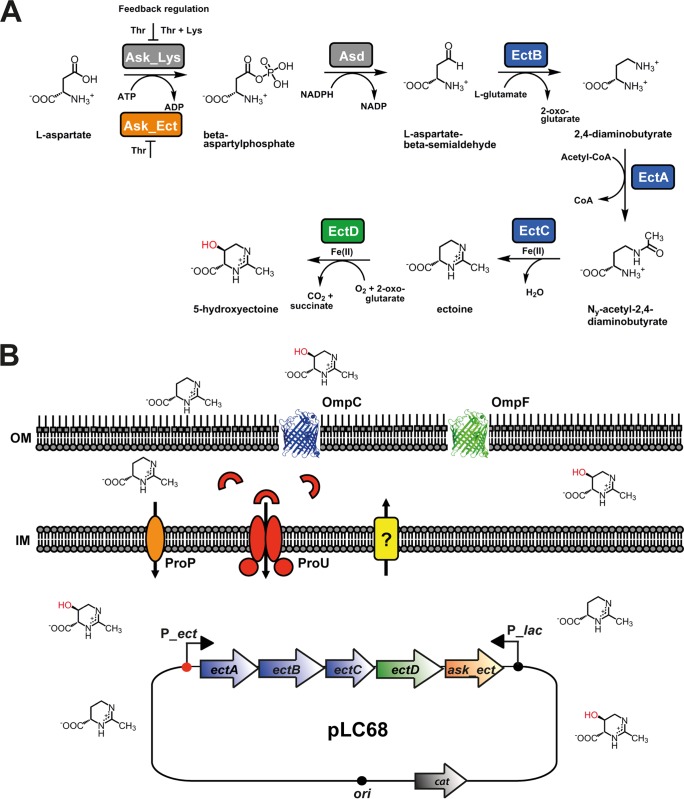
Pathway for the synthesis of ectoine and hydroxyectoine and design of a recombinant cell factory for the production of ectoines. (A) Biosynthetic route for ectoine and its derivative 5-hydroxyectoine from l-aspartate. The relevant data for the enzymes and metabolites involved in this process were compiled from the literature (17, 20, 21, 86). (B) The E. coli cell factory carries a low-copy-number plasmid harboring the ectABCD-ask_ect gene cluster from P. stutzeri A1501 (67) under the control of its authentic and osmotically inducible promoter (P_ect) (17). This plasmid (pLC68) is a derivative of the cloning vector pHSG575 (89), which carries a lac promoter (P_lac) that is constitutively expressed in all the E. coli strains used in this study, as they carry a deletion of the entire lac operon, including that of the lacI regulatory gene. ProP and ProU are osmotically inducible transport systems for osmostress protectants; ProP is a member of the MFS family (88), and ProU is a binding-protein-dependent ABC transporter (80). The presumed ectoine/hydroxyectoine efflux system is shown as a yellow box; its molecular identity is unknown. The trimeric OmpC and OmpF proteins (represented here as monomers) function as general porins that are inserted into the E. coli outer membrane. IM, inner membrane; OM, outer membrane.
FIG 2
FIG 2
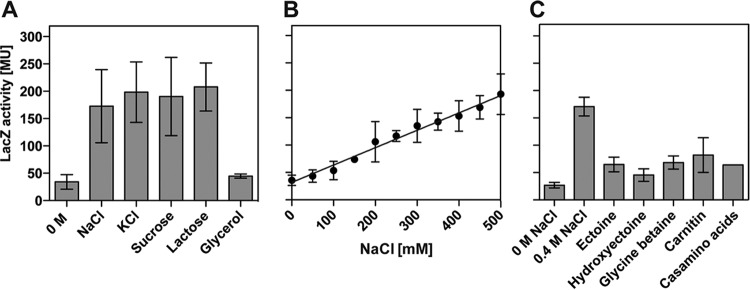
Transcriptional activity of the ect promoter in response to increases in osmolarity and presence of compatible solutes. (A) E. coli strain MC4100 carrying the ectB-lacZ gene fusion plasmid pGJK4 was grown in MMA in the absence or presence of various compounds to increase the osmolarity of the medium. The solute concentration was chosen such that all the media possessed an equivalent osmolarity [1.000 mosmol (kg H2O)−1]. (B) Cultures of strain MC4100(pGJK4) were grown in MMA with increasing NaCl concentrations until they reached approximately the same optical density (OD578 of about 1.8), whereupon they were harvested and processed for β-galactosidase reporter enzyme activity assays. (C) Cultures of strain MC4100(pGJK4) were grown in MMA with 0.4 NaCl in the absence or presence of 1 mM concentrations the indicated compatible solutes or Casamino Acids. When the cultures reached an OD578 of about 1.8, the cells were harvested and assayed for β-galactosidase reporter enzyme activity. The data shown were derived from four independently grown cultures, and each enzyme assay was performed at least twice. β-Galactosidase enzyme activity is given in Miller units (MU) (108).
FIG 3
FIG 3
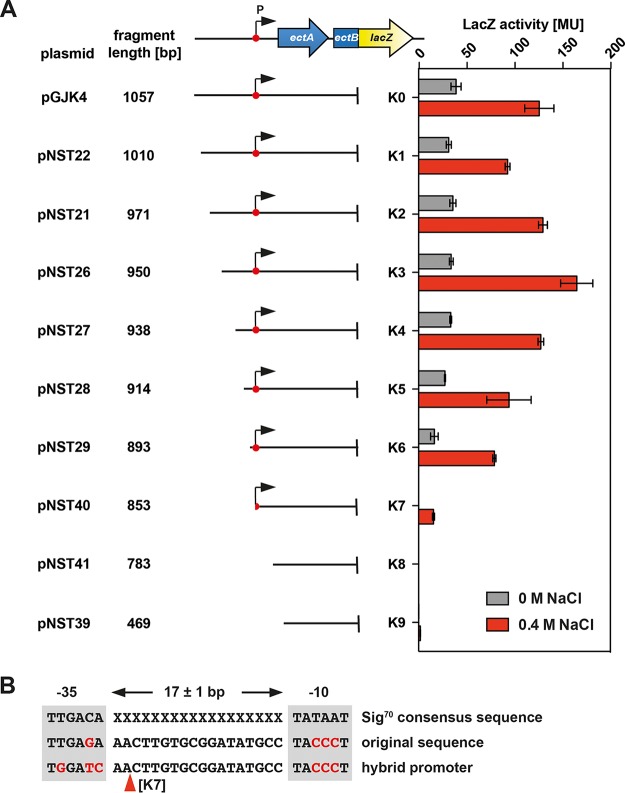
Deletion analysis of the ect promoter region. (A) Plasmid pGJK4 carries an ectB-lacZ reporter fusion that is expressed from the ect promoter present upstream of the ectA gene. The P. stutzeri A1501 genomic DNA located in front of the ectA start codon has a length of 264 bp. This genomic segment was successively shortened from its 5′ end, and the resulting E. coli reporter strains were assayed for β-galactosidase enzyme activity along with the wild-type plasmid-bearing strain. Cultures were grown in MMA or MMA containing 0.4 M NaCl and were harvested and processed for β-galactosidase enzyme activity when they reached an optical density (OD578) of about 1.8. The data shown were derived from four independently grown cultures, and each enzyme assay was performed at least twice. β-Galactosidase enzyme activity is given in Miller units (MU) (108). (B) DNA consensus sequence of Sig70-type E. coli promoters (78), of the predicted ect promoter, and of a hybrid promoter created through deletion analysis of the ect regulatory region (deletion junction K7) that generated plasmid pNST40. The −10 and −35 elements are highlighted, and the spacer length typical for Sig70-type E. coli promoters is indicated.
FIG 4
FIG 4
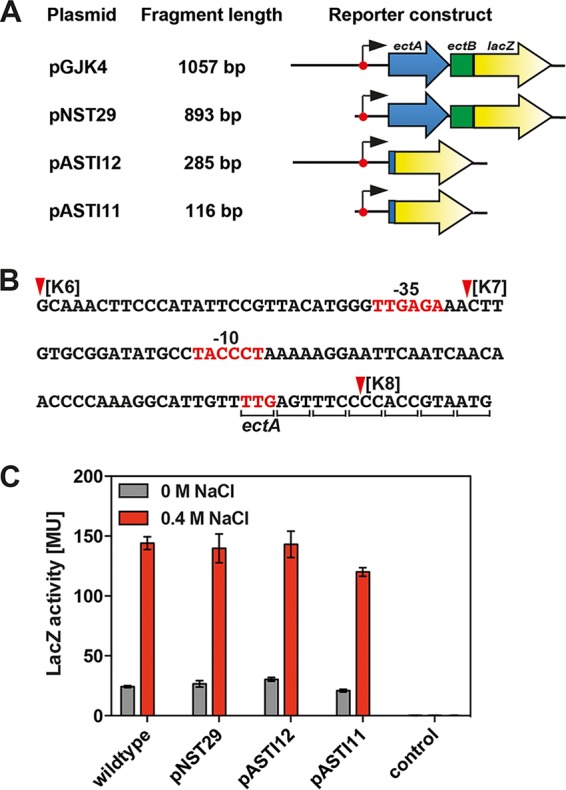
A minimal DNA fragment directing osmoregulated ect transcription. (A) Physical structures of ect-lacZ reporter constructs. (B) DNA sequence of the DNA fragment present in plasmid pASTI11. The deletion endpoints K6, K7, and K8 defined in the experiments for Fig. 3A are indicated, and the −35 and −10 elements of the ect promoter are highlighted. The fusion junction within ectA to the lacZ reporter gene lies in codon seven. (C) β-Galactosidase reporter enzyme activity in cells of strain MC4100 carrying the plasmids depicted in panel A. Cells of MC4100 carrying the vector (pBBR1MCS-2-lacZ) used to construct plasmids pGJK4, pNST29, pASTI12, and pASTI11 were used as the control. Cultures were grown in MMA or MMA containing 0.4 M NaCl and were harvested and processed for β-galactosidase enzyme activity when they reached an optical density (OD578) of about 1.8. The data shown were derived from four independently grown cultures, and each enzyme assay was performed at least twice. β-Galactosidase enzyme activity is given in Miller units (MU) (108).
FIG 5
FIG 5
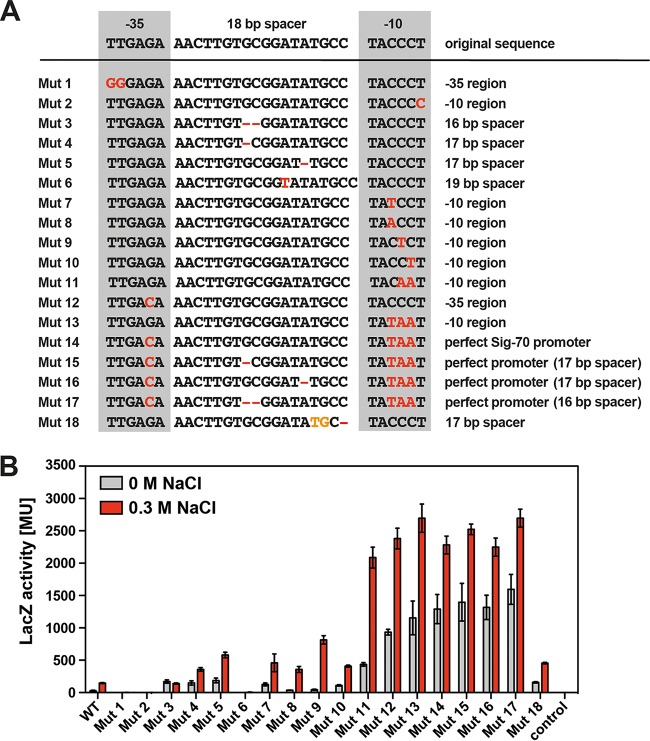
Site-directed mutagenesis of the ect promoter and assessment of the transcriptional activities of the promoter variants. (A) DNA sequences of the wild-type ect promoter and its mutant derivatives. The base pairs changed through site-directed mutagenesis are highlighted in red. (B) β-Galactosidase reporter enzyme activity of E. coli strains (MC4100) harboring the wild-type ectB-lacZ fusion or its mutant derivatives. Cultures were grown in MMA or MMA containing 0.3 M NaCl and were harvested and processed for β-galactosidase enzyme activity when they reached an optical density (OD578) of about 1.8. The data shown were derived from four independently grown cultures, and each enzyme assay was performed at least twice. β-Galactosidase enzyme activity is given in Miller units (MU) (108).
FIG 6
FIG 6
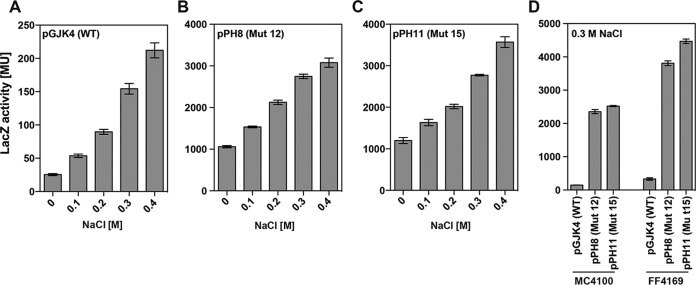
Transcriptional activity of the ect wild-type promoter and two of its mutant derivatives in response to sustained osmotic stress. (A to C) E. coli strains (MC4100) harboring either the wild-type ectB-lacZ reporter fusion plasmid pGJK4 (A), a plasmid (pPH8) carrying a point mutation (Mut 12) (Fig. 4A) in the ect −35 region (B), or a plasmid (pPH11) carrying a mutant ect promoter (Mut 15) (Fig. 4A) that was changed in its −10 region, −35 region, and spacer length to the consensus sequence of Sig70-type E. coli promoters (78) (C) were grown at various salinities. (D) Cells of strain MC4100 or FF4169 (otsA1::Tn10) carrying the wild-type plasmid pGJK4, pPH8, or pPH11 were grown in MMA with 0.3 M NaCl. Cultures were harvested and processed for β-galactosidase enzyme activity when they reached an optical density (OD578) of about 1.8. The data shown were derived from four independently grown cultures, and each enzyme assay was performed at least twice. β-Galactosidase enzyme activity is given in Miller units (MU) (108).
FIG 7
FIG 7
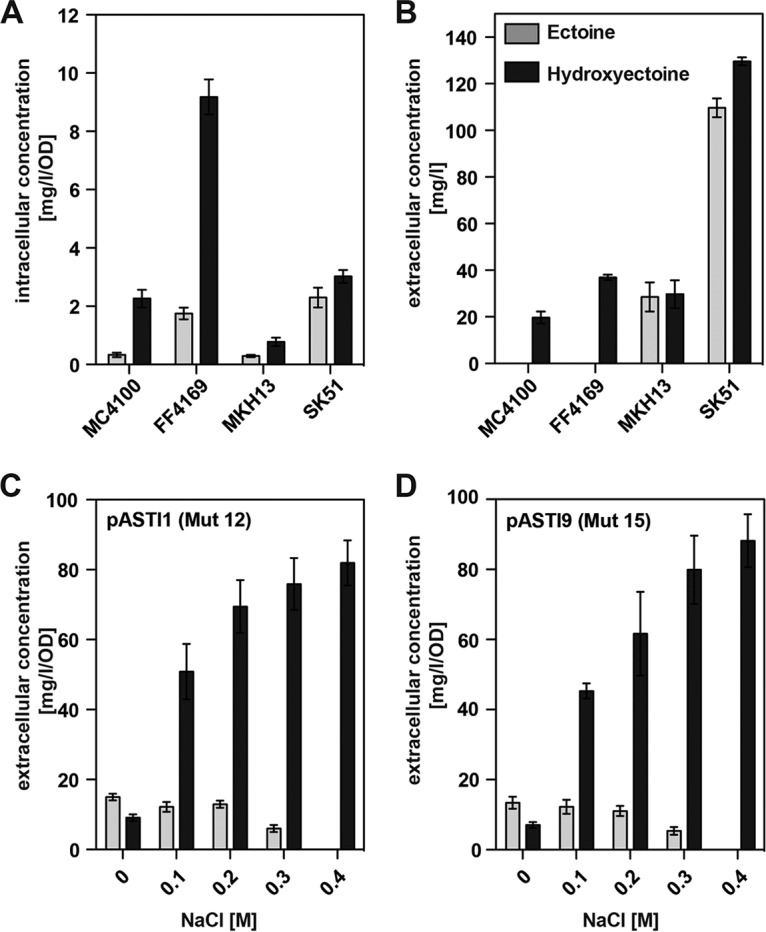
Comparison of ectoine and hydroxyectoine production in different E. coli mutant strains. (A and B) Cells of the E. coli wild-type strain MC4100 and its mutant derivatives FF4169 (otsA1::Tn10), MKH13 [Δ(proP)2 Δ(proU::spc)608], and SK51 [Δ(proP)2 Δ(proU::spc)608 otsA1::Tn10] carrying plasmid pLC68 (with a wild-type ect promoter) were cultivated in MMA with 0.4 M NaCl. After incubation for 48 h, cells were harvested and assayed for their intracellular (A) and extracellular (B) concentrations of ectoine (gray bars) and hydroxyectoine (black bars) via HPLC analysis. (C and D) Comparison of ectoine and hydroxyectoine production in strains carrying mutant ect promoters in response to graded increases in the external salinity. E. coli strain FF4169 (otsA1::Tn10) carrying either plasmid pASTI1 (Mut 12; point mutation in the −35 region) (Fig. 3A) (C) or plasmid pASTI9 (Mut 15; consensus Sig70-type promoter variant) (Fig. 3A) (D) was cultivated in MMA containing various concentrations of NaCl. The cultures were grown for 24 h, and the extracellular ectoine/hydroxyectoine content was then determined by HPLC analysis. The data shown were derived from four independently grown cultures, and each assessment of their ectoine/hydroxyectoine content was performed at least twice. Since the concentration of NaCl in the medium significantly influences cell growth, the ectoine/hydroxyectoine content of the supernatant was normalized to an OD568 of 1 and is reported here as mg/liter/OD unit.
FIG 8
FIG 8
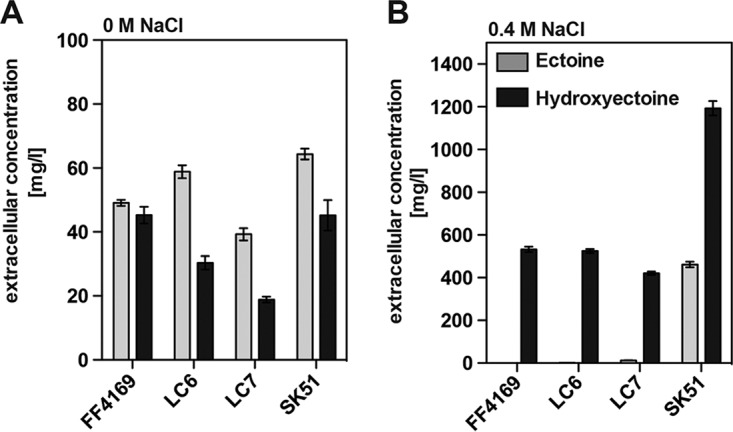
Influence of the ProP and ProU ectoine uptake systems on the extracellular amounts of ectoine and hydroxyectoine. E. coli strains FF4169, LC6, LC7, and SK51 carrying plasmid pASTI1 (Mut 12; point mutation in the −35 region) (Fig. 3A) were cultivated in MMA containing either 0 M NaCl (A) or 0.4 M NaCl (B) for 48 h, and the extracellular ectoine/hydroxyectoine content was then determined by HPLC analysis. The data shown were derived from four independently grown cultures, and each assessment of their ectoine/hydroxyectoine content was performed at least twice. The relevant genotypes of the E. coli strains used are as follows: FF4169, otsA1::Tn10 proP+ proU+; LC6, otsA1::Tn10 proP proU+; LC7, otsA1::Tn10 proP+ proU; and SK51, otsA1::Tn10 proP proU.
FIG 9
FIG 9
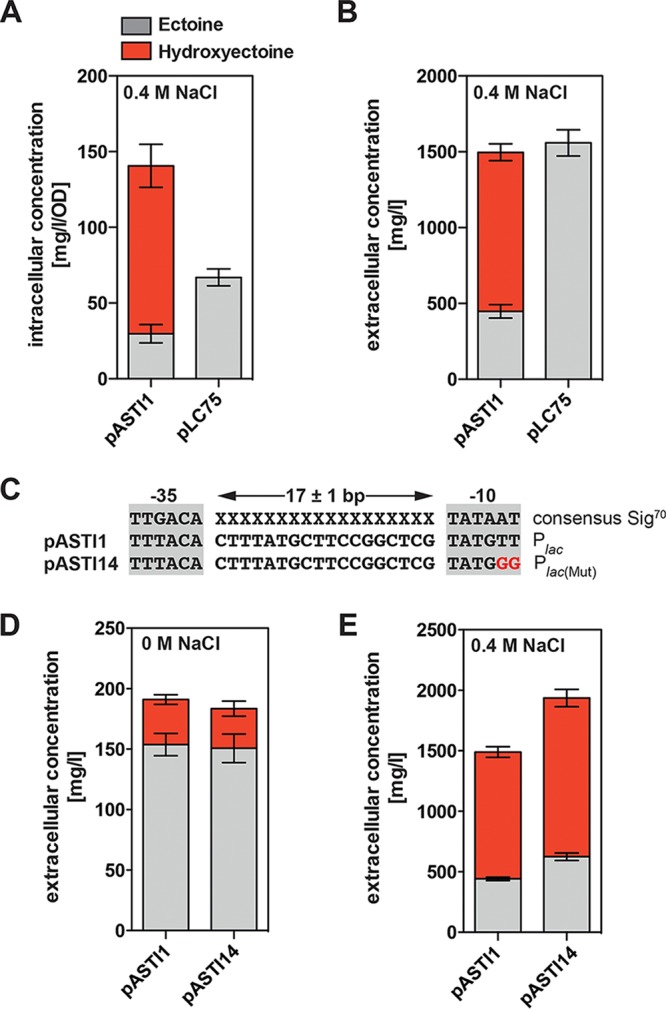
Influence of an ectD deletion on ectoine/hydroxyectoine production and secretion. (A and B) E. coli strain SK51 (otsA1::Tn10 proP proU) harboring either plasmid pASTI1 (ectABCD-ask_ect) or plasmid pLC75 [ectABCectD)-ask_ect] carrying a point mutation in the −35 region of the ect promoter was grown in MMA containing 0.4 M NaCl for 24 h, and the intracellular (A) and extracellular (B) ectoine/hydroxyectoine content was then determined by HPLC analysis. (C) Comparison of the lac promoter sequence present in the cloning vector pHSG575 (89) and its mutant derivative present in plasmid pASTI14 (ectABCD-ask_ect). (D and E) Cells of strain SK51 carrying either pASTI1 or pASTI14 were grown either in MMA (D) or MMA with 0.4 M NaCl (E) for 24 h, and the extracellular ectoine and hydroxyectoine concentrations were then determined by HPLC analysis. The data shown were derived from four independently grown cultures, and each assessment of their ectoine/hydroxyectoine content was performed at least twice.

References

    1. Pastor JM, Salvador M, Argandona M, Bernal V, Reina-Bueno M, Csonka LN, Iborra JL, Vargas C, Nieto JJ, Canovas M. 2010. Ectoines in cell stress protection: uses and biotechnological production. Biotechnol Adv 28:782–801. doi: 10.1016/j.biotechadv.2010.06.005. - DOI - PubMed
    1. Kempf B, Bremer E. 1998. Uptake and synthesis of compatible solutes as microbial stress responses to high osmolality environments. Arch Microbiol 170:319–330. doi: 10.1007/s002030050649. - DOI - PubMed
    1. Widderich N, Höppner A, Pittelkow M, Heider J, Smits SH, Bremer E. 2014. Biochemical properties of ectoine hydroxylases from extremophiles and their wider taxonomic distribution among microorganisms. PLoS One 9:e93809. doi: 10.1371/journal.pone.0093809. - DOI - PMC - PubMed
    1. Widderich N, Czech L, Elling FJ, Könneke M, Stöveken N, Pittelkow M, Riclea R, Dickschat JS, Heider J, Bremer E. 2016. Strangers in the archaeal world: osmostress-responsive biosynthesis of ectoine and hydroxyectoine by the marine thaumarchaeon Nitrosopumilus maritimus. Environ Microbiol 18:1227–1248. doi: 10.1111/1462-2920.13156. - DOI - PubMed
    1. Harding T, Brown MW, Simpson AG, Roger AJ. 2016. Osmoadaptative strategy and its molecular signature in obligately halophilic heterotrophic protists. Genome Biol Evol 8:2241–2258. doi: 10.1093/gbe/evw152. - DOI - PMC - PubMed

Publication types

MeSH terms