Comment
doi: 10.1126/sciimmunol.aao5703.
Candidalysin sets off the innate alarm
Affiliations
- PMID: 29101210
- PMCID: PMC6309692
- DOI: 10.1126/sciimmunol.aao5703
Item in Clipboard
Comment
Candidalysin sets off the innate alarm
Sci Immunol.
.
Abstract
Candidalysin-induced epithelial cell damage promotes expansion of innate TCRαβ+ cells during oropharyngeal candidiasis.
Copyright © 2017 The Authors, some rights reserved; exclusive licensee American Association for the Advancement of Science. No claim to original U.S. Government Works.
Figures
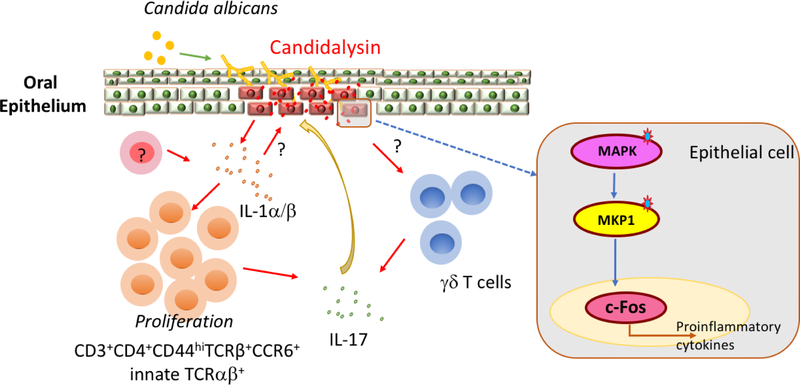
C. albicans switches from yeast to hyphal form upon adhesion to host cells in the oral mucosa. At the invasive hyphal stage, Candidalysin is secreted by invasive hyphae and triggers epithelial cell damage through the activation of a MAPK phosphatase MKP1/c-Fos dependent danger response. Candidalysin-induced oral epithelial damage leads to the production of IL-1α/β from epithelial cells and/or other unidentified cells types. IL-1α/β further drives innate TCRαβ+ cells expansion and IL-17 production, possibly by both innate TCRαβ+ and γδ T. IL-17 and Candidalysin synergistically amplify the danger responses, inducing IL-1α/β and other inflammatory mediators. This positive feedback-loop, linking pro-inflammatory cytokines with fungal virulence factor, is essential for the establishment of a protective innate response to oral candidiasis.
Comment on
-
Oral epithelial cells orchestrate innate type 17 responses to Candida albicans through the virulence factor candidalysin.Sci Immunol. 2017 Nov 3;2(17):eaam8834. doi: 10.1126/sciimmunol.aam8834. Sci Immunol. 2017. PMID: 29101209 Free PMC article.
References
-
- Conti HR, Peterson AC, Brane L, Huppler AR, Hernandez-Santos N, Whibley N, Garg AV, Simpson-Abelson MR, Gibson GA, Mamo AJ, Osborne LC, Bishu S, Ghilardi N, Siebenlist U, Watkins SC, Artis D, McGeachy MJ, Gaffen SL, Oral-resident natural Th17 cells and gammadelta T cells control opportunistic Candida albicans infections. J Exp Med 211, 2075–2084 (2014). - PMC - PubMed
-
- Moyes DL, Wilson D, Richardson JP, Mogavero S, Tang SX, Wernecke J, Hofs S, Gratacap RL, Robbins J, Runglall M, Murciano C, Blagojevic M, Thavaraj S, Forster TM, Hebecker B, Kasper L, Vizcay G, Iancu SI, Kichik N, Hader A, Kurzai O, Luo T, Kruger T, Kniemeyer O, Cota E, Bader O, Wheeler RT, Gutsmann T, Hube B, Naglik JR, Candidalysin is a fungal peptide toxin critical for mucosal infection. Nature 532, 64–+ (2016). - PMC - PubMed
-
- Verma AH, Richardson JP, Zhou CS, Coleman BM, Moyes DL, Ho J, Huppler AR, Ramani K, McGeachy MJ, Mufazalov IA, Waisman A, Kane LP, Biswas PS, Hube B, Naglik JR, Gaffen SL, Oral epithelial cells orchestrate innate Type 17 responses to Candida albicans through the virulence factor Candidalysin. Sci. Immunol, (2017). - PMC - PubMed
-
- LeibundGut-Landmann S, Gross O, Robinson MJ, Osorio F, Slack EC, Tsoni SV, Schweighoffer E, Tybulewicz V, Brown GD, Ruland J, Sousa CRE, Syk- and CARD9-dependent coupling of innate immunity to the induction of T helper cells that produce interleukin 17. Nat Immunol 8, 630–638 (2007). - PubMed
Publication types
MeSH terms
Substances
Grants and funding
LinkOut - more resources
Full Text Sources
Other Literature Sources