. 2018 Feb;73(2):167-173.
doi: 10.1136/thoraxjnl-2017-210149. Epub 2017 Nov 3.

A population-based prospective cohort study examining the influence of early-life respiratory tract infections on school-age lung function and asthma

Affiliations

A population-based prospective cohort study examining the influence of early-life respiratory tract infections on school-age lung function and asthma

Evelien R van Meel et al. Thorax. 2018 Feb.

Abstract

Background: Early-life respiratory tract infections could affect airway obstruction and increase asthma risk in later life. However, results from previous studies are inconsistent.

Objective: We examined the associations of early-life respiratory tract infections with lung function and asthma in school-aged children.

Methods: This study among 5197 children born between April 2002 and January 2006 was embedded in a population-based prospective cohort study. Information on physician-attended upper and lower respiratory tract infections until age 6 years (categorised into ≤ 3 and >3-6 years) was obtained by annual questionnaires. Spirometry measures and physician-diagnosed asthma were assessed at age 10 years.

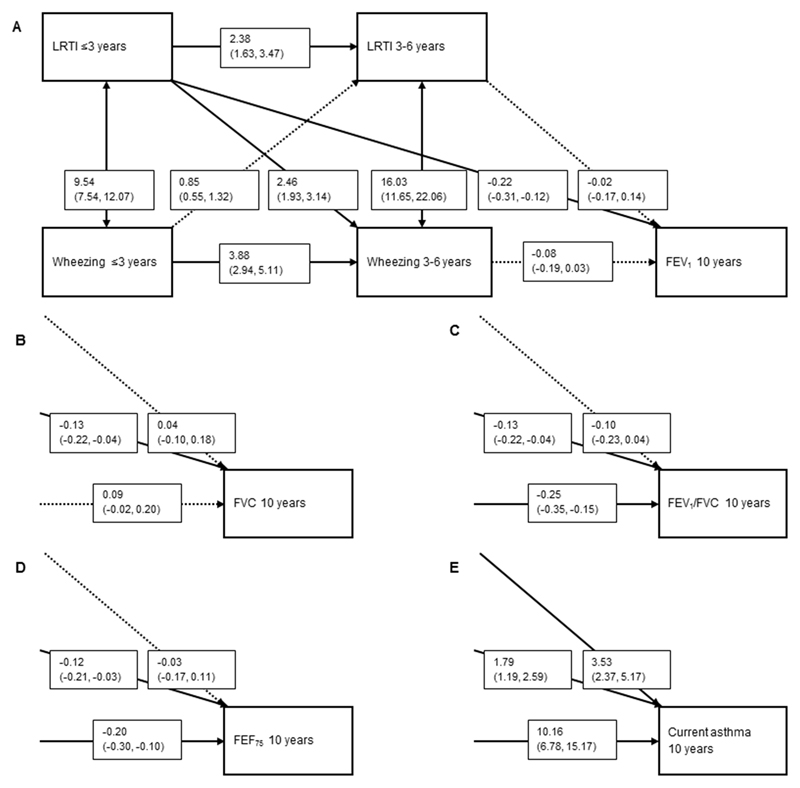
Results: Upper respiratory tract infections were not associated with adverse respiratory outcomes. Compared with children without lower respiratory tract infections ≤3 years, children with lower respiratory tract infections ≤3 years had a lower FEV1, FVC, FEV1:FVC and forced expiratory flow at 75% of FVC (FEF75) (Z-score (95% CI): ranging from -0.22 (-0.31 to -0.12) to -0.12 (-0.21 to -0.03)) and an increased risk of asthma (OR (95% CI): 1.79 (1.19 to 2.59)). Children with lower respiratory tract infections >3-6 years had an increased risk of asthma (3.53 (2.37 to 5.17)) only. Results were not mediated by antibiotic or paracetamol use and not modified by inhalant allergic sensitisation. Cross-lagged modelling showed that results were not bidirectional and independent of preschool wheezing patterns.

Conclusion: Early-life lower respiratory tract infections ≤3 years are most consistently associated with lower lung function and increased risk of asthma in school-aged children.

Keywords: asthma; clinical epidemiology; respiratory infection.


Conflict of interest statement

Competing interests: None declared.

Figures
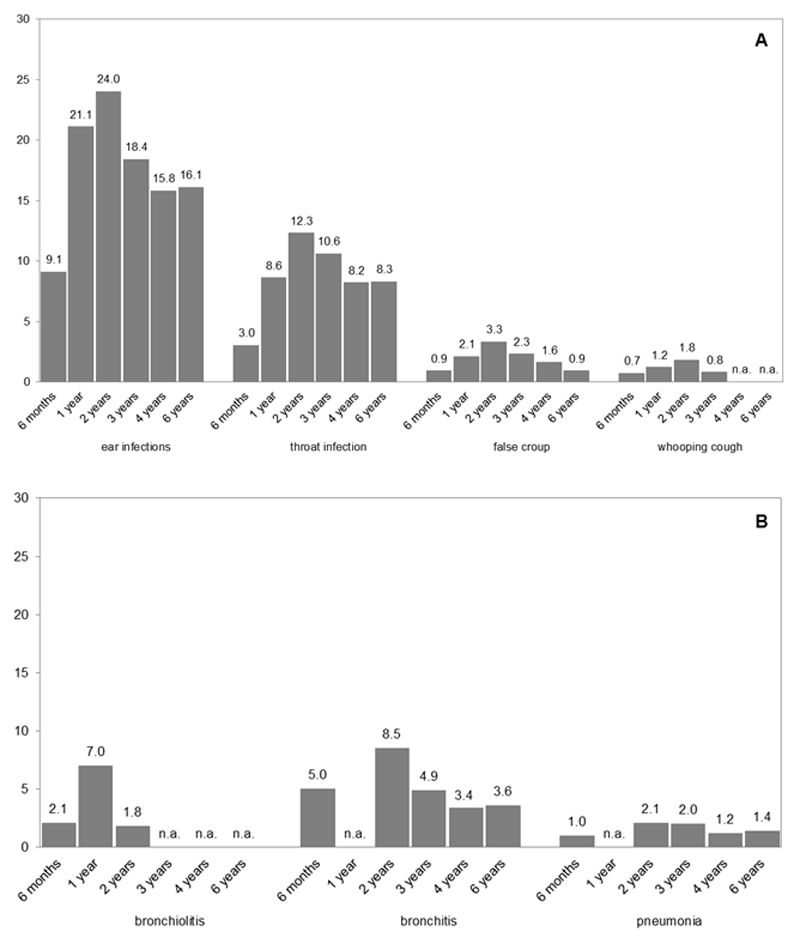
Figure 1
Figure 1
Prevalence of upper (A) and lower (B) respiratory tract infections. Values represent % of specific upper and lower respiratory tract infections per age, and were not imputed. Not available – no data on this specific infection at this timepoint (n.a.)
Figure 2
Figure 2
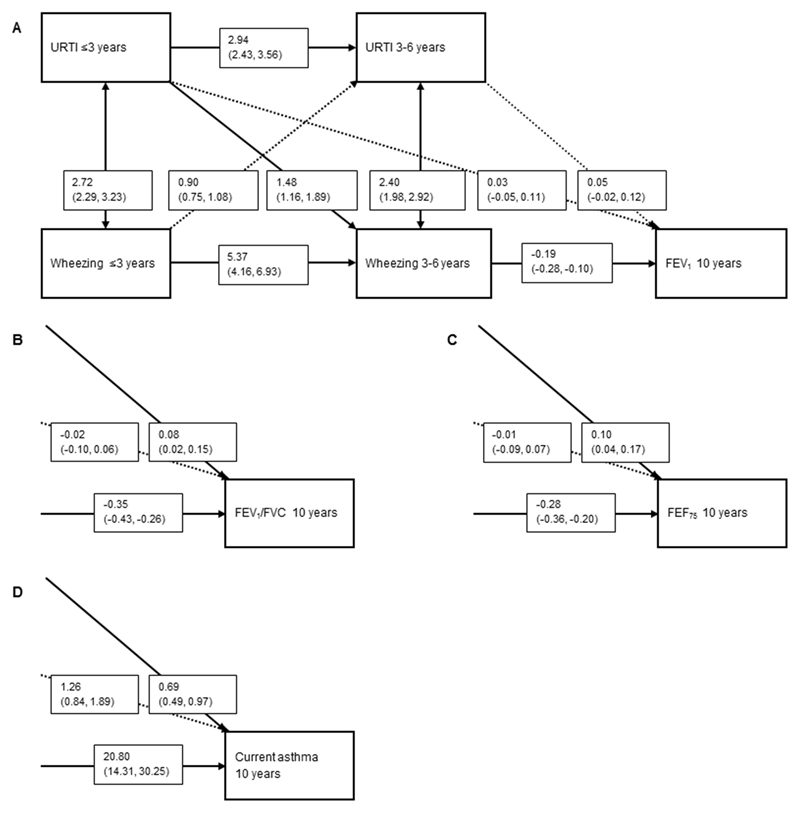
Direction of associations of upper respiratory tract infections (URTI) with wheezing and FEV1 (A), FEV1/FVC (B) FEF75 (C) and current asthma (D) at age 10 years. Values are odds ratios (OR) or change in Z-scores with their corresponding 95% confidence interval (95% CI) derived from binomial logistic or linear regression models, respectively, using cross-lagged modeling which takes bidirectional associations into account. Models are adjusted for maternal education, body mass index, parity, smoking during pregnancy, psychiatric symptoms during pregnancy, pet keeping, history of asthma or atopy, mode of delivery, and child’s sex, gestational age at birth, birth weight corrected for gestational age at birth, breastfeeding and day care attendance. Arrows indicate the direction of the associations and if they are significant (bold) or non-significant (dashed). Forced Expiratory Flow in 1 second (FEV1), Forced Vital Capacity (FVC), Forced Expiratory Flow when 75% of the FVC is exhaled. For Figure 2B, C and D only the right lower quadrant of the figure is presented. All other directions and effect estimates of the associations were approximately the same as presented in Figure 2A.
Figure 3
Figure 3
Direction of associations of lower respiratory tract infections (LRTI) with wheezing patterns and FEV1 (A), FVC (B), FEV1/FVC (C), FEF75 (D) and current asthma (E) at age 10 years. Values are odds ratios (OR) or Z-scores with their corresponding 95% confidence interval (95% CI) derived from binomial logistic or linear regression models, respectively, using cross-lagged modeling which takes bidirectional associations into account. Models are also adjusted for maternal education, body mass index, parity, smoking during pregnancy, psychiatric symptoms during pregnancy, pet keeping, history of asthma or atopy, mode of delivery, and child’s sex, gestational age at birth, birth weight corrected for gestational age at birth, breastfeeding and day care attendance. Arrows indicate the direction of the associations and if they are significant (bold) or non-significant (dashed). Forced Expiratory Flow in 1 second (FEV1), Forced Vital Capacity (FVC), Forced Expiratory Flow when 75% of the FVC is exhaled. For Figure 3B, C, D and E, only the right lower quadrant of the figure is presented. All other directions and effect estimates of the associations were approximately the same as presented in Figure 3A.

Comment in

References

    1. Chan JY, Stern DA, Guerra S, et al. Pneumonia in childhood and impaired lung function in adults: a longitudinal study. Pediatrics. 2015;135(4):607–16. - PMC - PubMed
    1. Johnston ID, Strachan DP, Anderson HR. Effect of pneumonia and whooping cough in childhood on adult lung function. The New England journal of medicine. 1998;338(9):581–7. - PubMed
    1. Shaheen SO, Sterne JA, Tucker JS, et al. Birth weight, childhood lower respiratory tract infection, and adult lung function. Thorax. 1998;53(7):549–53. - PMC - PubMed
    1. Guilbert TW, Singh AM, Danov Z, et al. Decreased lung function after preschool wheezing rhinovirus illnesses in children at risk to develop asthma. The Journal of allergy and clinical immunology. 2011;128(3):532–8.e1-10. - PMC - PubMed
    1. Bonnelykke K, Vissing NH, Sevelsted A, et al. Association between respiratory infections in early life and later asthma is independent of virus type. The Journal of allergy and clinical immunology. 2015 - PMC - PubMed

Publication types