


Associations of adversity in childhood and risk factors for cardiovascular disease in mid-adulthood
- PMID: 29102868
- PMCID: PMC5915314
- DOI: 10.1016/j.chiabu.2017.10.015
Associations of adversity in childhood and risk factors for cardiovascular disease in mid-adulthood
Abstract
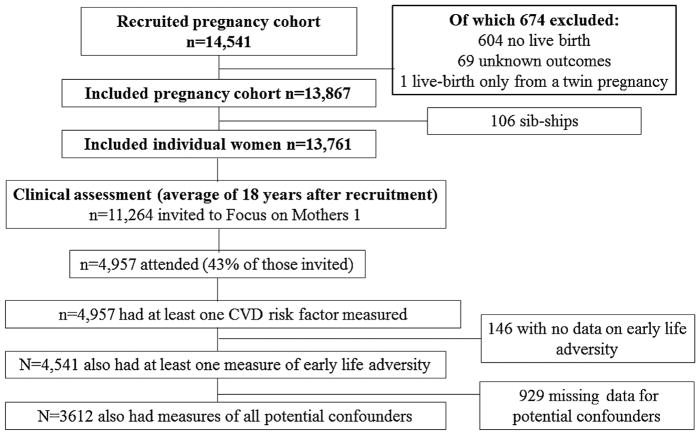
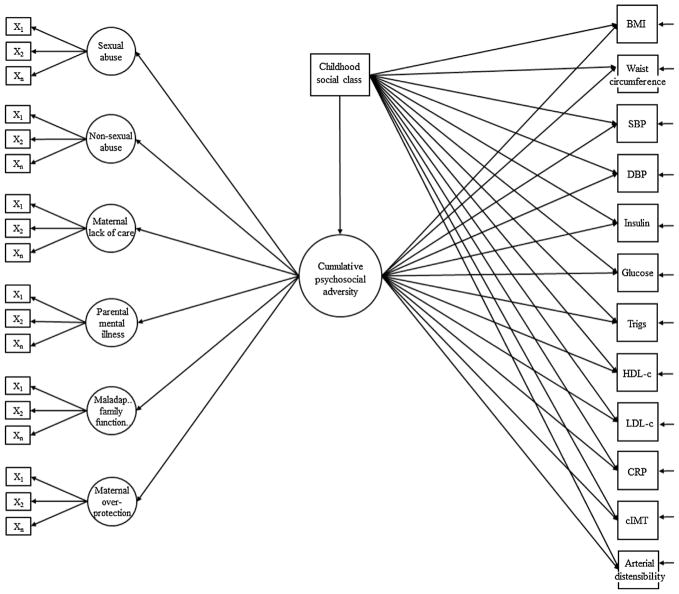
Studies assessing associations of childhood psychosocial adversity (e.g. sexual abuse, physical neglect, parental death), as opposed to socioeconomic adversity, with cardiovascular disease (CVD) risk factors in adulthood are scarce. The aim of this study is to assess associations of various types of psychosocial adversity and cumulative adversity in childhood, with multiple CVD risk factors in mid-life. At study enrolment, women from the Avon Longitudinal Study of Parents and Children (N=3612) retrospectively reported: lack of maternal care, maternal overprotection, parental mental illness, household dysfunction, sexual abuse, physical and emotional abuse, and neglect in childhood. Approximately 23 years later, body mass index (BMI), waist circumference, systolic and diastolic blood pressure, plasma glucose, insulin, triglycerides, low and high density lipoprotein cholesterol, C-reactive protein, carotid intima-media thickness (cIMT) and arterial distensibility were assessed (mean age 51 years). We examined associations of each specific type of psychosocial adversity and cumulative adversity with CVD risk factors. No specific type of psychosocial adversity was consistently associated with the CVD risk factors. There was evidence that a one standard deviation greater cumulative psychosocial adversity was associated with 0.51cm greater waist circumference (95% confidence interval [CI]: 0.02cm, 1.00cm, p=0.04) and a lower arterial distensibility, even after adjustment for age, ethnicity and childhood and adult socioeconomic position. We found no consistent evidence that any specific type of psychosocial adversity, or cumulative psychosocial adversity in childhood, is associated with CVD risk factors in adult women.
Keywords: Adversity; Cardiovascular disease; Childhood; Psychosocial.
Copyright © 2017 The Authors. Published by Elsevier Ltd.. All rights reserved.
Conflict of interest statement
The authors have no conflicts of interest to disclose.
Figures
References
-
- Bayer R, Fairchild AL, Hopper K, Nathanson CA. Public health. Confronting the sorry state of U.S. health. Science. 2013;341(6149):962–963. - PubMed
-
- Crowell JA, Davis CR, Joung KE, Usher N, McCormick SP, Dearing E, et al. Metabolic pathways link childhood adversity to elevated blood pressure in midlife adults. Obesity Research and Clinical Practice. 2015;10(5):580–588. - PubMed
-
- Felitti VJ, Anda RF, Nordenberg D, Williamson DF, Spitz AM, Edwards V, et al. Relationship of childhood abuse and household dysfunction to many of the leading causes of death in adults. The Adverse Childhood Experiences (ACE) Study. American Journal of Preventive Medicine. 1998;14(4):245–258. - PubMed
Publication types
MeSH terms
Substances
Grants and funding
- SP/07/008/24066/BHF_/British Heart Foundation/United Kingdom
- R01 AG048835/AG/NIA NIH HHS/United States
- G1001357/MRC_/Medical Research Council/United Kingdom
- MC_PC_15018/MRC_/Medical Research Council/United Kingdom
- MR/M020894/1/MRC_/Medical Research Council/United Kingdom
- MC_UU_12013/9/MRC_/Medical Research Council/United Kingdom
- MR/P014437/1/MRC_/Medical Research Council/United Kingdom
- WT_/Wellcome Trust/United Kingdom
- G9815508/MRC_/Medical Research Council/United Kingdom
- WT092830M/WT_/Wellcome Trust/United Kingdom
- MC_UU_12019/1/MRC_/Medical Research Council/United Kingdom
- MC_UU_12019/2/MRC_/Medical Research Council/United Kingdom
- 092731/WT_/Wellcome Trust/United Kingdom
- MC_UU_12013/5/MRC_/Medical Research Council/United Kingdom
- MR/M009351/1/MRC_/Medical Research Council/United Kingdom
LinkOut - more resources
Full Text Sources
Other Literature Sources
Medical
Research Materials
