. 2017:2017:1032846.
doi: 10.1155/2017/1032846. Epub 2017 Sep 29.

Genomic Survey, Characterization, and Expression Profile Analysis of the SBP Genes in Pineapple (Ananas comosus L.)

Affiliations

Genomic Survey, Characterization, and Expression Profile Analysis of the SBP Genes in Pineapple (Ananas comosus L.)

Hina Ali et al. Int J Genomics. 2017.

Abstract

Gene expression is regulated by transcription factors, which play many significant developmental processes. SQUAMOSA promoter-binding proteins (SBP) perform a variety of regulatory functions in leaf, flower, and fruit development, plant architecture, and sporogenesis. 16 SBP genes were identified in pineapple and were divided into four groups on basis of phylogenetic analysis. Five paralogs in pineapple for SBP genes were identified with Ka/Ks ratio varied from 0.20 for AcSBP14 and AcSBP15 to 0.36 for AcSBP6 and AcSBP16, respectively. 16 SBP genes were located on 12 chromosomes out of 25 pineapple chromosomes with highly conserved protein sequence structures. The isoionic points of SBP ranged from 6.05 to 9.57, while molecular weight varied from 22.7 to 121.9 kD. Expression profiles of SBP genes revealed that AcSBP7 and AcSBP15 (leaf), AcSBP13, AcSBP12, AcSBP8, AcSBP16, AcSBP9, and AcSBP11 (sepal), AcSBP6, AcSBP4, and AcSBP10 (stamen), AcSBP14, AcSBP1, and AcSBP5 (fruit) while the rest of genes showed low expression in studied tissues. Four genes, that is, AcSBP11, AcSBP6, AcSBP4, and AcSBP12, were highly expressed at 4°C, while AcSBP16 were upregulated at 45°C. RNA-Seq was validated through qRT-PCR for some genes. Salt stress-induced expression of two genes, that is, AcSBP7 and AcSBP14, while in drought stress, AcSBP12 and AcSBP15 were highly expressed. Our study lays a foundation for further gene function and expression studies of SBP genes in pineapple.


Figures

Figure 1
Figure 1
(a) Phylogenetic tree of Arabidopsis, rice, and pineapple SBP gene family. The unrooted phylogenetic tree was constructed using RAxML and maximum likelihood method. The full-length amino acid sequences were aligned by using ClustalX. The bootstrap test was performed with 1000 iterations and boot strip value of the subfamily larger than 60. AT: Arabidopsis; LOC: rice; and Aco: pineapple. (b) Phylogenetic relationship of SBP gene in pineapple genome. The full-length amino acid sequences were aligned by using MUSCLE, and a phylogenetic tree was constructed using RAxML.
Figure 2
Figure 2
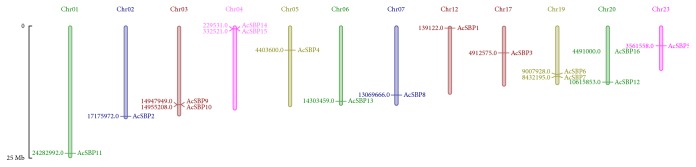
Distribution of SBP genes in pineapple genome. Mapinspect was used to locate genes on the chromosome. Gene start point is shown on the chromosome, while gene sizes are shown in megabases (Mb) against each gene.
Figure 3
Figure 3
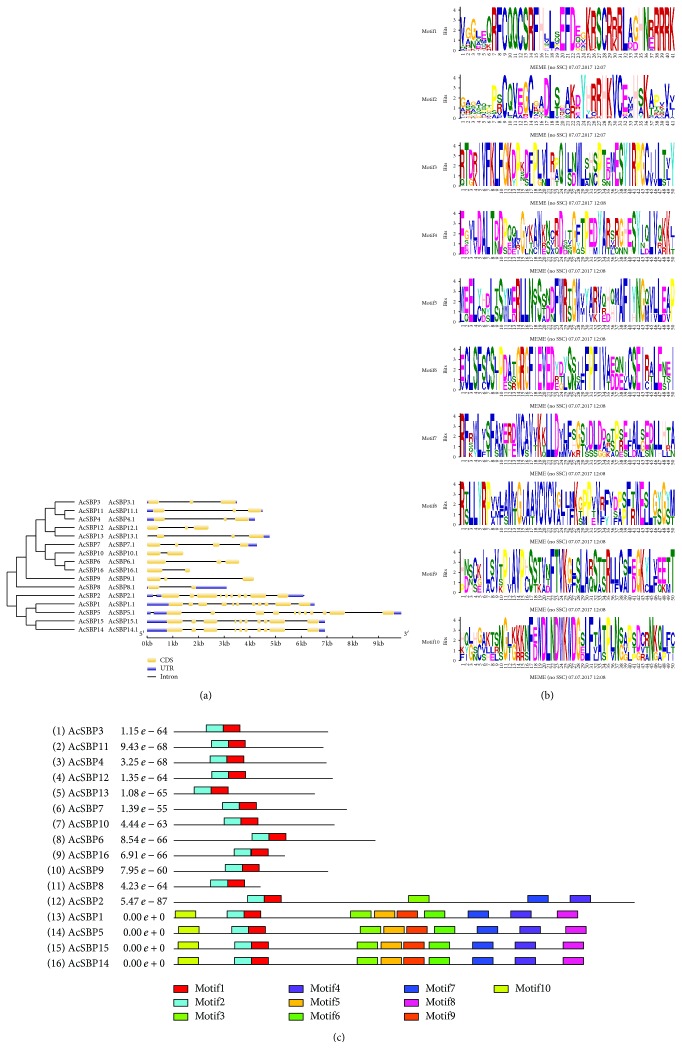
(a) Exon-intron structures of SBP genes in pineapple genome. All of the SBP genes were divided into four groups. Yellow color shows CDS (exon), blue color shows UTR (untranslated regions), and the normal line represents introns. (b) Sequence logo of SBP protein domains was obtained by MEME program. The overall height of each stack represents the degree of conservation at each position, while the height of letters within each stack indicates the relative frequency of amino acids. (c) Motif of SBP proteins in pineapple. MEME search tool was used to make motif structures.
Figure 4
Figure 4
A heat map of tissue-specific expression profile of SBP genes in pineapple. Expression level can be understood using the given scale.
Figure 5
Figure 5
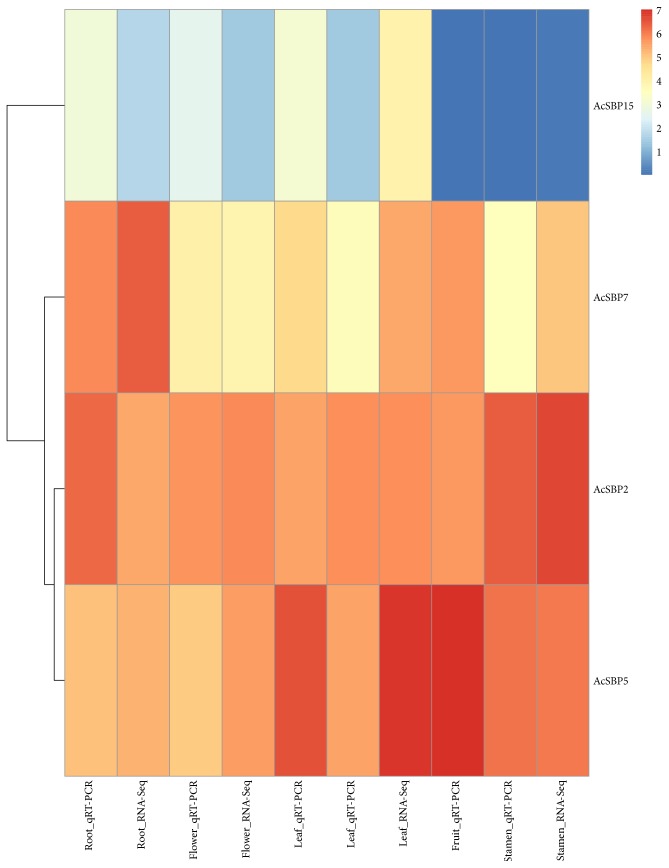
A heat map of validation of RNA-Seq of four SBP genes through qRT-PCR. The heat map was constructed using relative expression of four genes in five different tissues tested by qRT-PCR along with FPKM values of RNA-Seq of these tissues.
Figure 6
Figure 6
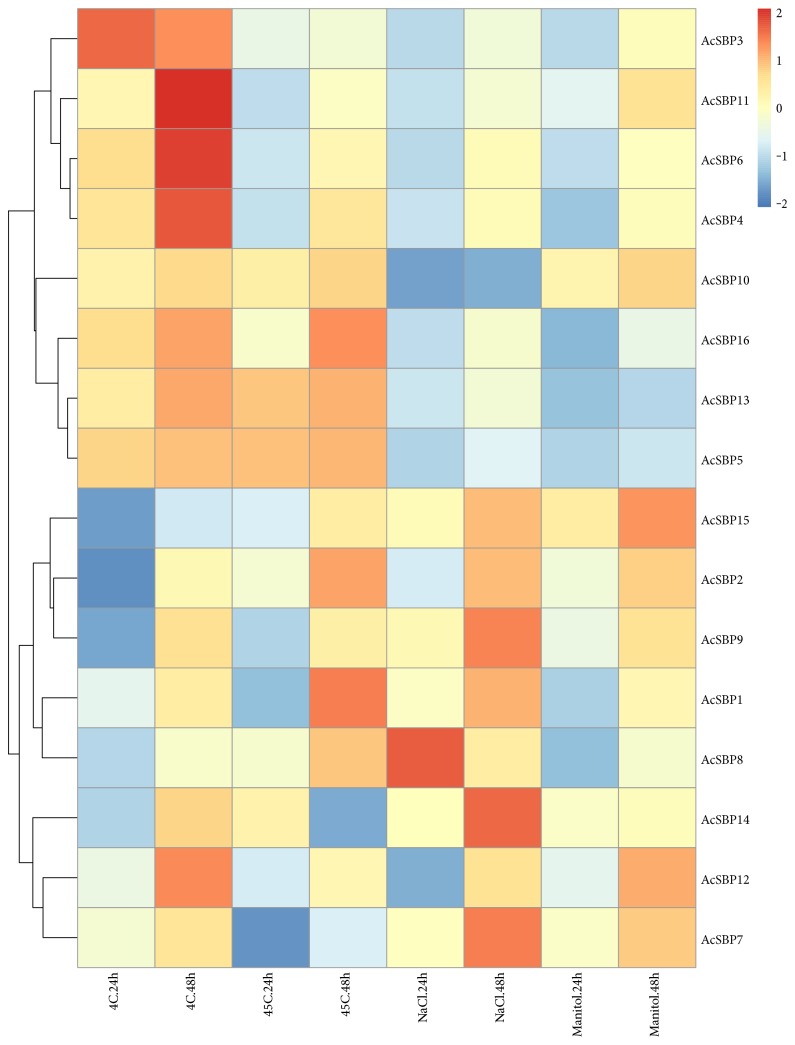
A heat map of expression profiles of SBP genes under abiotic stresses [cold (4°C), heat (45°C), salt (NaCl), and drought (mannitol)]. qRT-PCR was used to analyze the relative expression level of each SBP gene. The expression level of pineapple actin was used as the internal control to standardize RNA samples for each reaction, and the expression at 0 h was taken as 1 (data not shown). Expression level can be understood using the given scale.

References

    1. Firoozabady E., Gutterson N. Cost-effective in vitro propagation methods for pineapple. Plant Cell Reports. 2003;21:844–850. doi: 10.1007/s00299-003-0577-x. - DOI - PubMed
    1. Gangopadhyay S., Harding B. L., Rajagopalan B., Lukas J. J., Fulp T. J. A nonparametric approach for paleohydrologic reconstruction of annual streamflow ensembles. Water Resources Research. 2009;45 doi: 10.1029/2008WR007201. - DOI
    1. Escalona M., Lorenzo J. C., González B., et al. Pineapple (Ananas comosus L. Merr) micropropagation in temporary immersion systems. Plant Cell Reports. 1999;18:743–748. doi: 10.1007/s002990050653. - DOI
    1. Li J., Hou H., Li X., et al. Genome-wide identification and analysis of the SBP-box family genes in apple (Malus × domestica Borkh.) Plant Physiology and Biochemistry. 2013;70:100–114. doi: 10.1016/j.plaphy.2013.05.021. - DOI - PubMed
    1. Klein J., Saedler H., Huijser P. A new family of DNA binding proteins includes putative transcriptional regulators of the Antirrhinum majus floral meristem identity gene SQUAMOSA. Molecular & General Genetics. 1996;250:7–16. doi: 10.1007/BF02191820. - DOI - PubMed

LinkOut - more resources