


Significance of the thrombo-inflammatory status-based novel prognostic score as a useful predictor for in-hospital mortality of patients with type B acute aortic dissection
- PMID: 29108310
- PMCID: PMC5668043
- DOI: 10.18632/oncotarget.18105
Significance of the thrombo-inflammatory status-based novel prognostic score as a useful predictor for in-hospital mortality of patients with type B acute aortic dissection
Abstract
Background: Inflammation and thrombosis are associated with development and progression of acute aortic dissection (AAD). The aim of this study was to assess the prognostic significance of Simplified Thrombo-Inflammatory Prognostic Score (sTIPS), in patients with early phase type B AAD.
Methods: We retrospectively reviewed 491 patients with type B AAD between November 2012 and September 2015. sTIPS was calculated from the white blood cell count (WBC) and mean platelet volume to platelet count (MPV/PC) ratio, at the time of admission. Patients with both, WBC > 10 (109/L) and MPV/PC ratio > 7.5 (102fL/109L-1) were assigned a score of 2, while patients with high levels of either one or none of the above markers, were assigned scores of 1 and 0 respectively. Multivariable Cox regression analyses were used to investigate the associations between the score and hospital survival.
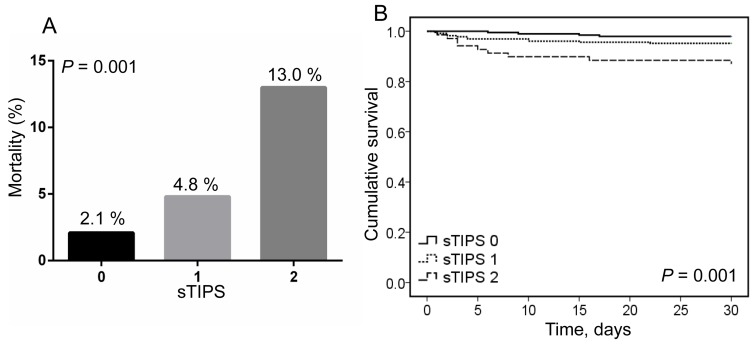
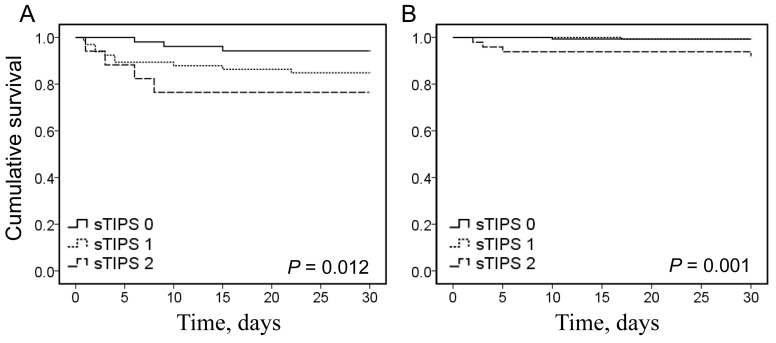
Results: Of the 491 type B AAD patients included in this analysis, 24 patients (4.9%) died during hospitalization. Kaplan-Meier analysis revealed that the cumulative mortality was significantly higher in patients with higher sTIPS (P = 0.001). Multivariable Cox regression analysis further indicated that higher sTIPS was a strong predictor of in-hospital mortality after eliminating all confounding factors (sTIPS 2: hazard ratio 4.704, 95%; confidence interval [CI] 1.184-18.685; P = 0.028; sTIPS 1: hazard ratio 1.918, 95%; CI 1.134-3.537; P = 0.045).
Conclusions: sTIPS at admission was a useful tool for stratifying the risk in type B AAD patients, for outcomes such as in-hospital mortality in the early phase.
Keywords: acute aortic dissection; inflammation; prognosis; thrombosis.
Conflict of interest statement
CONFLICTS OF INTEREST The authors declare that they have no competing interests.
Figures
 , 1 score:
 , 2 score:
 ).
).References
-
- Nienaber CA, Eagle KA. Aortic dissection: new frontiers in diagnosis and management: Part I: from etiology to diagnostic strategies. Circulation. 2003;108:628–635. - PubMed
-
- Tolenaar JL, Froehlich W, Jonker FH, Upchurch GR, Jr, Rampoldi V, Tsai TT, Bossone E, Evangelista A, O’Gara P, Pape L, Montgomery D, Isselbacher EM, Nienaber CA, et al. Predicting in-hospital mortality in acute type B aortic dissection: evidence from International Registry of Acute Aortic Dissection. Circulation. 2014;130:S45–S50. - PubMed
-
- Ko T, Higashitani M, Sato A, Uemura Y, Norimatsu T, Mahara K, Takamisawa I, Seki A, Shimizu J, Tobaru T, Aramoto H, Iguchi N, Fukui T, et al. Impact of Acute Kidney Injury on Early to Long-Term Outcomes in Patients Who Underwent Surgery for Type A Acute Aortic Dissection. Am J Cardiol. 2015;116:463–468. - PubMed
-
- Zeng R, Li D, Deng L, He Y, Sun X, Wan Z, Nie H, Du X, Cao Y, Zeng Z. Hypoalbuminemia predicts clinical outcome in patients with type B acute aortic dissection after endovascular therapy. Am J Emerg Med. 2016;34:1369–1372. - PubMed
LinkOut - more resources
Full Text Sources
Other Literature Sources
