Review
. 2018 Mar 24;391(10126):1224-1236.
doi: 10.1016/S0140-6736(17)32471-6. Epub 2017 Nov 3.

Cardiovascular, respiratory, and related disorders: key messages from Disease Control Priorities, 3rd edition

Collaborators, Affiliations
Review

Cardiovascular, respiratory, and related disorders: key messages from Disease Control Priorities, 3rd edition

Dorairaj Prabhakaran et al. Lancet. .

Abstract

Cardiovascular, respiratory, and related disorders (CVRDs) are the leading causes of adult death worldwide, and substantial inequalities in care of patients with CVRDs exist between countries of high income and countries of low and middle income. Based on current trends, the UN Sustainable Development Goal to reduce premature mortality due to CVRDs by a third by 2030 will be challenging for many countries of low and middle income. We did systematic literature reviews of effectiveness and cost-effectiveness to identify priority interventions. We summarise the key findings and present a costed essential package of interventions to reduce risk of and manage CVRDs. On a population level, we recommend tobacco taxation, bans on trans fats, and compulsory reduction of salt in manufactured food products. We suggest primary health services be strengthened through the establishment of locally endorsed guidelines and ensured availability of essential medications. The policy interventions and health service delivery package we suggest could serve as the cornerstone for the management of CVRDs, and afford substantial financial risk protection for vulnerable households. We estimate that full implementation of the essential package would cost an additional US$21 per person in the average low-income country and $24 in the average lower-middle-income country. The essential package we describe could be a starting place for low-income and middle-income countries developing universal health coverage packages. Interventions could be rolled out as disease burden demands and budgets allow. Our outlined interventions provide a pathway for countries attempting to convert the UN Sustainable Development Goal commitments into tangible action.


Conflict of interest statement

Declaration of interests

YF and JCM declare no competing interests.

Figures
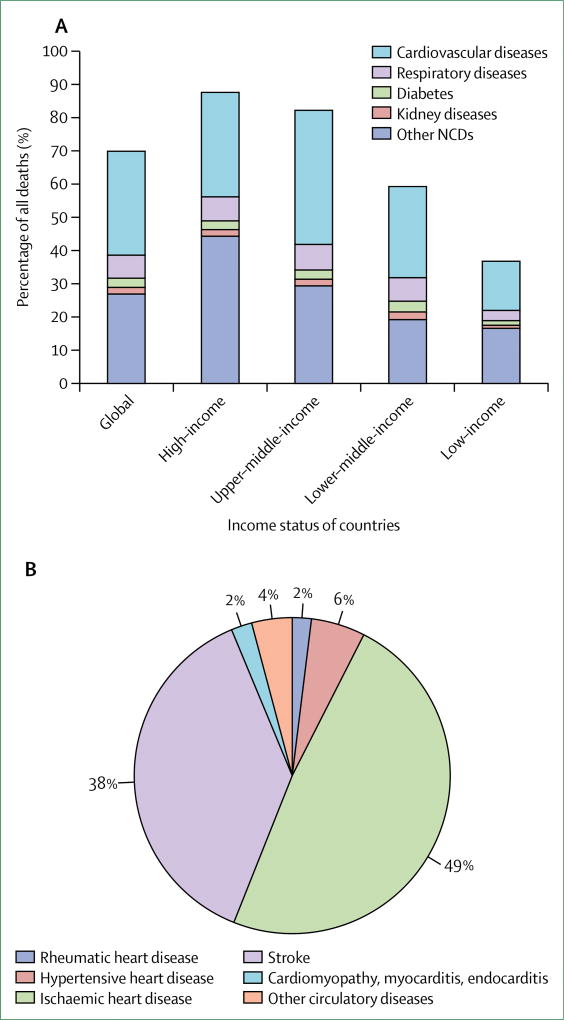
Figure 1
Figure 1
Share of all deaths caused by cardiovascular, respiratory, or related disorders and other non-communicable diseases, by country income (A), and specific causes of cardiovascular disease mortality in low-income and middle-income countries (B), 2015 Source: WHO Global Health Estimates 2015. NCDs=non-communicable diseases.
Figure 2
Figure 2
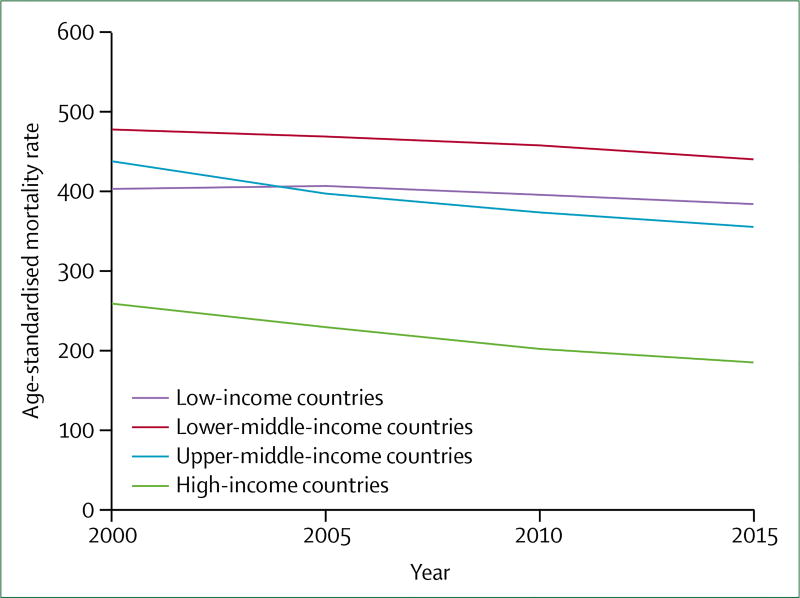
Trends in age-standardised mortality rates from cardiovascular disease for both sexes, by country income group, 2000–15 Per year, the decline in age-standardised mortality rates were −0·8% in countries of low income, −0·6% in countries of lower-middle income, −1·0% in countries of upper-middle income, and −2·3% in countries of high income.
Figure 3
Figure 3
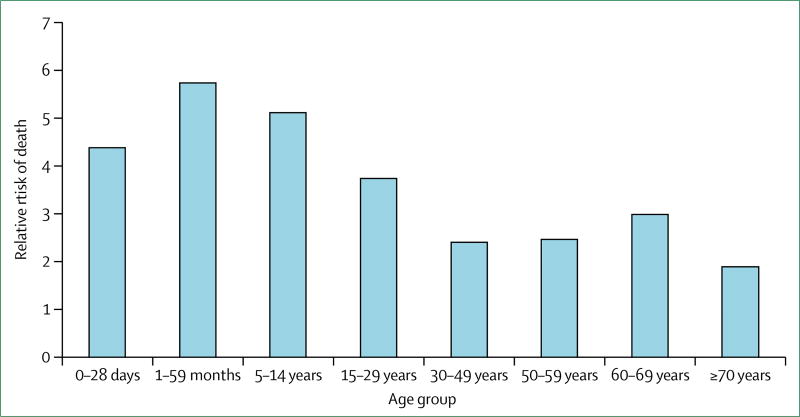
Relative risk of death due to cardiovascular and respiratory disease in low-income and middle-income countries versus high-income countries, by age group, 2015
Figure 4
Figure 4
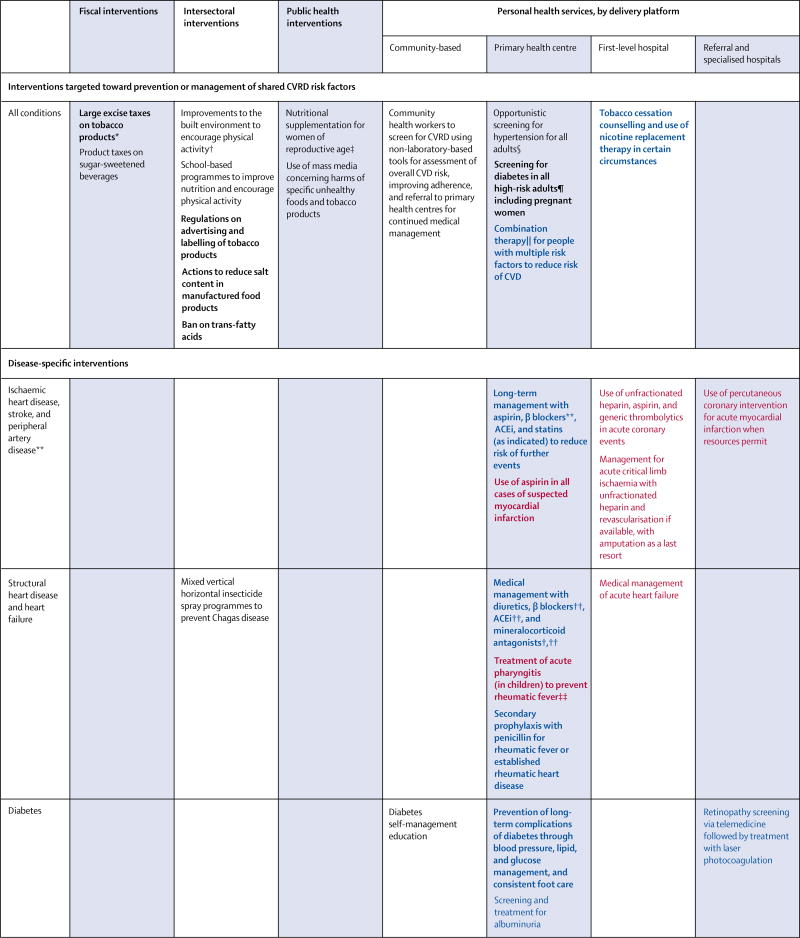
Interventions targeted toward the prevention or management of shared risk factors for cardiovascular and respiratory disease, and disease-specific interventions Black font denotes routine care, blue font denotes continuing care, and red font denotes urgent care. Recommendations in bold font denote core interventions. CVRD=cardiovascular, respiratory, or related disorder. CVD=cardiovascular disease. ACEi=angiotensin-converting-enzyme inhibitor. ARB=angiotensin receptor blocker. COPD=chronic obstructive pulmonary disease. *For fiscal and intersectoral policies that address CVRD attributable to indoor and outdoor sources of air pollution, see chapter 1 of volume 7 of Disease Control Priorities, 3rd edition. †Data from high-income countries only. ‡Aimed at the prevention of gestational diabetes and low birthweight. §Treatment with generic drugs is recommended, guided by the severity of hypertension or the presence of additional risk factors. ¶High risk is typically defined as individuals who are older, have high blood pressure, or are overweight or obese. ‖Where available, fixed-dose combination therapy is preferred. **Not applicable to peripheral artery disease. ††Applicable to heart failure with reduced ejection fraction. ‡‡Use available treatment algorithms to determine appropriate antibiotic use. §§Inhaled corticosteroids indicated in patients with COPD who have severe disease or frequent exacerbations.
Figure 4
Figure 4
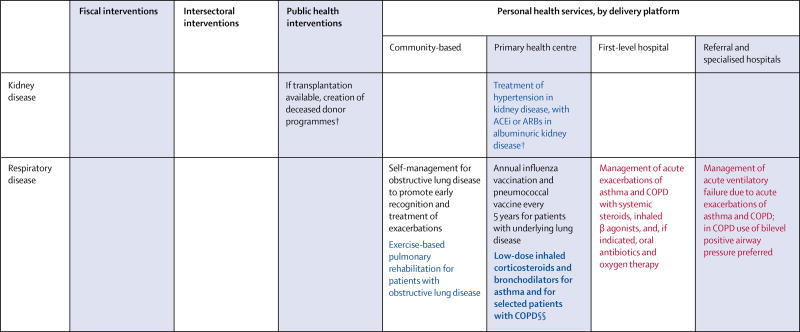
Interventions targeted toward the prevention or management of shared risk factors for cardiovascular and respiratory disease, and disease-specific interventions Black font denotes routine care, blue font denotes continuing care, and red font denotes urgent care. Recommendations in bold font denote core interventions. CVRD=cardiovascular, respiratory, or related disorder. CVD=cardiovascular disease. ACEi=angiotensin-converting-enzyme inhibitor. ARB=angiotensin receptor blocker. COPD=chronic obstructive pulmonary disease. *For fiscal and intersectoral policies that address CVRD attributable to indoor and outdoor sources of air pollution, see chapter 1 of volume 7 of Disease Control Priorities, 3rd edition. †Data from high-income countries only. ‡Aimed at the prevention of gestational diabetes and low birthweight. §Treatment with generic drugs is recommended, guided by the severity of hypertension or the presence of additional risk factors. ¶High risk is typically defined as individuals who are older, have high blood pressure, or are overweight or obese. ‖Where available, fixed-dose combination therapy is preferred. **Not applicable to peripheral artery disease. ††Applicable to heart failure with reduced ejection fraction. ‡‡Use available treatment algorithms to determine appropriate antibiotic use. §§Inhaled corticosteroids indicated in patients with COPD who have severe disease or frequent exacerbations.

References

    1. WHO. Global health estimates 2015: deaths by cause, age, sex, by country and by region, 2000–2015. Geneva: World Health Organization; 2017.
    1. UN General Assembly. High-level meeting on prevention and control of non-communicable diseases. New York: Sep 19–20, 2011.
    1. WHO. Global health observatory data for 2012. Geneva: World Health Organization; 2012.
    1. Gelband H, Sankaranarayanan R, Gauvreau CL, et al. Costs, affordability, and feasibility of an essential package of cancer control interventions in low-income and middle-income countries: key messages from Disease Control Priorities, 3rd edition. Lancet. 2016;387:2133–44. - PubMed
    1. Patel V, Chisholm D, Parikh R, et al. Addressing the burden of mental, neurological, and substance use disorders: key messages from Disease Control Priorities, 3rd edition. Lancet. 2016;387:1672–85. - PubMed

Publication types

MeSH terms