A three-talk model for shared decision making: multistage consultation process
- PMID: 29109079
- PMCID: PMC5683042
- DOI: 10.1136/bmj.j4891
A three-talk model for shared decision making: multistage consultation process
Abstract
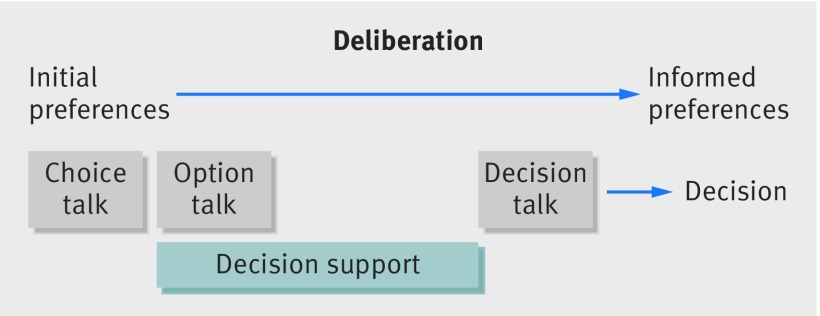
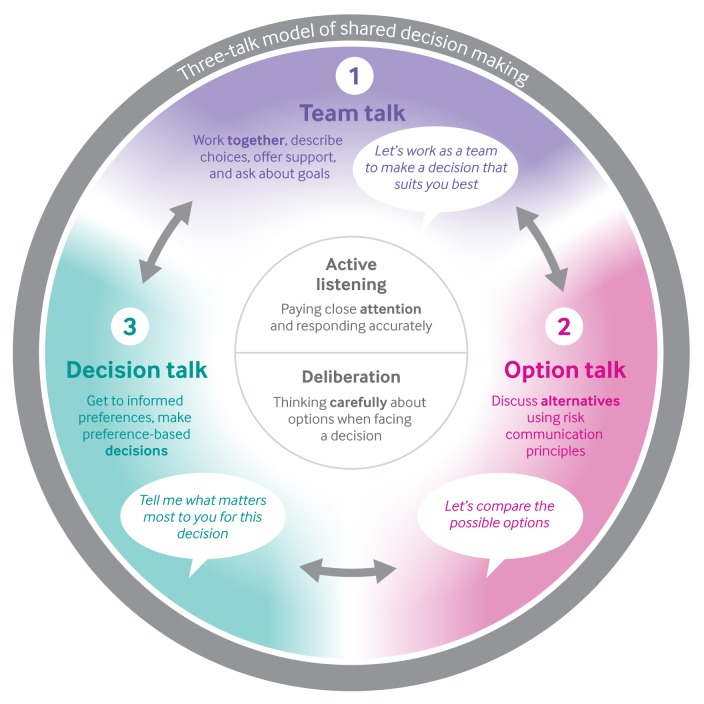
Objectives To revise an existing three-talk model for learning how to achieve shared decision making, and to consult with relevant stakeholders to update and obtain wider engagement.Design Multistage consultation process.Setting Key informant group, communities of interest, and survey of clinical specialties.Participants 19 key informants, 153 member responses from multiple communities of interest, and 316 responses to an online survey from medically qualified clinicians from six specialties.Results After extended consultation over three iterations, we revised the three-talk model by making changes to one talk category, adding the need to elicit patient goals, providing a clear set of tasks for each talk category, and adding suggested scripts to illustrate each step. A new three-talk model of shared decision making is proposed, based on "team talk," "option talk," and "decision talk," to depict a process of collaboration and deliberation. Team talk places emphasis on the need to provide support to patients when they are made aware of choices, and to elicit their goals as a means of guiding decision making processes. Option talk refers to the task of comparing alternatives, using risk communication principles. Decision talk refers to the task of arriving at decisions that reflect the informed preferences of patients, guided by the experience and expertise of health professionals.Conclusions The revised three-talk model of shared decision making depicts conversational steps, initiated by providing support when introducing options, followed by strategies to compare and discuss trade-offs, before deliberation based on informed preferences.
Published by the BMJ Publishing Group Limited. For permission to use (where not already granted under a licence) please go to http://group.bmj.com/group/rights-licensing/permissions.
Conflict of interest statement
Competing interests: All authors have completed the ICMJE uniform disclosure form at www.icmje.org/coi_disclosure.pdf and declare: no support from any organization for the submitted work; no financial relationships with any organizations that might have an interest in the submitted work in the previous three years; no other relationships or activities that could appear to have influenced the submitted work.
Figures

References
-
- Rosenbaum L. The Paternalism Preference--Choosing Unshared Decision Making. N Engl J Med 2015;373:589-92.pmid:26267618. - PubMed
-
- Légaré F, Thompson-Leduc P. Twelve myths about shared decision making. Patient Educ Couns 2014;96:281-6.pmid:25034637. - PubMed
-
- Elwyn G, Frosch D, Thomson R, et al. Shared decision making: a model for clinical practice. J Gen Intern Med 2012;27:1361-7.pmid:22618581. - PMC - PubMed
-
- Spatz ES, Krumholz HM, Moulton BW. Prime Time for Shared Decision Making. JAMA 2017;317:1309-10.pmid:28384834. - PubMed
-
- Barry MJ, Edgman-Levitan S. Shared decision making--pinnacle of patient-centered care. N Engl J Med 2012;366:780-1. 10.1056/NEJMp1109283 pmid:22375967. - DOI - PubMed
MeSH terms
LinkOut - more resources
Full Text Sources
Other Literature Sources
Medical