. 2017 Oct 29;22(11):1858.
doi: 10.3390/molecules22111858.

Olive (Olea europaea L.) Biophenols: A Nutriceutical against Oxidative Stress in SH-SY5Y Cells

Affiliations

Olive (Olea europaea L.) Biophenols: A Nutriceutical against Oxidative Stress in SH-SY5Y Cells

Syed Haris Omar et al. Molecules. .

Abstract

Plant biophenols have been shown to be effective in the modulation of Alzheimer's disease (AD) pathology resulting from free radical-induced oxidative stress and imbalance of the redox chemistry of transition metal ions (e.g., iron and copper). On the basis of earlier reported pharmacological activities, olive biophenols would also be expected to have anti-Alzheimer's activity. In the present study, the antioxidant activity of individual olive biophenols (viz. caffeic acid, hydroxytyrosol, oleuropein, verbascoside, quercetin, rutin and luteolin) were evaluated using superoxide radical scavenging activity (SOR), hydrogen peroxide (H₂O₂) scavenging activity, and ferric reducing ability of plasma (FRAP) assays. The identification and antioxidant activities in four commercial olive extracts-Olive leaf extractTM (OLE), Olive fruit extractTM (OFE), Hydroxytyrosol ExtremeTM (HTE), and Olivenol plusTM (OLP)-were evaluated using an on-line HPLC-ABTS•+ assay, and HPLC-DAD-MS analysis. Oleuropein and hydroxytyrosol were the predominant biophenols in all the extracts. Among the single compounds examined, quercetin (EC50: 93.97 μM) and verbascoside (EC50: 0.66 mM) were the most potent SOR and H₂O₂ scavengers respectively. However, OLE and HTE were the highest SOR (EC50: 1.89 μg/mL) and H₂O₂ (EC50: 115.8 μg/mL) scavengers among the biophenol extracts. The neuroprotection of the biophenols was evaluated against H₂O₂-induced oxidative stress and copper (Cu)-induced toxicity in neuroblastoma (SH-SY5Y) cells. The highest neuroprotection values (98% and 92%) against H₂O₂-induced and Cu-induced toxicities were shown by the commercial extract HTETM. These were followed by the individual biophenols, caffeic acid (77% and 64%) and verbascoside (71% and 72%). Our results suggest that olive biophenols potentially serve as agents for the prevention of neurodegenerative diseases such as AD, and other neurodegenerative ailments that are caused by oxidative stress.

Keywords: Alzheimer’s disease; SH-SY5Y cells; free radical scavenging; olive biophenols; oxidative stress.


Conflict of interest statement

We wish to confirm that there are no known conflicts of interest associated with this publication and there has been no significant financial support for this work that could have influenced its outcome.

Figures
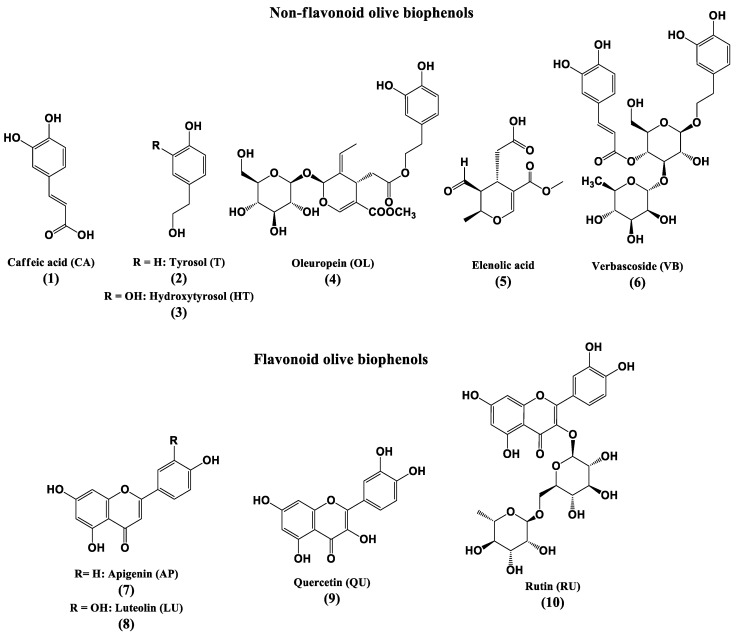
Figure 1
Figure 1
Structures of the major non-flavonoid and flavonoid olive biophenols.
Figure 2
Figure 2
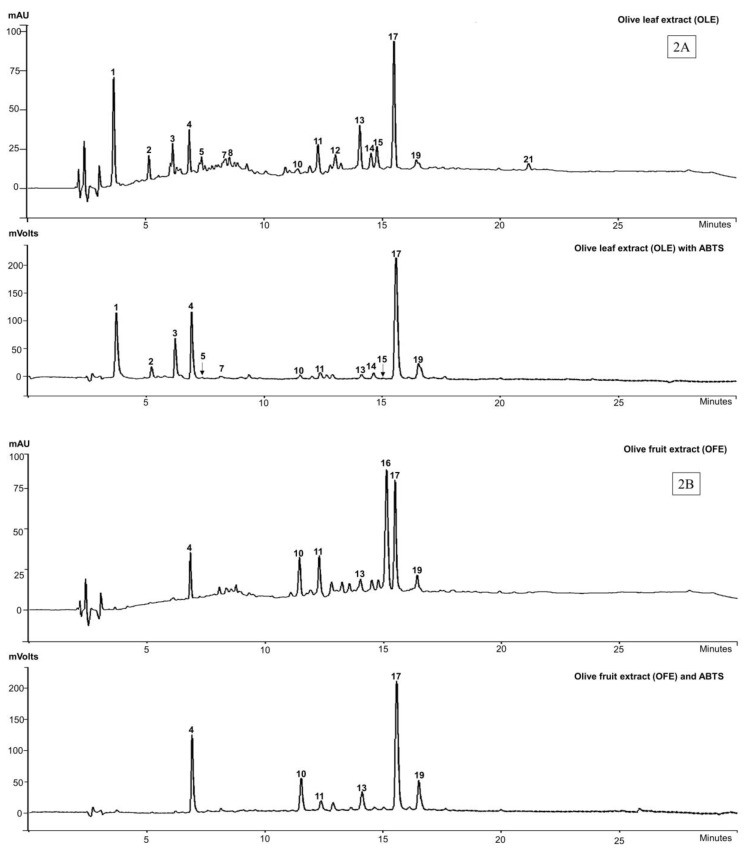
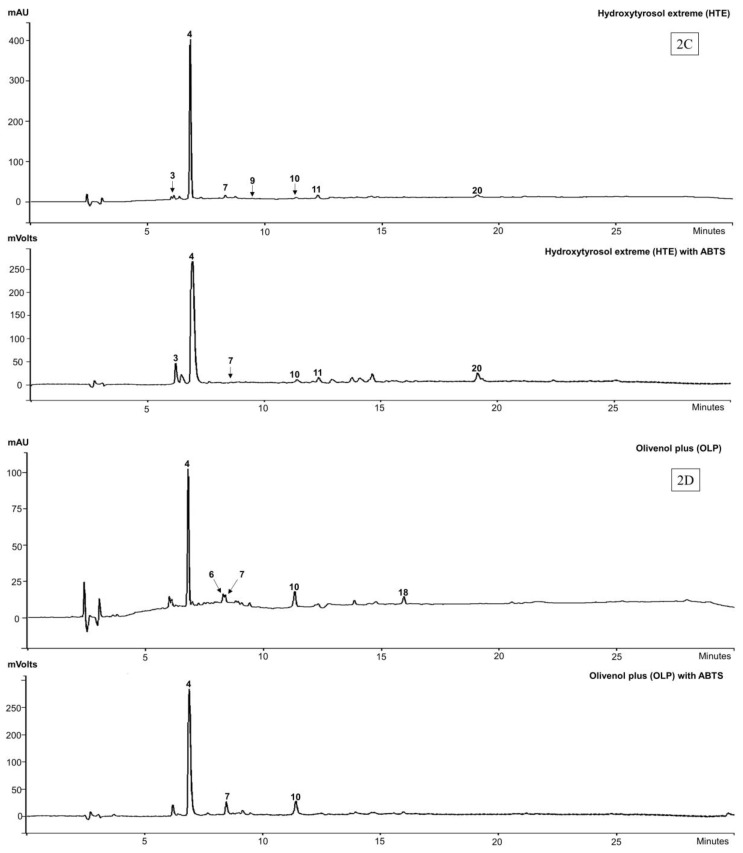
HPLC-DAD-ABTS chromatograms of four commercial extracts of olive at 280 nm and ABTS scavenging at 414 nm. (2A) olive leaf extracts (OLE); (2B) olive fruit extracts (OFE); (2C) Hydroxytyrosol ExtremeTM (HTE) and (2D) Olivenol PlusTM (OLP).
Figure 2
Figure 2
HPLC-DAD-ABTS chromatograms of four commercial extracts of olive at 280 nm and ABTS scavenging at 414 nm. (2A) olive leaf extracts (OLE); (2B) olive fruit extracts (OFE); (2C) Hydroxytyrosol ExtremeTM (HTE) and (2D) Olivenol PlusTM (OLP).
Figure 3
Figure 3
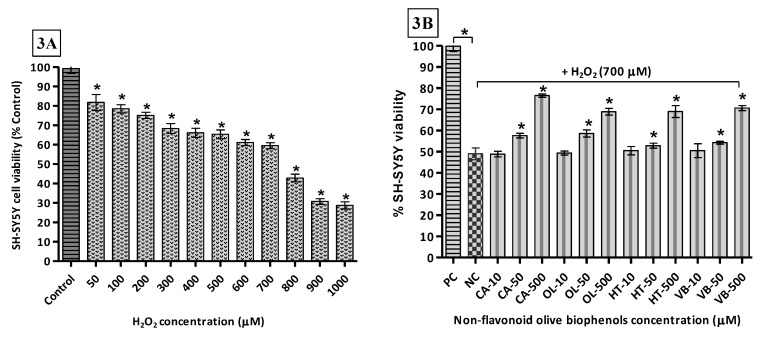
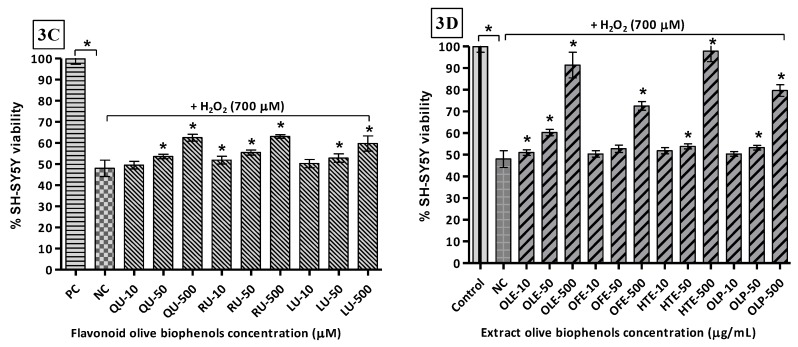
H2O2-induced SH-SY5Y cells toxicity and protection by olive biophenols: SH-SY5Y cells were treated with different concentrations of H2O2 for 24 h (3A). SH-SY5Y cells were incubated with different concentrations of non-flavonoid olive biophenols (3B), flavonoid olive biophenols (3C) and extract olive biophenols (3D) for 24 h followed by 700 μM of H2O2 for 24 h. The results are mean ± SE of each parallel measurements analyzed by one way ANOVA, * p < 0.05 vs. control and negative control. NS: non-significant. PC: positive control (cells with media), NC: negative control (cells and H2O2 without biophenols), CA: caffeic acid, OL: oleuropein, HT: hydoxytyrosol, VB: verbascoside, QU: quercetin, RU: rutin, LU: luteolin, OLE: olive leaf extract, OFE: olive fruit extract, HTE: Hydroxytyrosol extremeTM, OLP: Olivenol plusTM.
Figure 3
Figure 3
H2O2-induced SH-SY5Y cells toxicity and protection by olive biophenols: SH-SY5Y cells were treated with different concentrations of H2O2 for 24 h (3A). SH-SY5Y cells were incubated with different concentrations of non-flavonoid olive biophenols (3B), flavonoid olive biophenols (3C) and extract olive biophenols (3D) for 24 h followed by 700 μM of H2O2 for 24 h. The results are mean ± SE of each parallel measurements analyzed by one way ANOVA, * p < 0.05 vs. control and negative control. NS: non-significant. PC: positive control (cells with media), NC: negative control (cells and H2O2 without biophenols), CA: caffeic acid, OL: oleuropein, HT: hydoxytyrosol, VB: verbascoside, QU: quercetin, RU: rutin, LU: luteolin, OLE: olive leaf extract, OFE: olive fruit extract, HTE: Hydroxytyrosol extremeTM, OLP: Olivenol plusTM.
Figure 4
Figure 4
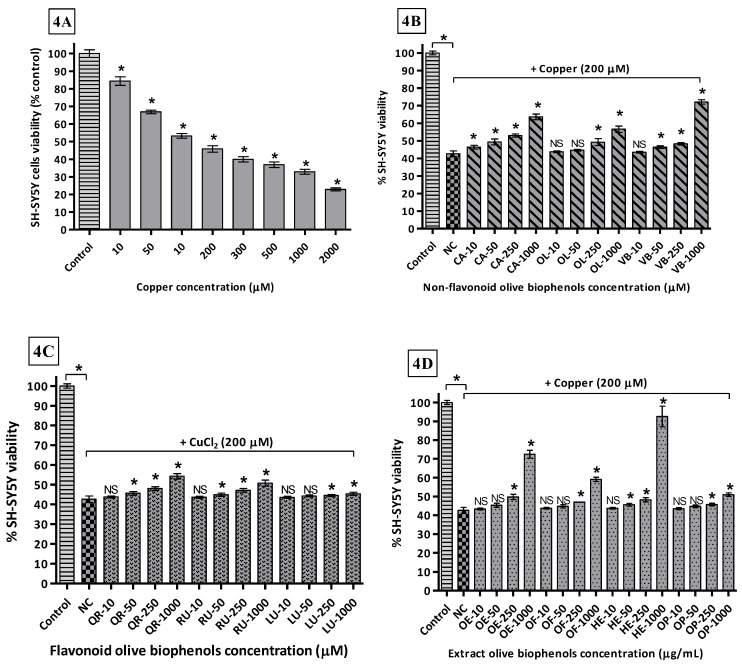
Copper-induced SH-SY5Y cells toxicity and protection by olive biophenols: SH-SY5Y cells were treated with different concentrations of copper for 24 h (4A). SH-SY5Y cells were incubated with different concentrations of non-flavonoid olive biophenols (4B), flavonoid olive biophenols (4C) and extract olive biophenols (4D) for 24 h followed by 200 μM of copper for 24 h. The results are mean ± S.E. of each parallel measurements analyzed by one way ANOVA (Tukey’s test), * p < 0.05 vs. control and negative control. NS: non-significant. PC: positive control (cells with media), NC: negative control (cells and H2O2 without biophenols), CA: caffeic acid, OL: oleuropein, HT: hydoxytyrosol, VB: verbascoside, QU: quercetin, RU: rutin, LU: luteolin, OLE: olive leaf extract, OFE: olive fruit extract, HTE: Hydroxytyrosol extremeTM, OLP: Olivenol plusTM.

References

    1. Selkoe D.J. Alzheimer’s disease: Genes, proteins, and therapy. Physiol. Rev. 2001;81:741–766. doi: 10.1101/cshperspect.a004457. - DOI - PubMed
    1. Smith M.A., Rottkamp C.A., Nunomura A., Raina A.K., Perry G. Oxidative stress in Alzheimer’s disease. BBA Mol. Basis Dis. 2000;1502:139–144. doi: 10.1016/S0925-4439(00)00040-5. - DOI - PubMed
    1. Pratico D. Oxidative stress hypothesis in Alzheimer’s disease: A reappraisal. Trends Pharmacol. Sci. 2008;29:609–615. doi: 10.1016/j.tips.2008.09.001. - DOI - PubMed
    1. Smith M.A., Harris P.L., Sayre L.M., Perry G. Iron accumulation in Alzheimer disease is a source of redox-generated free radicals. Proc. Natl. Acad. Sci. USA. 1997;94:9866–9868. doi: 10.1073/pnas.94.18.9866. - DOI - PMC - PubMed
    1. Jomova K., Vondrakova D., Lawson M., Valko M. Metals, oxidative stress and neurodegenerative disorders. Mol. Cell. Biochem. 2010;345:91–104. doi: 10.1007/s11010-010-0563-x. - DOI - PubMed

MeSH terms

LinkOut - more resources