


Low PTEN levels and PIK3CA mutations predict resistance to neoadjuvant lapatinib and trastuzumab without chemotherapy in patients with HER2 over-expressing breast cancer
- PMID: 29110152
- PMCID: PMC5821069
- DOI: 10.1007/s10549-017-4533-9
Low PTEN levels and PIK3CA mutations predict resistance to neoadjuvant lapatinib and trastuzumab without chemotherapy in patients with HER2 over-expressing breast cancer
Abstract
Purpose: Aberrant activation of the PI3K pathway has been implicated in resistance to HER2-targeted therapy, but results of clinical trials are confounded by the co-administration of chemotherapy. We investigated the effect of perturbations of this pathway in breast cancers from patients treated with neoadjuvant anti-HER2-targeted therapy without chemotherapy.
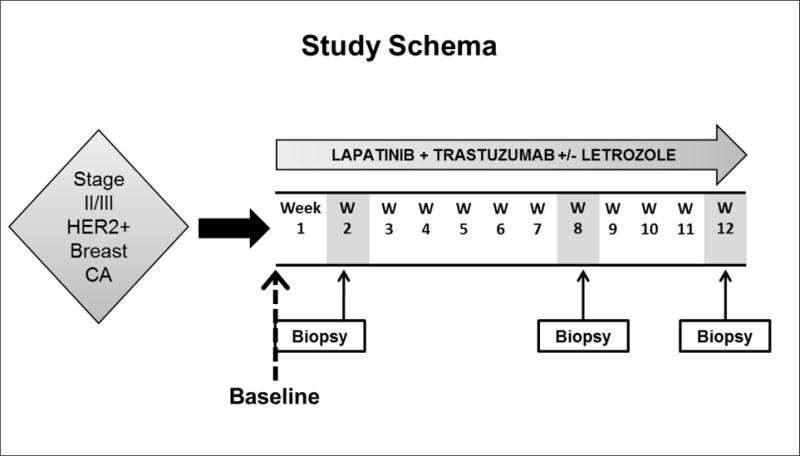
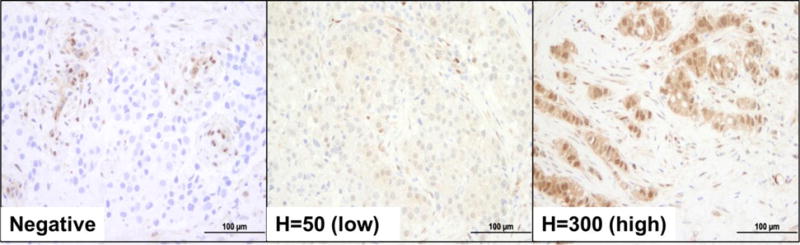
Patients and methods: Baseline tumor samples from patients with HER2-positive breast cancer enrolled in TBCRC006 (NCT00548184), a 12-week neoadjuvant clinical trial with lapatinib plus trastuzumab [plus endocrine therapy for estrogen receptor (ER)-positive tumors], were assessed for PTEN status by immunohistochemistry and PIK3CA mutations by sequencing. Results were correlated with pathologic complete response (pCR).
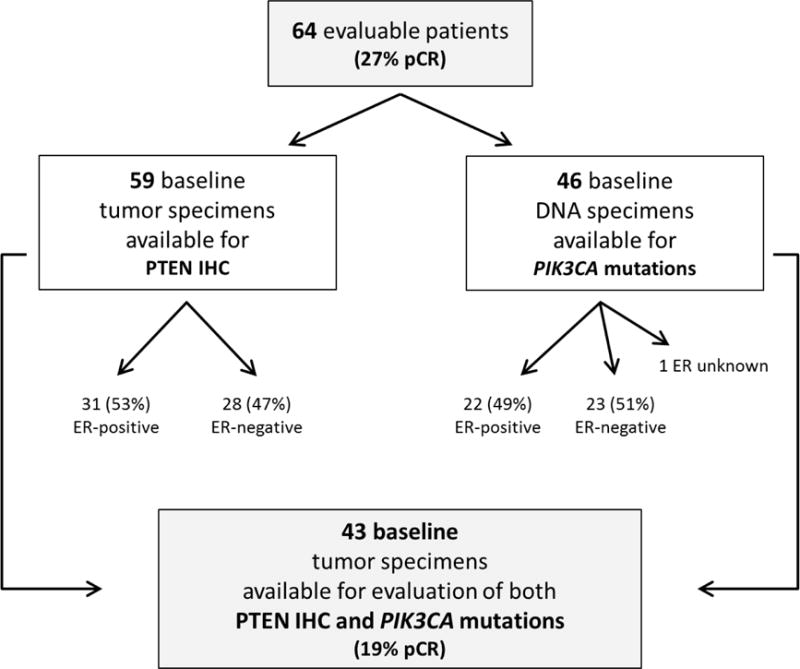
Results: Of 64 evaluable patients, PTEN immunohistochemistry and PIK3CA mutation analysis were performed for 59 and 46 patients, respectively. PTEN status (dichotomized by H-score median) was correlated with pCR (32% in high PTEN vs. 9% in low PTEN, p = 0.04). PIK3CA mutations were identified in 14/46 tumors at baseline (30%) and did not correlate with ER or PTEN status. One patient whose tumor harbored a PIK3CA mutation achieved pCR (p = 0.14). When considered together (43 cases), 1/25 cases (4%) with a PIK3CA mutation and/or low PTEN expression levels had a pCR compared to 7/18 cases (39%) with wild-type PI3KCA and high PTEN expression levels (p = 0.006).
Conclusion: PI3K pathway activation is associated with resistance to lapatinib and trastuzumab in breast cancers, without chemotherapy. Further studies are warranted to investigate how to use these biomarkers to identify upfront patients who may respond to anti-HER2 alone, without chemotherapy.
Keywords: HER2-positive breast cancer; Lapatinib; PIK3CA mutations; PTEN levels; Trastuzumab; pCR.
Conflict of interest statement
Mothaffar F. Rimawi: Research grant from GlaxoSmithKline (to Institution), Consulting with Genentech.
Carmine De Angelis: Nothing to disclose
Alejandro Contreras: Nothing to disclose
Fresia Pareja: Nothing to disclose
Felipe C. Geyer: Nothing to disclose
Kathleen A. Burke: Nothing to disclose
Sabrina Herrera: Nothing to disclose
Tao Wang: Nothing to disclose
Ingrid A Mayer: Nothing to disclose
Andres Forero: Research grants from GlaxoSmithKline and Genentech (to Institution)
Rita Nanda: Nothing to disclose
Matthew P. Goetz: Nothing to disclose
Jenny C. Chang: Nothing to disclose
Ian E. Krop: Consulting: Genentech/Roche. Research grant from Genentech/Roche (to Institution)
Antonio C. Wolff: Research grant from Genentech (to Institution)
Anne C. Pavlick: Nothing to disclose
Suzanne A. W. Fuqua: Nothing to disclose
Carolina Gutierrez: Nothing to disclose
Susan G. Hilsenbeck: Nothing to disclose
Marilyn M. Li: Nothing to disclose
Britta Weigelt: Nothing to disclose
Jorge S. Reis-Filho: Nothing to disclose
C. Kent Osborne: Nothing to disclose
Rachel Schiff: Nothing to disclose
Figures
References
-
- Slamon DJ, Godolphin W, Jones LA, Holt JA, Wong SG, Keith DE, et al. Studies of the HER-2/neu proto-oncogene in human breast and ovarian cancer. Science. 1989;244(4905):707–12. - PubMed
-
- Thor AD, Berry DA, Budman DR, Muss HB, Kute T, Henderson IC, et al. erbB-2, p53, and efficacy of adjuvant therapy in lymph node-positive breast cancer. J Natl Cancer Inst. 1998;90(18):1346–60. - PubMed
-
- Citri A, Yarden Y. EGF-ERBB signalling: towards the systems level. Nat Rev Mol Cell Biol. 2006;7(7):505–16. - PubMed
Publication types
MeSH terms
Substances
Grants and funding
LinkOut - more resources
Full Text Sources
Other Literature Sources
Medical
Research Materials
Miscellaneous
