


Characterization and correlates of exercise among adolescents with anorexia nervosa and bulimia nervosa
- PMID: 29112280
- PMCID: PMC5761671
- DOI: 10.1002/eat.22796
Characterization and correlates of exercise among adolescents with anorexia nervosa and bulimia nervosa
Abstract
Objective: To characterize exercise behaviors among adolescents with anorexia nervosa (AN), atypical AN, or bulimia nervosa (BN), and determine associations between exercise and medical risk.
Study design: Cross-sectional electronic medical records of all patients evaluated by the Eating Disorder Program at Stanford between January 1997 and February 2011 were retrospectively reviewed.
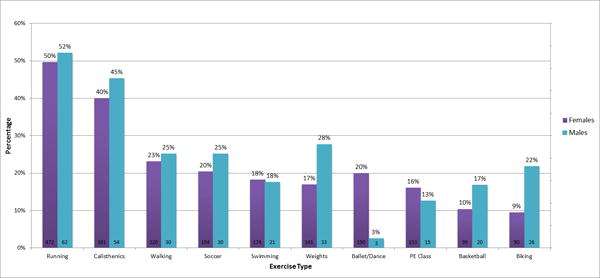
Results: 1,083 subjects (961 females, 122 males; mean age 15.6) met eligibility criteria. Most patients (89.7%) reported exercise (mean 7.0 h per week over mean 5.4 days per week) prior to presentation. Running (49.9%), calisthenics (40.7%), walking (23.4%), soccer (20.9%), and swimming (18.2%) were the most common exercises; a majority (60.6%) reported team sport participation. Males were less likely to report team exercise (p = .005). Bradycardia (heart rate <50) at presentation was associated with team sport participation (adjusted odds ratio [AOR] 1.66, 95% confidence interval [CI] 1.02-2.72) and hours of exercise per week (AOR 1.05, 95% CI 1.02-1.09), controlling for diagnosis, sex, age, duration of illness, rate of weight loss, and percent median body mass index (%mBMI).
Discussion: Adolescents with AN, atypical AN, and BN reported high levels of exercise. Females reported more team sport participation. Greater exercise frequency and team sport participation were associated with bradycardia. Further studies assessing the relationship between exercise and bradycardia may help inform the medical management of adolescents with these eating disorders who are more physically active.
Keywords: QTc; anorexia nervosa; atypical anorexia nervosa; bradycardia; bulimia nervosa; cardiovascular; exercise; physical activity; team sport.
© 2017 Wiley Periodicals, Inc.
Conflict of interest statement
References
-
- American Psychiatric Association. Diagnostic and statistical manual of mental disorders. 5th. Washington, D.C: American Psychiatric Association; 2013.
-
- Andersen AE, Holman JE. Males with eating disorders: Challenges for treatment and research. Psychopharmacology Bulletin. 1997;33(3):391–397. - PubMed
-
- Bal BS, Singh B, Singh O. Achievement motivation and locus of control of university level and team sport players- a prognostic study. Journal of Physical Education and Sports Management. 2010;1(3):33–36.
MeSH terms
Grants and funding
LinkOut - more resources
Full Text Sources
Other Literature Sources
Medical
Miscellaneous
