


Exosomal miR-665 as a novel minimally invasive biomarker for hepatocellular carcinoma diagnosis and prognosis
- PMID: 29113334
- PMCID: PMC5655229
- DOI: 10.18632/oncotarget.20881
Exosomal miR-665 as a novel minimally invasive biomarker for hepatocellular carcinoma diagnosis and prognosis
Abstract
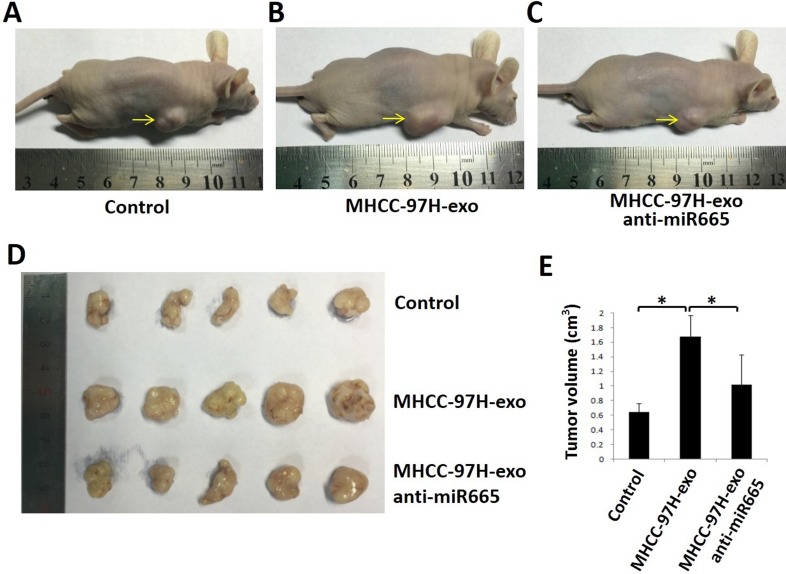
Recent studies have shown that circulating microRNAs are potential biomarkers for various types of malignancies. The aim of this study was to investigate the feasibility of using serum exosomal microRNAs (miRNAs) as novel serological biomarkers for hepatocellular carcinoma (HCC) diagnosis and prognosis. Exosomes are small membranous vesicles (30-100 nm). Exosomal miR-665 levels in HCC patients were significantly higher than those in healthy subjects (P < 0.05), and exosomal miR-665 levels were significantly upregulated in tumours larger in size (> 5 cm), in tumours with local invasion and in those at an advanced clinical stage (stage III/IV) of HCC (P = 0.0042, 0.0197, and 0.0276, respectively). The survival time of the exosomal miR-665 high-expression group (n = 17) was significantly shorter than that of the low-expression group (n = 13) (P = 0.036). In addition, we found that HCC cell-derived exosomes promoted hepatoma cell proliferation and upregulated the expression level of proteins in the MAPK/ERK pathway in vitro and in vivo. This study suggests that serum exosomal miR-665 may be a novel minimally invasive biomarker for HCC diagnosis and prognosis.
Keywords: ERK; HCC; biomarker; exosomal miRNA-665; tumor growth.
Conflict of interest statement
CONFLICTS OF INTEREST There are no conflicts of interest to declare.
Figures



References
-
- Jemal A, Bray F, Center MM, Ferlay J, Ward E, Forman D. Global cancer statistics. CA Cancer J Clin. 2011;61:69–90. - PubMed
-
- El-Serag HB, Rudolph KL. Hepatocellular carcinoma: epidemiology and molecular carcinogenesis. Gastroenterology. 2007;132:2557–2576. - PubMed
-
- El-Serag HB. Hepatocellular carcinoma. N Engl J Med. 2011;365:1118–1127. - PubMed
-
- Lewis BP, Burge CB, Bartel DP. Conserved seed pairing, often flanked by adenosines, indicates that thousands of human genes are microRNA targets. Cell. 2005;120:15–20. - PubMed
-
- Ruan K, Fang X, Ouyang G. MicroRNAs: novel regulators in the hallmarks of human cancer. Cancer Lett. 2009;285:116–126. - PubMed
LinkOut - more resources
Full Text Sources
Other Literature Sources
Miscellaneous
