


Long-term survival and toxicity outcomes of intensity modulated radiation therapy for the treatment of esophageal cancer: A large single-institutional cohort study
- PMID: 29114598
- PMCID: PMC5605282
- DOI: 10.1016/j.adro.2017.04.002
Long-term survival and toxicity outcomes of intensity modulated radiation therapy for the treatment of esophageal cancer: A large single-institutional cohort study
Abstract
Purpose: In patients with esophageal cancer (EC), intensity modulated radiation therapy (IMRT) improves dose sparing to the heart and lung, with some evidence showing clinical benefit. Herein, we report our cumulative clinical experience with the use of IMRT for EC.
Methods and materials: This is a retrospective analysis of 587 patients with nonmetastatic EC who were treated consecutively with IMRT from January 2004 to June 30, 2013. All patients with stage I-IVA (American Joint Committee on Cancer 2002) received concurrent chemoradiation therapy either preoperatively or definitively. The Kaplan-Meier method was used to compute overall survival (OS) and locoregional recurrence-free survival and disease-free survival. The Common Terminology Criteria for Adverse Events, Version 4.0 were used to grade acute and subacute complications.
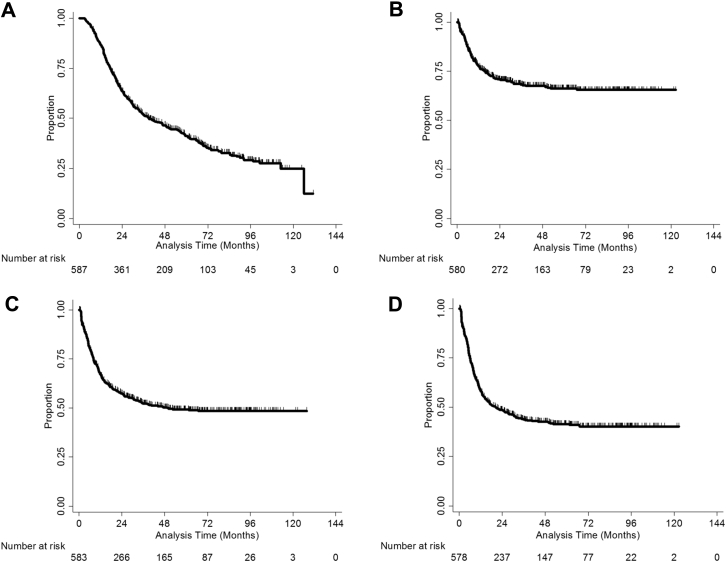
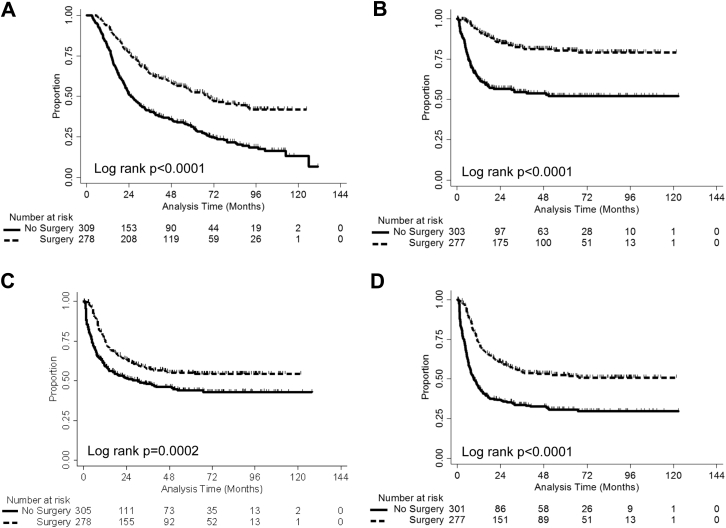
Results: The median radiation dose was 50.4 Gy in 28 daily fractions. As of July 2015, the median follow-up was 31.4 months (range, 2.9-130.7 months) for all patients and 61.8 months (range, 7.7-130.7 months) for survivors. The median OS was 38.9 months, and the 1-, 3-, and 5-year OS rates were 86.7%, 51.8%, and 41.2%, respectively. The 1-, 3-, and 5-year locoregional recurrence-free survival rates were 77.6%, 68.2%, and 66.1%, respectively, and the 1-, 3-, and 5-year disease-free survival rates were 58.6%, 43.7%, and 41.4%, respectively. Outcomes for both trimodality and bimodality treated patients were better than the outcomes reported in the literature. Eight patients (1.4%) experienced grade ≥3 pneumonitis, and 74 patients (13%) developed grade ≥3 esophagitis. For patients who underwent surgery, the most common postoperative complications were pneumonia (9.6%), anastomotic leakage (11.1%), and atrial fibrillation (12.5%).
Conclusions: This is the largest, single institutional study to date on the long-term outcomes of treatment with IMRT for EC. For photon-based radiation therapy, IMRT yields excellent outcomes and should be considered for the treatment of EC.
Figures
References
-
- American Cancer Society . 2nd edition. American Cancer Society; Atlanta, GA: 2011. Global Cancer Facts & Figures.
-
- American Cancer Society . American Cancer Society; Atlanta, GA: 2015. Cancer Facts & Figures 2015.
-
- Ajani J.A., Barthel J.S., Bentrem D.J. Esophageal and esophagogastric junction cancers. J Natl Compr Canc Netw. 2011;9:830–887. - PubMed
-
- van Hagen P., Hulshof M.C., van Lanschot J.J. Preoperative chemoradiotherapy for esophageal or junctional cancer. N Engl J Med. 2012;366:2074–2084. - PubMed
Grants and funding
LinkOut - more resources
Full Text Sources
Other Literature Sources
Research Materials
