


Fluctuations in the incidence of type 1 diabetes in the United States from 2001 to 2015: a longitudinal study
- PMID: 29115947
- PMCID: PMC5688827
- DOI: 10.1186/s12916-017-0958-6
Fluctuations in the incidence of type 1 diabetes in the United States from 2001 to 2015: a longitudinal study
Abstract
Background: While the United States has the largest number of children with type 1 diabetes mellitus, less is known regarding adult-onset disease. The present study utilizes nationwide data to compare the incidence of type 1 diabetes in youth (0-19 years) to that of adults (20-64 years).
Methods: In this longitudinal study, the Clinformatics® Data Mart Database was used, which contains information from 61 million commercially insured Americans (years 2001-2015). Incidence rates and exact Poisson 95% confidence intervals were calculated by age group, sex, census division, and year of diagnosis. Changes in rates over time were assessed by negative binomial regression.
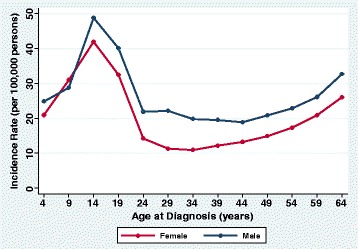
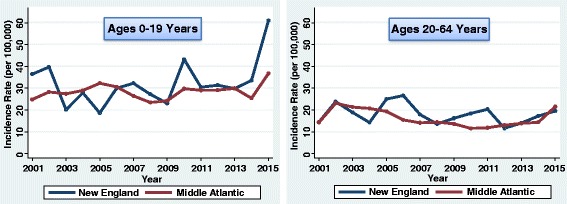
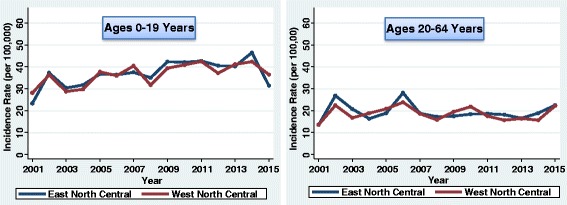
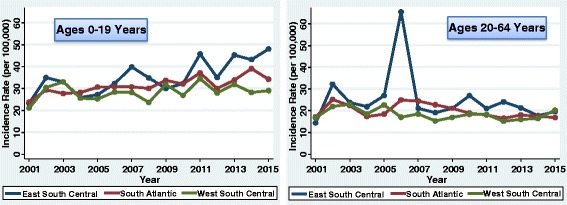
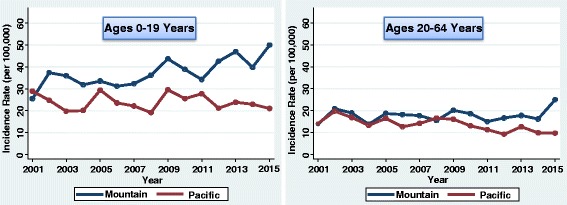
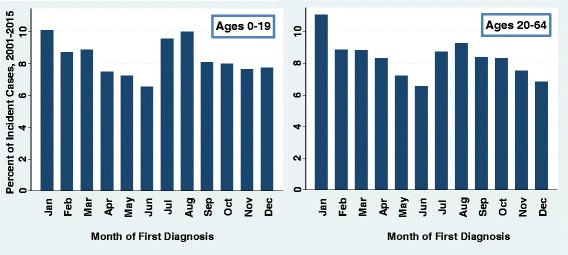
Results: Overall, there were 32,476 individuals who developed type 1 diabetes in the cohort. The incidence rate was greatest in youth aged 10-14 years (45.5 cases/100,000 person-years); however, because adulthood spans over a longer period than childhood, there was a greater number of new cases in adults than in youth (n = 19,174 adults; n = 13,302 youth). Predominance in males was evident by age 10 and persisted throughout adulthood. The male to female incidence rate ratio was 1.32 (95% CI 1.30-1.35). The incidence rate of type 1 diabetes in youth increased by 1.9% annually from 2001 to 2015 (95% CI 1.1-2.7%; P < 0.001), but there was variation across regions. The greatest increases were in the East South Central (3.8%/year; 95% CI 2.0-5.6%; P < 0.001) and Mountain divisions (3.1%/year; 95% CI 1.6-4.6%; P < 0.001). There were also increases in the East North Central (2.7%/year; P = 0.010), South Atlantic (2.4%/year; P < 0.001), and West North Central divisions (2.4%/year; P < 0.001). In adults, however, the incidence decreased from 2001 to 2015 (-1.3%/year; 95% CI -2.3% to -0.4%; P = 0.007). Greater percentages of cases were diagnosed in January, July, and August for both youth and adults. The number of new cases of type 1 diabetes (ages 0-64 years) in the United States is estimated at 64,000 annually (27,000 cases in youth and 37,000 cases in adults).
Conclusions: There are more new cases of type 1 diabetes occurring annually in the United States than previously recognized. The increase in incidence rates in youth, but not adults, suggests that the precipitating factors of youth-onset disease may differ from those of adult-onset disease.
Keywords: Age differences; Incidence study; Trends; Type 1 diabetes mellitus.
Conflict of interest statement
Ethics approval and consent to participate
This project was reviewed by the School of Medicine Institutional Review Board at the University of Michigan, Ann Arbor, Michigan, USA. It was determined “Not Regulated” and received a waiver of informed consent [HUM00116754].
Consent for publication
Not applicable.
Competing interests
The authors declare that they have no competing interests.
Publisher’s Note
Springer Nature remains neutral with regard to jurisdictional claims in published maps and institutional affiliations.
Figures
References
-
- Hamman RF, Bell RA, Dabelea D, D’Agostino RB, Dolan L, Imperatore G, Lawrence JM, Linder B, Marcovina SM, Mayer-Davis EJ, Pihoker C, Rodriguez BL, Saydah S. SEARCH for Diabetes in Youth Study Group. The SEARCH for Diabetes in Youth Study: rationale, findings, and future directions. Diabetes Care. 2014;37(12):3336–3344. doi: 10.2337/dc14-0574. - DOI - PMC - PubMed
-
- Thomas NJM, Jones S, Weedon M, Hattersley A, Oram R. Classifying diabetes by type 1 genetic risk shows autoimmune diabetes cases are evenly distributed above and below 30 years of age. Diabetologia. 2016;59 Suppl 1:S135.
MeSH terms
Grants and funding
LinkOut - more resources
Full Text Sources
Other Literature Sources
Medical
