


Role of mHealth applications for improving antenatal and postnatal care in low and middle income countries: a systematic review
- PMID: 29115992
- PMCID: PMC5678803
- DOI: 10.1186/s12913-017-2664-7
Role of mHealth applications for improving antenatal and postnatal care in low and middle income countries: a systematic review
Abstract
Background: From 1990 to 2015, the number of maternal deaths globally has dropped by 43%. Despite this, progress in attaining MDG 5 is not remarkable in LMICs. Only 52% of pregnant women in LMICs obtain WHO recommended minimum of four antenatal consultations and the coverage of postnatal care is relatively poor. In recent years, the increased cellphone penetration has brought the potential for mHealth to improve preventive maternal healthcare services. The objective of this review is to assess the effectiveness of mHealth solutions on a range of maternal health outcomes by categorizing the interventions according to the types of mHealth applications.
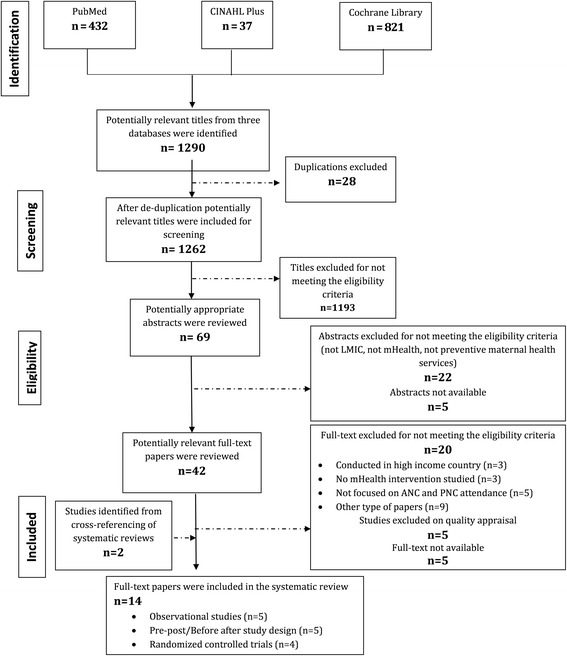
Methods: Three international online electronic databases were searched between January 1, 2000 and January 25, 2016 to identify studies exploring the role of mHealth solutions in improving preventive maternal healthcare services. Of 1262 titles screened after duplication, 69 potentially relevant abstracts were obtained. Out of 69 abstracts, 42 abstracts were shortlisted. Full text of 42 articles was reviewed using data extraction sheet. A total of 14 full text studies were included in the final analysis.
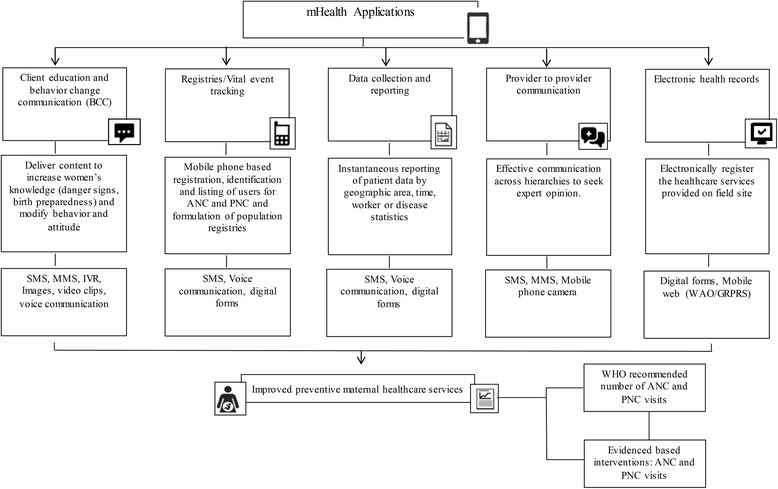
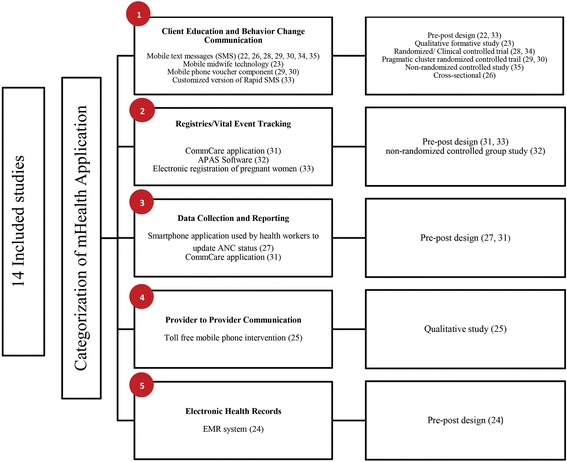
Results: The 14 final studies were categorized in to five mHealth applications defined in the conceptual framework. Based on our analysis, the most reported use of mHealth was for client education and behavior change communication, such as SMS and voice reminders [n = 9, 65%]. The categorization provided the understanding that much work have been done on client education and behavior change communication. Most of the studies showed that mHealth interventions have proven to be effective to improve antenatal care and postnatal care services, especially those that are aimed at changing behavior of pregnant women and women in postnatal period. However, little evidence exists on other type of mHealth applications.
Conclusion: This review suggests that mHealth solutions targeted at pregnant women and women in postnatal period can improve preventive maternal healthcare services. However, there is a need to conduct more controlled-trials and quasi-experimental studies to strengthen the literature in this research area. The review recommends that mHealth researchers, sponsors, and publishers should prioritize the transparent reporting of interventions to allow effective interpretation of extracted data.
Keywords: Mobile health, mHealth interventions, Antenatal care services, Postnatal care services, Low and middle income countries, Systematic review.
Conflict of interest statement
Ethics approval and consent to participate
Not applicable.
Consent for publication
Not applicable.
Competing interests
The authors declare that they have no competing interests.
Publisher’s Note
Springer Nature remains neutral with regard to jurisdictional claims in published maps and institutional affiliations.
Figures
References
-
- Unicef. Trends in maternal mortality: 1990 to 2013. 2014. Retrieved from http://www.who.int/reproductivehealth/publications/monitoring/maternal-m...
-
- World Health Organization, UNICEF . Trends in maternal mortality: 1990 to 2013: estimates by WHO, UNICEF, UNFPA, the World Bank and the United Nations population division: executive summary. 2014.
Publication types
MeSH terms
LinkOut - more resources
Full Text Sources
Other Literature Sources
Medical
