Review
. 2018 Dec;175(24):4404-4414.
doi: 10.1111/bph.14085. Epub 2017 Dec 22.

Microbial biotransformations in the human distal gut

Affiliations
Review

Microbial biotransformations in the human distal gut

Elisabeth M Bik et al. Br J Pharmacol. 2018 Dec.

Abstract

The human distal gut is home to a rich and dense microbial community with representatives of all three domains of life which are intricately connected with our physiology and health. The combined genomes of these microbes, collectively called the human microbiome, vastly expand the metabolic capacities of our own genome, allowing us to break down and extract energy from dietary compounds that human enzymes cannot digest. In addition, the variable composition of these communities and their biotransformations might explain inter-individual differences in toxicities, tolerances and efficacies for certain drugs. Recent advances in sequencing technologies and bioinformatics have provided exciting new insights into the genomes of our microbial symbionts, their functional capacities and the interactions between these microbes and their human host. This review summarizes the metabolic conversions of dietary components and pharmaceuticals that take place in the human distal gut, as well as their implications for human health. LINKED ARTICLES: This article is part of a themed section on When Pharmacology Meets the Microbiome: New Targets for Therapeutics? To view the other articles in this section visit http://onlinelibrary.wiley.com/doi/10.1111/bph.v175.24/issuetoc.


Figures

Figure 1
Figure 1
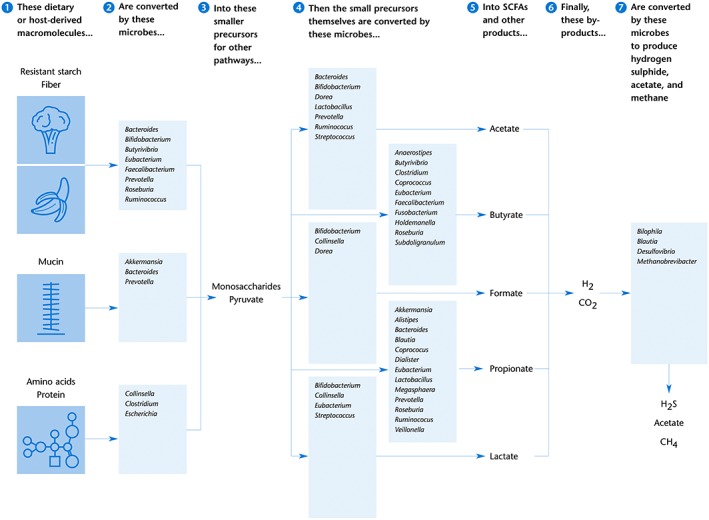
Main microbial fermentation pathways in the human gut. Boxes show the bacterial and archaeal genera involved in the digestion of macromolecules and the generation of SCFAs and other small molecules. The main species within those genera performing these reactions within the human gut are shown in Table 1. This graph is a simplified scheme; not all conversions and cross‐feedings could be shown here. For example, acetate and lactate can be used by some gut bacteria as a precursor to produce butyrate. Compiled from data provided by Louis and Flint (2016); Magnúsdóttir et al. (2017); Desai et al. (2016); Koh et al. (2016); Ríos‐Covián et al. (2016); Ze et al. (2015); Blekhman et al. (2015); Reichardt et al. (2014); LeBlanc et al. (2013); Flint et al. (2012); Nakamura et al. (2010); Belenguer et al. (2006).
Figure 2
Figure 2
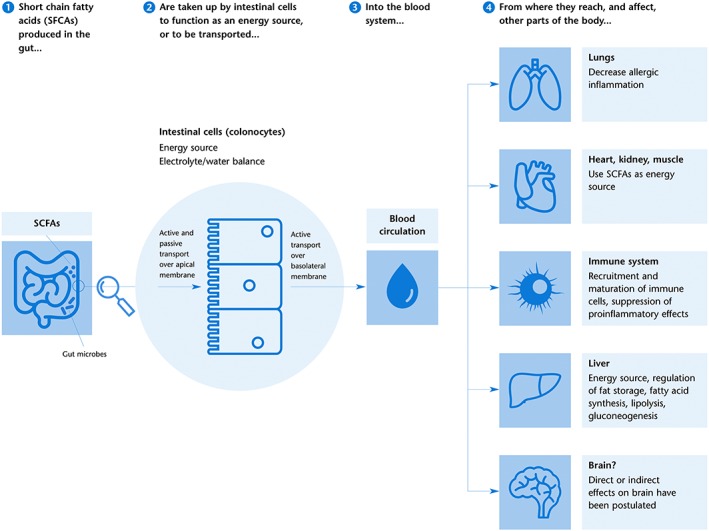
SCFAs effects on the gut and beyond. SCFAs are produced as the result of microbial fermentation in the distal gut (Figure 1) and absorbed by colonocytes through active and passive transport over the apical membrane. SCFAs are partly consumed by colonocytes as an energy source, while the remaining molecules are actively transported over the basolateral membrane and enter the blood circulation. From there, SCFA can affect processes in several peripheral organs by changing DNA transcription through the inhibition of histone deacetylation, binding to and activating GPCRs, or as metabolites in mitochondrial β‐oxidation. Effects of SCFAs, in particular butyrate, on the brain have been hypothesized, either directly by passing the blood–brain barrier or indirectly by effects on the peripheral nervous system. Graphic based on den Besten et al. (2013), Koh et al. (2016) and Stilling et al. (2016).

References

    1. Almonacid DE, Kraal L, Ossandon FJ, Budovskaya YV, Cardenas JP, Bik EM et al (2017). 16S rRNA gene sequencing and healthy reference ranges for 28 clinically relevant microbial taxa from the human gut microbiome. PLoS ONE 12: e0176555. - PMC - PubMed
    1. Bäckhed F, Roswall J, Peng Y, Feng Q, Jia H, Kovatcheva‐Datchary P et al (2015). dynamics and stabilization of the human gut microbiome during the first year of life. Cell Host Microbe 17: 690–703. - PubMed
    1. Belenguer A, Duncan SH, Calder AG, Holtrop G, Louis P, Lobley GE et al (2006). Two routes of metabolic cross‐feeding between Bifidobacterium adolescentis and butyrate‐producing anaerobes from the human gut. Appl Environ Microbiol 72: 3593–3599. - PMC - PubMed
    1. den Besten G, van Eunen K, Groen AK, Venema K, Reijngoud D‐J, Bakker BM (2013). The role of short‐chain fatty acids in the interplay between diet, gut microbiota, and host energy metabolism. J Lipid Res 54: 2325–2340. - PMC - PubMed
    1. Blekhman R, Goodrich JK, Huang K, Sun Q, Bukowski R, Bell JT et al (2015). Host genetic variation impacts microbiome composition across human body sites. Genome Biol 16: 191. - PMC - PubMed

MeSH terms