


Group B Streptococcal Disease Worldwide for Pregnant Women, Stillbirths, and Children: Why, What, and How to Undertake Estimates?
- PMID: 29117323
- PMCID: PMC5850012
- DOI: 10.1093/cid/cix653
Group B Streptococcal Disease Worldwide for Pregnant Women, Stillbirths, and Children: Why, What, and How to Undertake Estimates?
Abstract
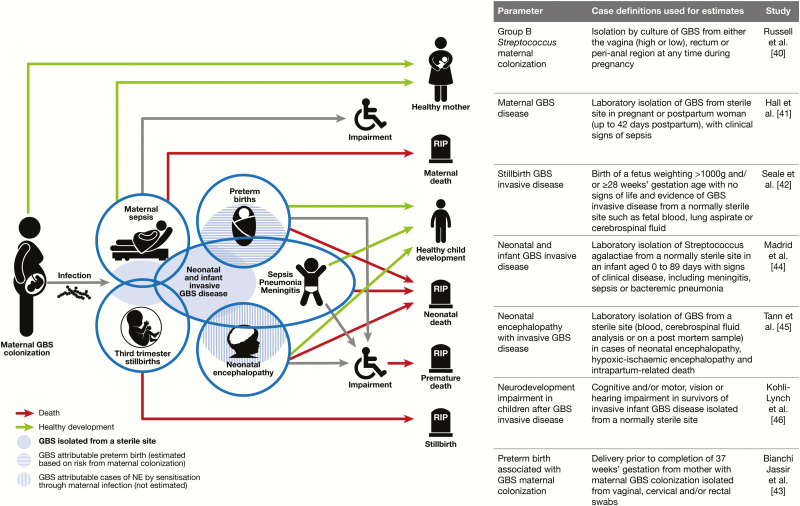
Improving maternal, newborn, and child health is central to Sustainable Development Goal targets for 2030, requiring acceleration especially to prevent 5.6 million deaths around the time of birth. Infections contribute to this burden, but etiological data are limited. Group B Streptococcus (GBS) is an important perinatal pathogen, although previously focus has been primarily on liveborn children, especially early-onset disease. In this first of an 11-article supplement, we discuss the following: (1) Why estimate the worldwide burden of GBS disease? (2) What outcomes of GBS in pregnancy should be included? (3) What data and epidemiological parameters are required? (4) What methods and models can be used to transparently estimate this burden of GBS? (5) What are the challenges with available data? and (6) How can estimates address data gaps to better inform GBS interventions including maternal immunization? We review all available GBS data worldwide, including maternal GBS colonization, risk of neonatal disease (with/without intrapartum antibiotic prophylaxis), maternal GBS disease, neonatal/infant GBS disease, and subsequent impairment, plus GBS-associated stillbirth, preterm birth, and neonatal encephalopathy. We summarize our methods for searches, meta-analyses, and modeling including a compartmental model. Our approach is consistent with the World Health Organization (WHO) Guidelines for Accurate and Transparent Health Estimates Reporting (GATHER), published in The Lancet and the Public Library of Science (PLoS). We aim to address priority epidemiological gaps highlighted by WHO to inform potential maternal vaccination.
Keywords: global burden; group B Streptococcus; maternal; neonatal; stillbirth.
© The Author 2017. Published by Oxford University Press for the Infectious Diseases Society of America.
Figures




References
-
- United Nations. Millennium Development Goals and beyond 2015 Available at: http://www.un.org/millenniumgoals/. Accessed 13 July 2017.
-
- Lawn JE, Blencowe H, Oza S et al. Lancet Every Newborn Study Group Every Newborn: progress, priorities, and potential beyond survival. Lancet 2014; 384:189–205. - PubMed
-
- Frøen JF, Friberg IK, Lawn JE et al. Lancet Ending Preventable Stillbirths Series Study Group Stillbirths: progress and unfinished business. Lancet 2016; 387:574–86. - PubMed
-
- United Nations. Sustainable Development Goals Available at: http://www.un.org/sustainabledevelopment/sustainable-development-goals/. Accessed 13 July 2017.
MeSH terms
Substances
Grants and funding
LinkOut - more resources
Full Text Sources
Other Literature Sources
Medical
