


Evaluation of Genetic Predisposition for MYCN-Amplified Neuroblastoma
- PMID: 29117357
- PMCID: PMC6279278
- DOI: 10.1093/jnci/djx093
Evaluation of Genetic Predisposition for MYCN-Amplified Neuroblastoma
Abstract
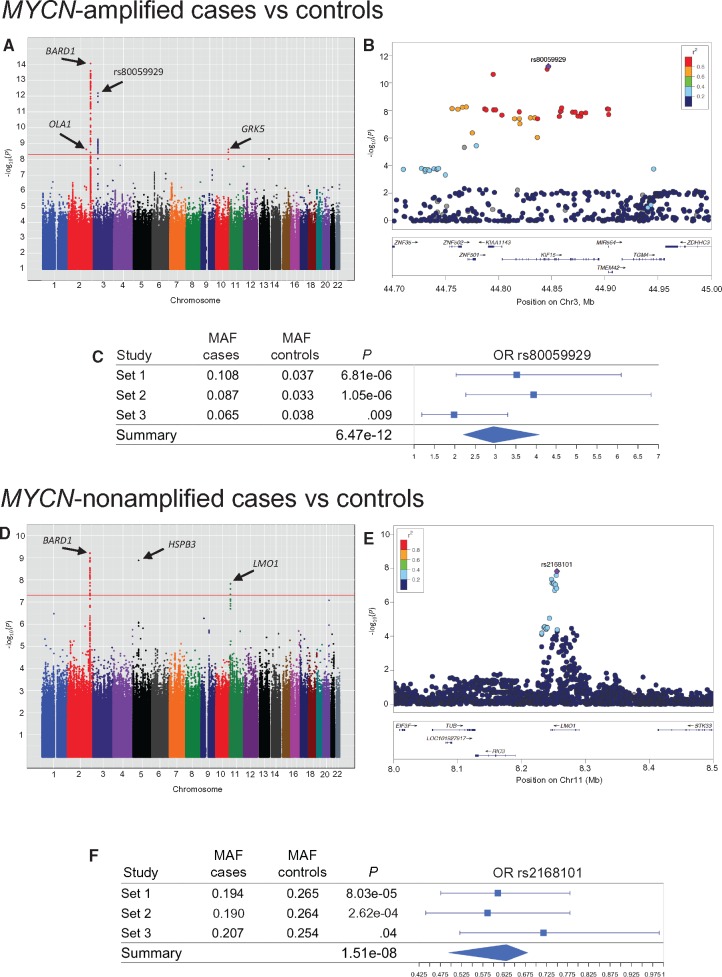
To investigate genetic predispositions for MYCN-amplified neuroblastoma, we performed a meta-analysis of three genome-wide association studies totaling 615 MYCN-amplified high-risk neuroblastoma cases and 1869 MYCN-nonamplified non-high-risk neuroblastoma cases as controls using a fixed-effects model with inverse variance weighting. All statistical tests were two-sided. We identified a novel locus at 3p21.31 indexed by the single nucleotide polymorphism (SNP) rs80059929 (odds ratio [OR] = 2.95, 95% confidence interval [CI] = 2.17 to 4.02, Pmeta = 6.47 × 10⁻¹²) associated with MYCN-amplified neuroblastoma, which was replicated in 127 MYCN-amplified cases and 254 non-high-risk controls (OR = 2.30, 95% CI = 1.12 to 4.69, Preplication = .02). To confirm this signal is exclusive to MYCN-amplified tumors, we performed a second meta-analysis comparing 728 MYCN-nonamplified high-risk patients to identical controls. rs80059929 was not statistically significant in MYCN-nonamplified high-risk patients (OR = 1.24, 95% CI = 0.90 to 1.71, Pmeta = .19). SNP rs80059929 is within intron 16 in the KIF15 gene. Additionally, the previously reported LMO1 neuroblastoma risk locus was statistically significant only in patients with MYCN-nonamplified high-risk tumors (OR = 0.63, 95% CI = 0.53 to 0.75, Pmeta = 1.51 × 10⁻⁸; Pmeta = .95). Our results indicate that common genetic variation predisposes to different neuroblastoma genotypes, including the likelihood of somatic MYCN-amplification.
© The Author 2017. Published by Oxford University Press. All rights reserved. For Permissions, please e-mail: journals.permissions@oup.com.
Figures
References
-
- Shohet JM, Ghosh R, Coarfa C, et al.A genome-wide search for promoters that respond to increased MYCN reveals both new oncogenic and tumor suppressor microRNAs associated with aggressive neuroblastoma. Cancer Res. 2011;7111:3841–3851. - PubMed
Publication types
MeSH terms
Substances
Grants and funding
LinkOut - more resources
Full Text Sources
Other Literature Sources
Medical
