


Isolation, Cryopreservation, and Immunophenotyping of Human Peripheral Blood Mononuclear Cells
- PMID: 29117436
- PMCID: PMC5726299
- DOI: 10.1002/cptx.31
Isolation, Cryopreservation, and Immunophenotyping of Human Peripheral Blood Mononuclear Cells
Abstract
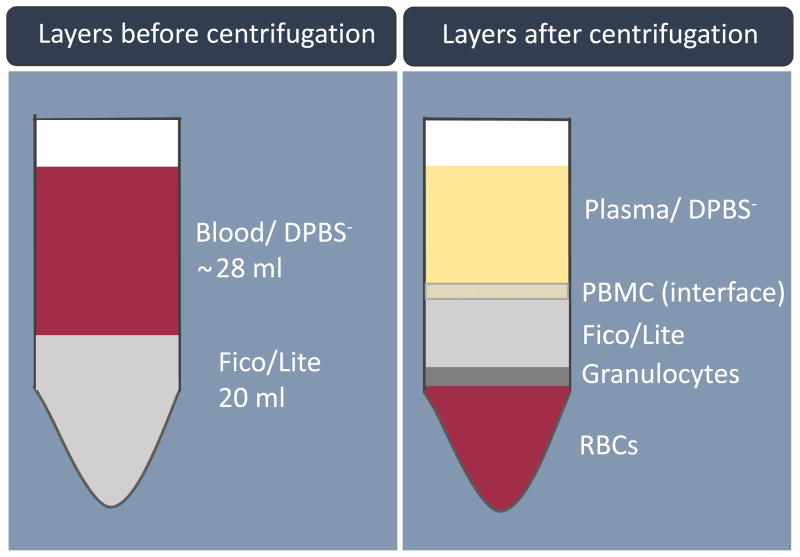
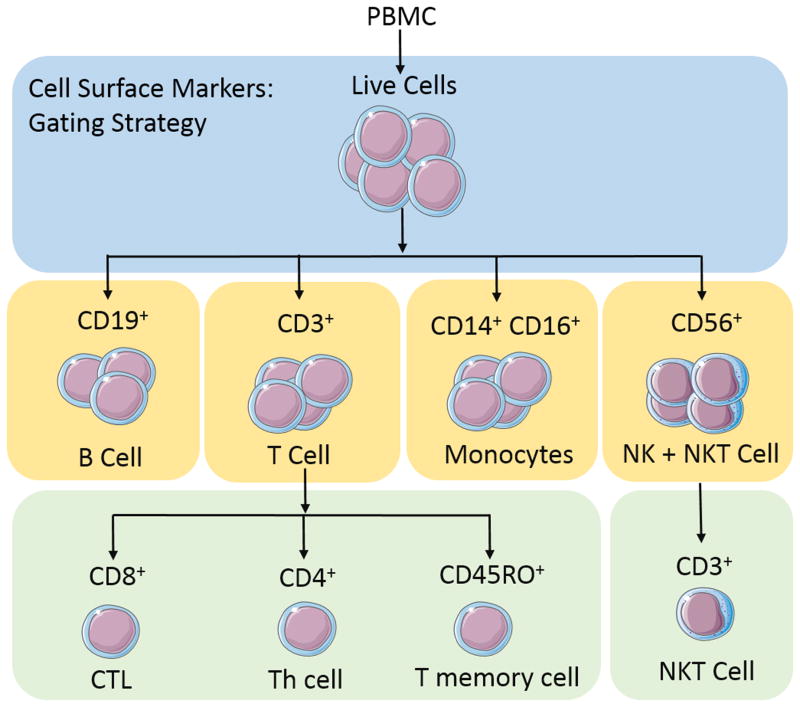
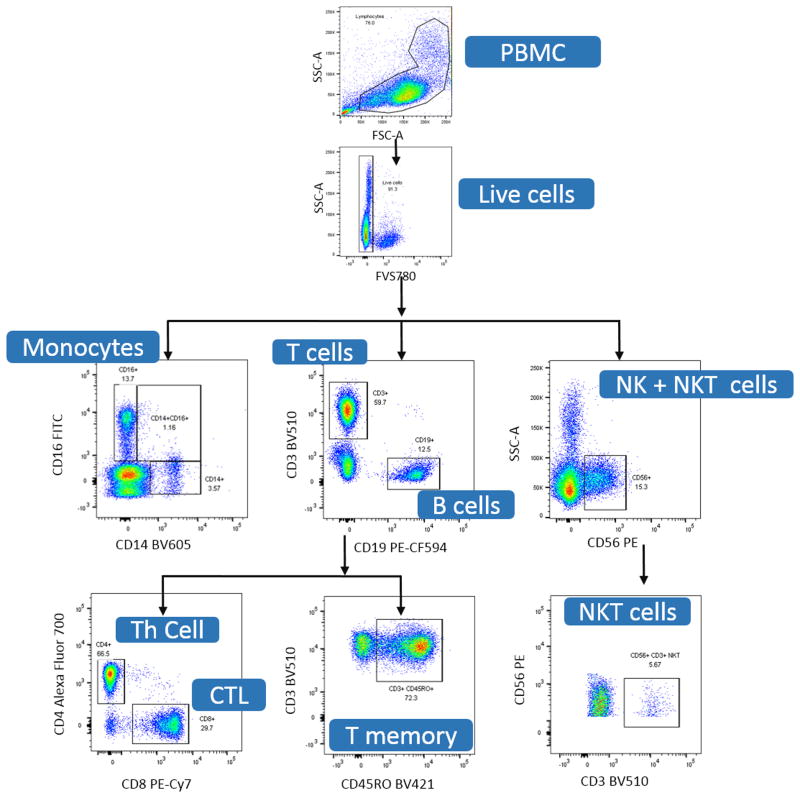
This unit describes procedures for the isolation, cryopreservation, and thawing of human peripheral blood mononuclear cells (HPBMC) and analysis of cell surface markers (CSM) for immunophenotyping using polychromatic flow cytometry. This methodology can be used to ensure that cell integrity and phenotype stability are not altered through cryopreservation and extended storage. For this analysis, HPBMC were isolated from 7 healthy individuals, and 11-color flow cytometry was performed on freshly isolated samples as well as samples cryopreserved for short- and long-term periods. There is no significant difference in the percentage of cells expressing the CSM CD3, CD4, CD8, CD45RO, CD16, CD19, or CD56 between freshly isolated and cryopreserved HPBMC. Hence, cryopreservation of HPBMC does not influence the phenotype of distinct cellular subsets in isolated mononuclear cells. This protocol for HPBMC isolation, cryopreservation, and thawing of HPBMC is intended for long-term studies of large cohorts requiring sample shipment and subsequent batch analysis. © 2017 by John Wiley & Sons, Inc.
Keywords: HPBMC; cell surface markers; flow cytometry; immune cell subsets; phenotyping.
Copyright © 2017 John Wiley & Sons, Inc.
Figures
References
-
- Betts MR, Nason MC, West SM, De Rosa SC, Migueles SA, Abraham J, Lederman MM, Benito JM, Goepfert PA, Conors M, Roederer M, Koup RA. HIV nonprogressors preferentially maintain highly functional HIV-specific CD8+ T-cells. Blood. 2006;107:4781–4789. doi: 10.1182/blood-2005-12-4818. - DOI - PMC - PubMed
-
- Burchiel SW, Lauer FT, Beswick EJ, Gandolfi AJ, Parvez F, Liu KJ, Hudson LG. Differential Susceptibility of Human Peripheral Blood T Cells to Suppression by Environmental Levels of Sodium Arsenite and Monomethylarsonous Acid. PLoS One. 2014;9(10):e109192. doi: 10.1371/journal.pone.0109192. - DOI - PMC - PubMed
-
- Chng WJ, Tan GB, Kuperan P. Establishment of Adult Peripheral Blood Lymphocyte Subset Reference Range for an Asian Population by Single-Platform Flow Cytometry: Influence of Age, Sex, Race and Comparison with Other Published Studies. Clinical and Diagnostic Laboratory Immunology. 2004:168–173. - PMC - PubMed
MeSH terms
Substances
Grants and funding
LinkOut - more resources
Full Text Sources
Other Literature Sources
Research Materials
