. 2017 Nov 8;7(1):15044.
doi: 10.1038/s41598-017-15407-4.

Methods for Scarless, Selection-Free Generation of Human Cells and Allele-Specific Functional Analysis of Disease-Associated SNPs and Variants of Uncertain Significance

Affiliations

Methods for Scarless, Selection-Free Generation of Human Cells and Allele-Specific Functional Analysis of Disease-Associated SNPs and Variants of Uncertain Significance

Nicole B Coggins et al. Sci Rep. .

Erratum in

Abstract

With the continued emergence of risk loci from Genome-Wide Association studies and variants of uncertain significance identified from patient sequencing, better methods are required to translate these human genetic findings into improvements in public health. Here we combine CRISPR/Cas9 gene editing with an innovative high-throughput genotyping pipeline utilizing KASP (Kompetitive Allele-Specific PCR) genotyping technology to create scarless isogenic cell models of cancer variants in ~1 month. We successfully modeled two novel variants previously identified by our lab in the PALB2 gene in HEK239 cells, resulting in isogenic cells representing all three genotypes for both variants. We also modeled a known functional risk SNP of colorectal cancer, rs6983267, in HCT-116 cells. Cells with extremely low levels of gene editing could still be identified and isolated using this approach. We also introduce a novel molecular assay, ChIPnQASO (Chromatin Immunoprecipitation and Quantitative Allele-Specific Occupation), which uses the same technology to reveal allele-specific function of these variants at the DNA-protein interaction level. We demonstrated preferential binding of the transcription factor TCF7L2 to the rs6983267 risk allele over the non-risk. Our pipeline provides a platform for functional variant discovery and validation that is accessible and broadly applicable for the progression of efforts towards precision medicine.


Conflict of interest statement

The authors declare that they have no competing interests.

Figures
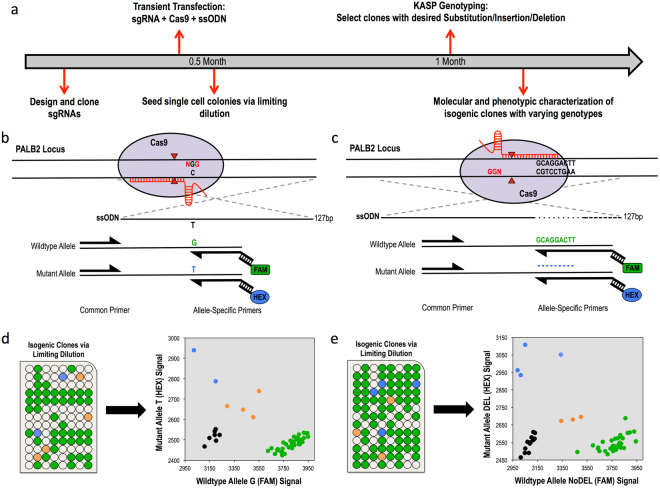
Figure 1
Figure 1
Scarless genome editing in HEK239 cells modeling Gastric Cancer novel VUSs, a single-base substitution (PALB2-SNV) and a 9-base deletion (PALB2-DEL) in the PALB2 gene. (a) Timeline of CRISPR-Cas9 mediated HDR followed by KASP clonal genotyping pipeline to isogenic clones. (b,c) CRISPR-Cas9 HDR strategy and KASP mutation detection probes with mutation of interest (black nucleotides), guide RNA (red line), PAM site (red nucleotides), cleavage sites (red triangles) and 127-bp single-stranded asymmetric donor template for SNV and 9-base deletion respectively. (d,e) Isogenic clone plating in 96-well plate format and KASP genotyping cluster output of single-cell clones color-coded by genotype, Mut/Mut (blue), Mut/WT (orange), WT/WT (green) and no template controls (black) for SNV and 9-base deletion respectively.
Figure 2
Figure 2
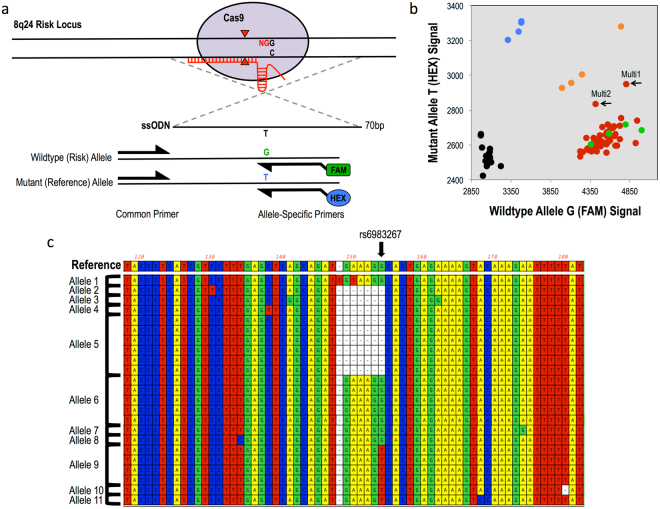
Multi-cell cloning to produce scarless single-base genome editing modeling Colorectal Cancer risk SNP rs6983267 in HCT-116 cells. (a) CRISPR-Cas9 HDR strategy and KASP mutation detection probes with mutation of interest (black nucleotides), guide RNA (red line), PAM site (red nucleotides), cleavage sites (red triangles) and 70-bp single-stranded symmetric donor template centered around risk SNP. (b) KASP genotyping cluster output of multi-cell clones produced from 10-cell per well seeding in 96-well plates (red) with genotyping controls: Mut/Mut (blue), Mut/WT (orange), WT/WT (green) and no template controls (black). Black arrows indicate multi-cell clones, Multi 1 and Multi 2, that form a distinct 4th cluster between the homozygous wildtype and heterozygous clusters, indicating these clones contain HDR-positive cells. (c) Alignment of sanger sequencing of correct-sized TOPO TA colony PCR amplicons grouped by allele for Multi 2. Reference sequence indicates unmodified HCT-116 sanger sequence. Arrow indicates location of risk SNP. Allele 9 displays desired scarless single-base substitution. Thus, Multi 2 was expanded for a second round of limiting dilution at single-cell per well seeding concentration to produce isogenic heterozygous clones.
Figure 3
Figure 3
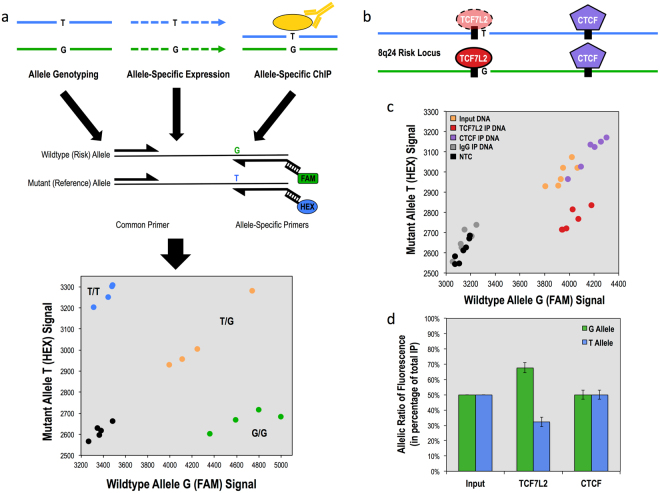
Allele-specific functional analysis of risk SNP rs6983267 within heterozygous HCT-116 clones using KASP genotyping technology. (a) Overview of the allele-specific applications of KASP genotyping: allele genotyping of nuclease-modified clones, relative allele-specific expression of RNA transcripts harboring a heterozygous mutation and relative allele-specific binding affinity of DNA binding proteins that bind on or in the vicinity of a heterozygous mutation. (b) Diagram of heterozygous 8q24 risk locus with transcription factor TCF7L2 (red) and insulating protein CTCF (purple) with binding motifs depicted as black boxes. Risk SNP is located immediately adjacent to the core TCF7L2 binding motif (TCAAAG). (c) KASP fluorescence ratio output of TCF7L2 and CTCF binding at 8q24 locus between G allele and T allele in heterozygous clones (n = 3) run in duplicate with input genomic DNA (orange), immunoprecipitated DNA for TCF7L2 (red), CTCF (purple) and IgG (gray) and no DNA template controls (black). CTCF IPed DNA samples cluster with Input DNA while TCF7L2 IPed DNA samples create a separate cluster favoring the G allele compared to Input DNA. (d) Allelic ratios of G (green) and T (blue) alleles in percentage of total fluorescence for input control, TCF7L2 and CTCF, quantifying G-allele allelic preference of TCF7L2 compared to CTCF relative to Input DNA control. Errors bars show standard deviation.

References

    1. Freedman ML, et al. Principles for the post-GWAS functional characterization of cancer risk loci. Nat Genet. 2011;43:513–518. doi: 10.1038/ng.840. - DOI - PMC - PubMed
    1. Tak YG, Farnham PJ. Making sense of GWAS: using epigenomics and genome engineering to understand the functional relevance of SNPs in non-coding regions of the human genome. Epigenetics Chromatin. 2015;8:57. doi: 10.1186/s13072-015-0050-4. - DOI - PMC - PubMed
    1. Foley SB, et al. Use of Whole Genome Sequencing for Diagnosis and Discovery in the Cancer Genetics Clinic. EBioMedicine. 2015;2:74–81. doi: 10.1016/j.ebiom.2014.12.003. - DOI - PMC - PubMed
    1. Cheon JY, Mozersky J, Cook-Deegan R. Variants of uncertain significance in BRCA: a harbinger of ethical and policy issues to come? Genome Med. 2014;6:121. doi: 10.1186/s13073-014-0121-3. - DOI - PMC - PubMed
    1. Sur IK, et al. Mice lacking a Myc enhancer that includes human SNP rs6983267 are resistant to intestinal tumors. Science. 2012;338:1360–1363. doi: 10.1126/science.1228606. - DOI - PubMed

Publication types

MeSH terms

Substances