. 2017 Nov 2:7:57.
doi: 10.1186/s13578-017-0185-z. eCollection 2017.

Differential regulation of IFNα, IFNβ and IFNε gene expression in human cervical epithelial cells

Affiliations

Differential regulation of IFNα, IFNβ and IFNε gene expression in human cervical epithelial cells

Jennifer Couret et al. Cell Biosci. .

Abstract

Interferonε (IFNε) is a unique type I IFN that has distinct functions from IFNα/β. IFNε is constitutively expressed at mucosal tissues, including the female genital mucosa, and is reported to be modulated by estrogen and seminal plasma. However, its regulation by cytokines, including TNFα, IL-1β, IL-6, IL-8, IL-17, IL-22 and IFNα, which are commonly present in the female genital mucosa, is not well documented in freshly isolated primary cervical cells from tissues. We determined the effect of these cytokines on gene expression of type I IFNs in an immortalized endocervical epithelial cell line (A2EN) and in primary cervical epithelial cells. Several pro-inflammatory cytokines were found to induce IFNε, and TNFα induced the strongest response in both cell types. Pretreatment of cells with the IκB inhibitor, which blocks the NF-κB pathway, suppressed TNFα-mediated IFNε gene induction and promoter activation. Expression of IFNα, IFNβ, and IFNε was differentially regulated in response to various cytokines. Taken together, our results show that regulation of these IFNs depends on cell type, cytokine concentration, and incubation time, highlighting the complexity of the cytokine network in the cervical epithelium.


Figures
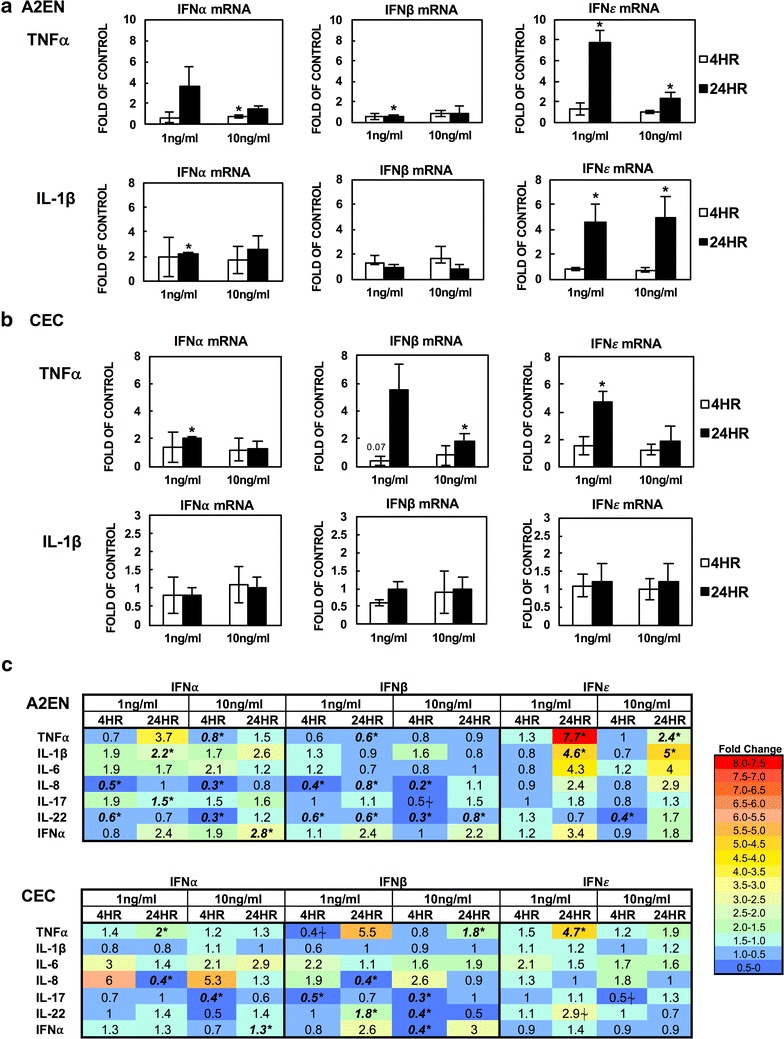
Fig. 1
Fig. 1
Regulation of IFNα, IFNβ and IFNε by various cytokines in A2EN cells and primary cervical cells. A2EN or primary cervical epithelial cells were treated with stated cytokines at 1 or 10 ng/ml for 4 or 24 h. Total RNAs were prepared and gene expression of IFN⍺, IFNβ and IFNε was measured by real-time RT-PCR. Induction of each gene (as fold-change relative to untreated control) was calculated using the ΔΔCT method as described in “Materials and methods”. The value of 1 indicates the level of gene expression of untreated control cells. Data for TNFα and IL-1β are mean ± SD of four independent experiments in A2EN cells (a) and of experiments from primary cervical cells from different donors (b). Average of fold-changes of other cytokines-treated samples relative to untreated samples from four different experiments were summarized in c. Numbers in bold represents significant changes (*p < 0.05). ⍭p=0.057–0.07
Fig. 2
Fig. 2
TNFα-mediated IFNε gene expression is mediated by the NFκB pathway. a Primary cervical cells were pre-treated with or without IKK inhibitor, BAY 11-7082 at 10μM, for 1 h followed by TNFα (1 ng/ml) stimulation. Total RNA was prepared and IFNε gene expression was measured by RT-qPCR. b Primary cervical cells were pre-treated with or without BAY 11-7082 at 10μM for 1 h before TNFα stimulation for 30 min. The Ser 536 phosphorylation of NFκB p65 was measured by Perkin Elmer AlphaLISA SureFire Ultra pNFκB p65 (Ser 536) assay kit according to the manufacture’s instruction. c A2EN cells were transfected with pGL3 or pGL3 containing IFNε promoter. The promoterless pGL3 basic vector was included as the baseline control. Cells were then treated with or without 1 ng/ml TNF for 24 h before measuring luciferase activity (RLUs). d A2EN cells were transfected with the IFNε promoter construct and then treated with or without BAY 11-7082 at 10μM for 1 h. Cells were then stimulated with or without TNFα at 1 ng/ml for 24 h before the measurement of the luciferase activity. Data are mean ± SD of three independent experiments. *p < 0.05

References

    1. Xi Y, Day SL, Jackson RJ, Ranasinghe C. Role of novel type I interferon epsilon in viral infection and mucosal immunity. Mucosal Immunol. 2012;5:610–622. doi: 10.1038/mi.2012.35. - DOI - PMC - PubMed
    1. Hardy MP, Owczarek CM, Jermiin LS, Ejdeback M, Hertzog PJ. Characterization of the type I interferon locus and identification of novel genes. Genomics. 2004;84:331–345. doi: 10.1016/j.ygeno.2004.03.003. - DOI - PubMed
    1. Fung KY, Mangan NE, Cumming H, Horvat JC, Mayall JR, Stifter SA, et al. Interferon-epsilon protects the female reproductive tract from viral and bacterial infection. Science. 2013;339:1088–1092. doi: 10.1126/science.1233321. - DOI - PMC - PubMed
    1. Peng FW, Duan ZJ, Zheng LS, Xie ZP, Gao HC, Zhang H, et al. Purification of recombinant human interferon-epsilon and oligonucleotide microarray analysis of interferon-epsilon-regulated genes. Protein Expr Purif. 2007;53:356–362. doi: 10.1016/j.pep.2006.12.013. - DOI - PubMed
    1. Day SL, Ramshaw IA, Ramsay AJ, Ranasinghe C. Differential effects of the type I interferons alpha4, beta, and epsilon on antiviral activity and vaccine efficacy. J Immunol. 2008;180:7158–7166. doi: 10.4049/jimmunol.180.11.7158. - DOI - PubMed

LinkOut - more resources
