


Coinfection of intestinal schistosomiasis and malaria and association with haemoglobin levels and nutritional status in school children in Mara region, Northwestern Tanzania: a cross-sectional exploratory study
- PMID: 29121978
- PMCID: PMC5679344
- DOI: 10.1186/s13104-017-2904-2
Coinfection of intestinal schistosomiasis and malaria and association with haemoglobin levels and nutritional status in school children in Mara region, Northwestern Tanzania: a cross-sectional exploratory study
Abstract
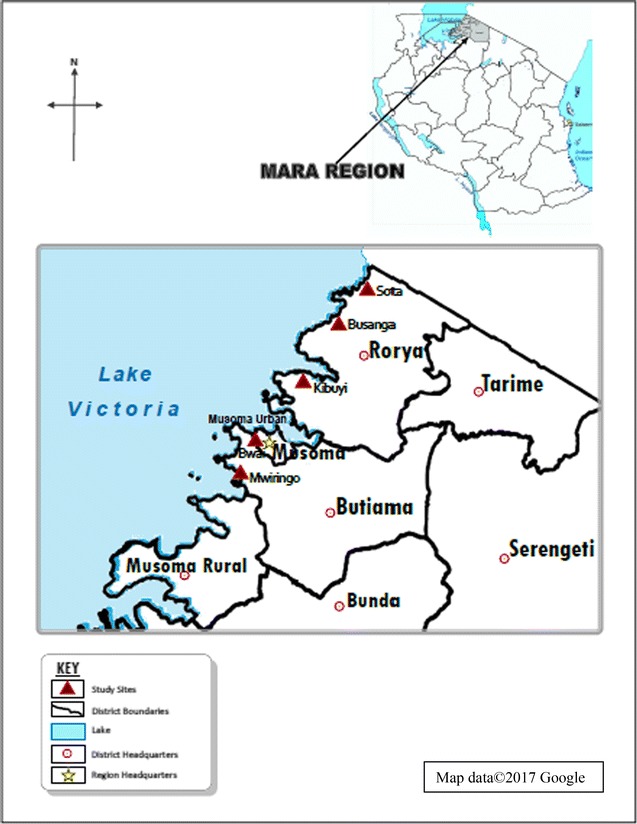
Background: Schistosomiasis represents a major public health problem in Tanzania despite ongoing national control efforts. This study examined whether intestinal schistosomiasis is associated with malaria and assessed the contribution of intestinal schistosomiasis and malaria on anaemia and undernutrition in school children in Mara region, North-western Tanzania.
Methods: Stool samples were collected from each of 928 school children randomly selected from 5 schools and examined for intestinal schistosomiasis using the Kato Katz method. Finger prick blood samples were collected and examined for malaria parasites and haemoglobin concentrations using the Giemsa stain and Haemocue methods, respectively. Nutritional status was assessed by taking anthropometric measurements.
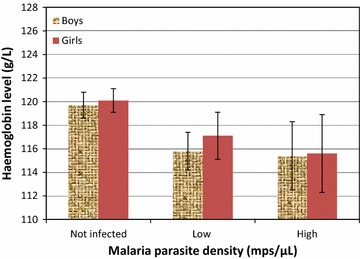
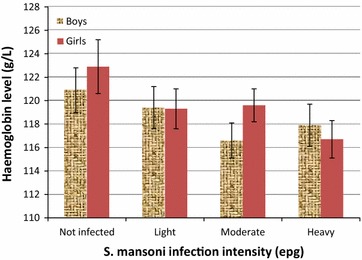
Results: The overall prevalence and infection intensity of S. mansoni was 85.6% (794/928) and 192 (100-278), respectively. The prevalence of malaria was 27.4% (254/928) with significant differences among villages (χ 2 = 96.11, p < 0.001). The prevalence of anaemia was 42.3% (392/928) with significant differences among villages (χ 2 = 39.61, p < 0.001). The prevalence of stunting, thinness and underweight was 21, 6.8 and 1.3%, respectively. Stunting varied significantly by sex (χ 2 = 267.8, p < 0.001), age group (χ 2 = 96.4, p < 0.001) and by village (χ 2 = 20.5, p < 0.001). Out of the 825 infected children, 217 (26.4%) had multiple parasite infections (two to three parasites). The prevalence of co-infections occurred more frequently in boys than in girls (χ 2 = 21.65, p = 0.010). Mean haemoglobin concentrations for co-infected children was significantly lower than that of children not co-infected (115.2 vs 119.6; t = 0.01, p = 0.002). Co-infected children were more likely to be stunted than children who were not co-infected (χ 2 = 11.6, p = 0.003). On multivariate analysis, age group, village of residence and severe anaemia were significant predictors of stunting after adjusting for sex and infection status.
Conclusions: Intestinal schistosomiasis and malaria are prevalent in Mara region. Coinfections of these parasites as well as chronic undernutrition were also common. We recommend Mara region to be included in national schistosomiasis control programmes.
Keywords: Coinfection; Malaria; Mara region; Schistosomiasis; Tanzania.
Figures
References
-
- Clements ACA, Lwambo NJS, Blair L, Nyandidi U, Kaatano G, Kinung’hi S, Webster JP, Fenwick A, Brooker S. Bayesian spatial analysis and disease mapping: tools to enhance planning and implementation of a schistosomiasis control programme in Tanzania. Trop Med Int Health. 2006;11(4):490–503. doi: 10.1111/j.1365-3156.2006.01594.x. - DOI - PMC - PubMed
MeSH terms
Substances
Grants and funding
LinkOut - more resources
Full Text Sources
Other Literature Sources
Medical
