. 2017 Nov 9;5(1):147.
doi: 10.1186/s40168-017-0363-6.

Pancreatic cyst fluid harbors a unique microbiome

Affiliations

Pancreatic cyst fluid harbors a unique microbiome

Shan Li et al. Microbiome. .

Abstract

Background: It is clear that specific intestinal bacteria are involved in the development of different premalignant conditions along the gastrointestinal tract. An analysis of the microbial constituents in the context of pancreatic cystic lesions has, however, as yet not been performed. This consideration prompted us to explore whether endoscopically obtained pancreatic cyst fluids (PCF) contain bacterial DNA and to determine the genera of bacteria present in such material.

Methods: Total DNA was isolated from 69 PCF samples. Bacterial 16S rRNA gene-specific PCR was performed followed by Sanger sequencing and de novo deep sequencing for the V3-V4 variable region of 16S rRNA gene.

Results: We observed that 98.2% of the samples were positive in conventional PCR, and that 100% of selected PCF samples (n = 33) were positive for bacterial microbiota as determined by next generation sequencing (NGS). Comprehensive NGS data analysis of PCF showed the presence of 408 genera of bacteria, of which 17 bacterial genera were uniquely abundant to PCF, when compared to the Human Microbiome Project (HMP) database and 15 bacterial microbiota were uniquely abundant in HMP only. Bacteroides spp., Escherichia/Shigella spp., and Acidaminococcus spp. which were predominant in PCF, while also a substantial Staphylococcus spp. and Fusobacterium spp. component was detected.

Conclusion: These results reveal and characterize an apparently specific bacterial ecosystem in pancreatic cyst fluid samples and may reflect the local microbiota in the pancreas. Some taxa with potential deleterious functions are present in the bacterial abundance profiles, suggesting that the unique microbiome in this specific niche may contribute to neoplastic processes in the pancreas. Further studies are needed to explore the intricate relationship between pathophysiological status in the host pancreas and its microbiota.

Keywords: 16S rRNA gene; Bacterial translocation; Cystic tumors; Fusobacterium spp.; Human Microbiome Project; NGS; Pancreatic cyst fluid.


Conflict of interest statement

Ethics approval and consent to participate

This study received approval of the Institutional Review Board (MEC-2008–233 and MEC-2012–107). A Declaration of Helsinki protocols was followed, and all patients provided written informed consent.

Consent for publication

Not applicable.

Competing interests

The authors declare that they have no competing interests.

Publisher’s Note

Springer Nature remains neutral with regard to jurisdictional claims in published maps and institutional affiliations.

Figures
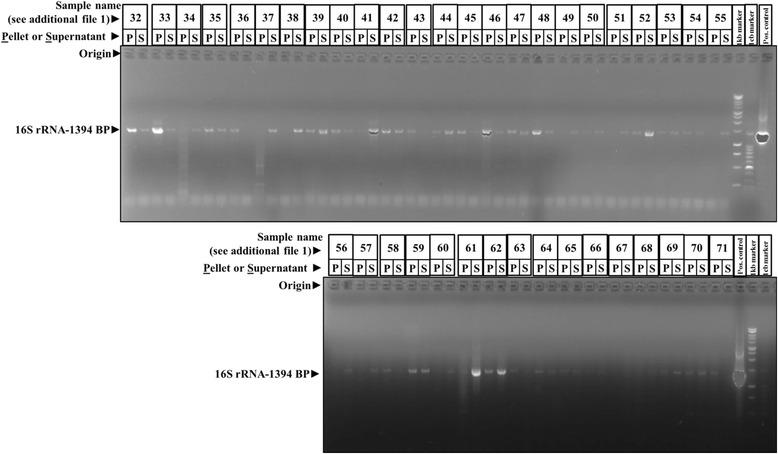
Fig. 1
Fig. 1
Abundance of bacterial DNA in pancreatic cyst fluid. A series of pancreatic cyst fluids (patient characteristics can be found by linking sample name to the patient information provided through additional Table 1) were exposed to bead beating and centrifugation followed by DNA extraction from both the pellet as well as the supernatant. Subsequently, the DNA was probed for the presence of sequence coding for bacterial 16S RNA through PCR. Reaction products were resolved by gel electrophoresis employing an agarose gel. The results show that bacterial DNA is commonly found in pancreatic cyst fluids
Fig. 2
Fig. 2
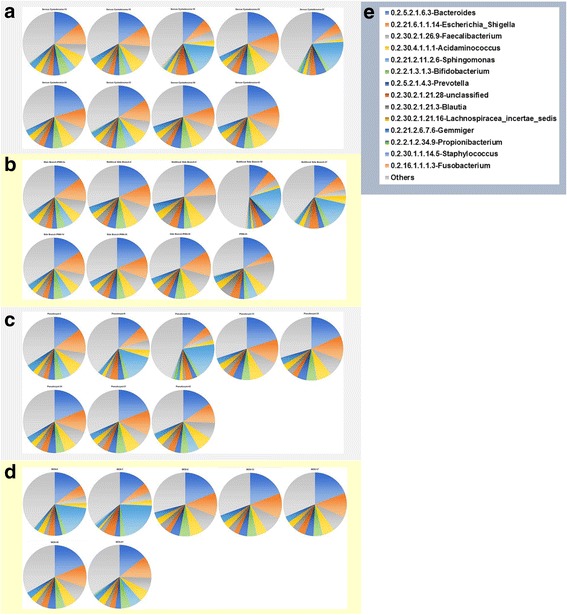
Taxonomic composition of microbiological genera of pancreatic cyst fluid. DNA isolated from 33 pancreatic cyst fluid samples (selected based on strong PCR signals for 16S) was characterized by 16S rRNA NGS for its microbiological composition. The numbers indicated correspond to the sample names in Additional file 1. a Serous cystadenoma aspiration fluid microbiome. b Intraductal papillary mucinous neoplasm aspiration fluid microbiome. c Pseudocyst aspiration fluid microbiome. d Mucinous cystic neoplasm aspiration fluid microbiome. e Legend of the pie chart
Fig. 3
Fig. 3
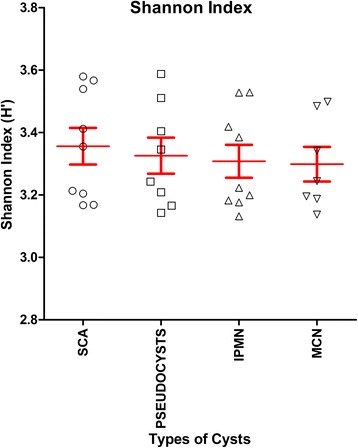
Shannon index for ecological microbial diversity in pancreatic cyst fluids. Employing the NGS results from PCF-derived DNA, the Shannon index for ecological diversity was calculated. There are no significant differences in the ecological diversity of the microbiome in the different types of PCF
Fig. 4
Fig. 4
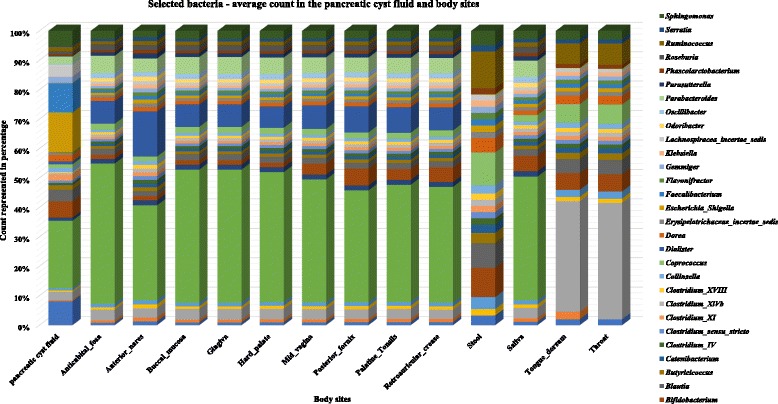
Pancreatic cyst microbiome is unique among other human body microbiomes. Publicly accessible databases were mined for composition of microbiomes at different human body sites and compared to those observed in PCF. It appears that there are 27 to 314 bacterial genotypes differently present in the PCF when compared to the selected body sites when analyzed via pairwise binomial test with high abundance PCF bacteria(P < 0.0001) and ANOVA test, respectively
Fig. 5
Fig. 5
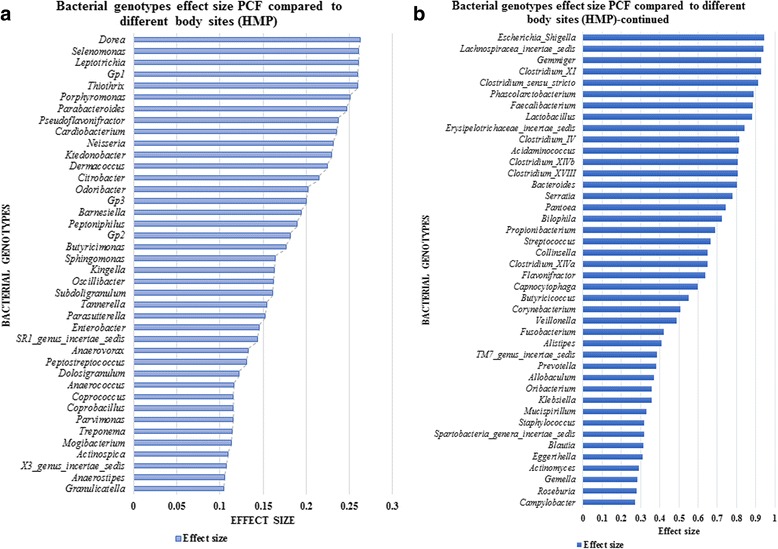
a, b Contribution of individual bacterial genera to the unique aspect of PCF fluid. For 82 different genera the relative in abundance in PCF was compared to that 13 other body sites and the relative contribution to the PCF-specific nature of the microbiome spectrum was calculated. In additional files information on a further 232 genera can be found. The results show that PCF contains a microbiome that is characterized by an overall uniqueness that cannot be attributed to a single genus
Fig. 6
Fig. 6
Bacterial commensals of PCF and selected different body sites comparison (HMP database) shows the difference in the distribution uniqueness in the PCF than the body sites. One hundred thirty-six bacterial genus of high and low abundance with P < 0.0001, and their difference of mean is plotted with 99% confidence interval, obtained via the Welch’s t test comparison between the groups

References

    1. Matthaei H, Schulick RD, Hruban RH, Maitra A. Cystic precursors to invasive pancreatic cancer. Nat Rev Gastroenterol Hepatol. 2011;8(3):141–150. doi: 10.1038/nrgastro.2011.2. - DOI - PMC - PubMed
    1. Wu BU, Sampath K, Berberian CE, Kwok KK, Lim BS, Kao KT, Giap AQ, Kosco AE, Akmal YM, Difronzo AL, et al. Prediction of malignancy in cystic neoplasms of the pancreas: a population-based cohort study. Am J Gastroenterol. 2014;109(1):121–129. doi: 10.1038/ajg.2013.334. - DOI - PubMed
    1. Grutzmann R, Niedergethmann M, Pilarsky C, Kloppel G, Saeger HD. Intraductal papillary mucinous tumors of the pancreas: biology, diagnosis, and treatment. Oncologist. 2010;15(12):1294–1309. doi: 10.1634/theoncologist.2010-0151. - DOI - PMC - PubMed
    1. Farrell J, Zhang L, Zhou H, et al. Variations of oral microbiota are associated with pancreatic diseases including pancreatic cancer. Gut. 2012;61:582–588. doi: 10.1136/gutjnl-2011-300784. - DOI - PMC - PubMed
    1. Farrell JJ, Fernandez-del Castillo C. Pancreatic cystic neoplasms: management and unanswered questions. Gastroenterology. 2013;144(6):1303–1315. doi: 10.1053/j.gastro.2013.01.073. - DOI - PubMed

MeSH terms

LinkOut - more resources