Review
. 2018 Mar;26(3):186-190.
doi: 10.1016/j.tim.2017.10.004. Epub 2017 Nov 6.

A Tale of Two Viruses: Does Heterologous Flavivirus Immunity Enhance Zika Disease?

Affiliations
Review

A Tale of Two Viruses: Does Heterologous Flavivirus Immunity Enhance Zika Disease?

Carlos A Sariol et al. Trends Microbiol. 2018 Mar.

Abstract

The rise of Zika virus (ZIKV) and its unusual clinical manifestations provided ground for speculative debate. The clinical severity of secondary dengue virus (DENV) infections is associated with antibody-dependent enhancement (ADE), and it was recently suggested that previous exposure to DENV may worsen ZIKV clinical outcomes. In this Opinion article we analyze the relationship among different flaviviruses and ADE. We discuss new evidence obtained in non-human primates and human cohorts demonstrating that there is no correlation to ADE when ZIKV infection occurs in the presence of pre-existing DENV immunity. We propose a redefinition of ADE in the context of complex immunological flavivirus interactions to provide a more objective perspective when translating in vitro or in vivo observations into the clinical setting.

Keywords: ADE; Zika; dengue; flavivirus.


Figures

Figure 1
Figure 1
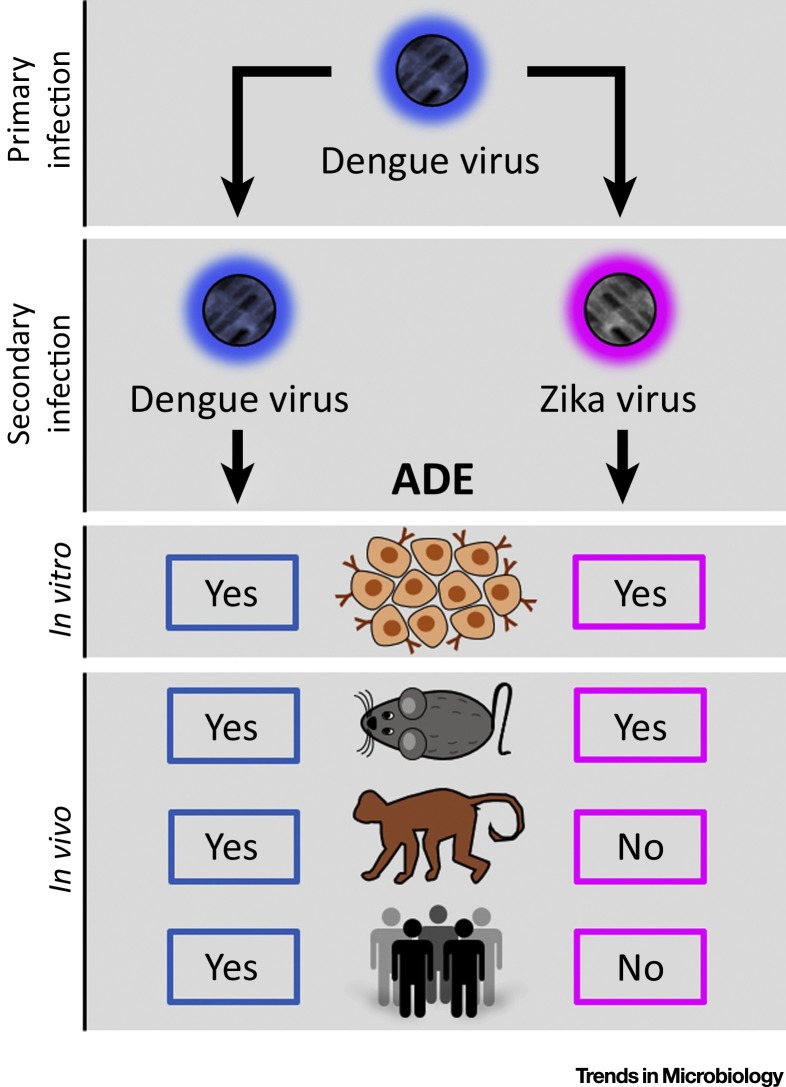
Antibody-Dependent Enhancement (ADE) of Dengue and Zika Virus. ADE during a secondary heterologous Dengue virus infection has been documented in vitro, in mice, in non-human primates, and in humans playing a key role in the worsening of the clinical presentations. In contrast, ADE of Zika virus by pre-existing immunity to Dengue virus can be induced in vitro, and in immunodeficient mice. However, there is no evidence to support ADE occurring in non-human primates or in humans.

References

    1. Aliota M.T. Zika in the Americas, year 2: what have we learned? What gaps remain? A report from the Global Virus Network. Antiviral Res. 2017;144:223–246. - PMC - PubMed
    1. Campos G.C. Zika virus infection, a new public health challenge. Braz. J. Infect. Dis. 2016;20:227–228. - PMC - PubMed
    1. Brasil P. Zika virus infection in pregnant women in Rio de Janeiro. N. Engl. J. Med. 2016;375:2321–2334. - PMC - PubMed
    1. Cao-Lormeau V.M. Guillain–Barré syndrome outbreak associated with Zika virus infection in French Polynesia: a case-control study. Lancet. 2016 doi: 10.1016/S0140-6736(16)00562-6. Published online February 29, 2016. - DOI - PMC - PubMed
    1. Roze B. Zika virus detection in cerebrospinal fluid from two patients with encephalopathy, Martinique, February 2016. Euro. Surveill. 2016 doi: 10.2807/1560-7917.ES.2016.21.16.30205. Published online April 21, 2016. - DOI - PubMed

Publication types