


Eligibility for PCSK9 Inhibitors According to American College of Cardiology (ACC) and European Society of Cardiology/European Atherosclerosis Society (ESC/EAS) Guidelines After Acute Coronary Syndromes
- PMID: 29122809
- PMCID: PMC5721754
- DOI: 10.1161/JAHA.117.006537
Eligibility for PCSK9 Inhibitors According to American College of Cardiology (ACC) and European Society of Cardiology/European Atherosclerosis Society (ESC/EAS) Guidelines After Acute Coronary Syndromes
Abstract
Background: The American College of Cardiology (ACC) and European Society of Cardiology/European Atherosclerosis Society (ESC/EAS) have recently published recommendations for the use of proprotein convertase subtilisin/kexin-9 (PCSK9) inhibitors in situations of very high risk. We aim to assess in the real world the suitability of PCSK9 inhibitors for acute coronary syndromes.
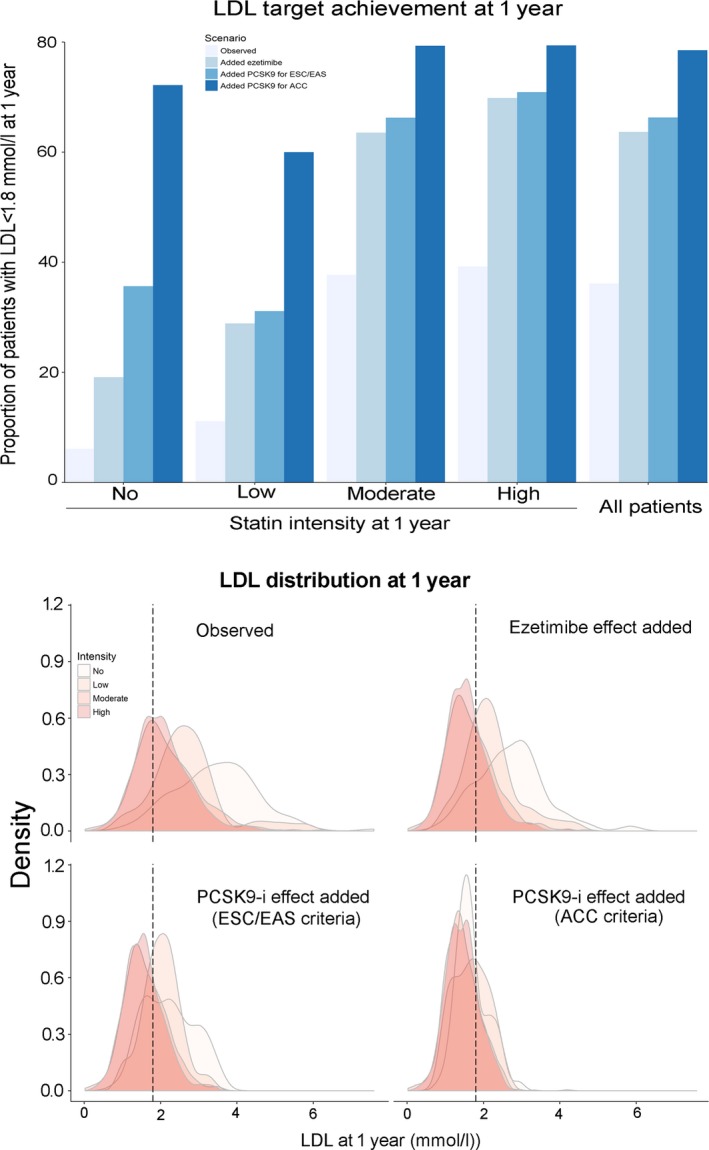
Methods and results: We analyzed a prospective Swiss cohort of 2023 patients hospitalized for acute coronary syndromes between 2009 and 2014 with available data for low-density lipoprotein cholesterol and lipid-lowering therapy at 1 year. Clinical familial hypercholesterolemia was defined using the Dutch Lipid Clinic Network algorithm as unlikely, possible, probable, or definite. We simulated a fixed relative reduction of 24% in low-density lipoprotein cholesterol levels at 1 year in all patients not treated with ezetimibe, irrespective of the low-density lipoprotein cholesterol levels and statin regimen. At 1 year, 94.3% of patients were treated with statin, 5.8% with ezetimibe, and 35.8% of patients had on-target low-density lipoprotein cholesterol levels (<1.8 mmol/L); 25.6% met criteria for possible or probable/definite familial hypercholesterolemia. After a simulation of the lipid-lowering effect of ezetimibe, the proportion of patients who would be eligible for PCSK9 inhibitors at 1 year was 13.4% using American College of Cardiology criteria and 2.7% using European Society of Cardiology/European Atherosclerosis Society criteria. Patients with possible or probable/definite familial hypercholesterolemia were more eligible for PCSK9 inhibitors compared with their non-familial hypercholesterolemia counterparts: 27.6% versus 8.8% according to American College of Cardiology criteria and 6.6% versus 1.8% according to European Society of Cardiology/European Atherosclerosis Society criteria (P<0.001).
Conclusions: Recommendations made by the American College of Cardiology guidelines would lead to 5-fold higher eligibility rates for PCSK9 inhibitors compared to the European Society of Cardiology/European Atherosclerosis Society consensus statement in acute coronary syndrome patients.
Keywords: PCSK9; lipids; secondary prevention.
© 2017 The Authors. Published on behalf of the American Heart Association, Inc., by Wiley.
Figures


References
-
- Jernberg T, Hasvold P, Henriksson M, Hjelm H, Thuresson M, Janzon M. Cardiovascular risk in post‐myocardial infarction patients: Nationwide real world data demonstrate the importance of a long‐term perspective. Eur Heart J. 2015;36:1163–1170. - PubMed
-
- Cannon CP, Blazing MA, Giugliano RP, McCagg A, White JA, Theroux P, Darius H, Lewis BS, Ophuis TO, Jukema JW, De Ferrari GM, Ruzyllo W, De Lucca P, Im K, Bohula EA, Reist C, Wiviott SD, Tershakovec AM, Musliner TA, Braunwald E, Califf RM. Ezetimibe added to statin therapy after acute coronary syndromes. N Engl J Med. 2015;372:2387–2397. - PubMed
-
- Roffi M, Patrono C, Collet JP, Mueller C, Valgimigli M, Andreotti F, Bax JJ, Borger MA, Brotons C, Chew DP, Gencer B, Hasenfuss G, Kjeldsen K, Lancellotti P, Landmesser U, Mehilli J, Mukherjee D, Storey RF, Windecker S, Baumgartner H, Gaemperli O, Achenbach S, Agewall S, Badimon L, Baigent C, Bueno H, Bugiardini R, Carerj S, Casselman F, Cuisset T, Erol C, Fitzsimons D, Halle M, Hamm C, Hildick‐Smith D, Huber K, Iliodromitis E, James S, Lewis BS, Lip GY, Piepoli MF, Richter D, Rosemann T, Sechtem U, Steg PG, Vrints C, Luis Zamorano J. 2015 ESC guidelines for the management of acute coronary syndromes in patients presenting without persistent ST‐segment elevation: task force for the management of acute coronary syndromes in patients presenting without persistent ST‐segment elevation of the European Society of Cardiology (ESC). Eur Heart J. 2016;37:267–315. - PubMed
-
- Catapano AL, Graham I, De Backer G, Wiklund O, Chapman MJ, Drexel H, Hoes AW, Jennings CS, Landmesser U, Pedersen TR, Reiner Z, Riccardi G, Taskinen MR, Tokgozoglu L, Verschuren WM, Vlachopoulos C, Wood DA, Zamorano JL. 2016 ESC/EAS Guidelines for the Management of Dyslipidaemias: the task force for the management of dyslipidaemias of the European Society of Cardiology (ESC) and European Atherosclerosis Society (EAS) Developed with the special contribution of the European Assocciation for Cardiovascular Prevention & Rehabilitation (EACPR). Atherosclerosis. 2016;253:281–344. - PubMed
Publication types
MeSH terms
Substances
LinkOut - more resources
Full Text Sources
Other Literature Sources
Medical
Miscellaneous
