


Prevalence and correlates of health information-seeking among Hispanic and non-Hispanic childhood cancer survivors
- PMID: 29124416
- PMCID: PMC5823727
- DOI: 10.1007/s00520-017-3956-5
Prevalence and correlates of health information-seeking among Hispanic and non-Hispanic childhood cancer survivors
Abstract
Purpose: Childhood cancer survivors (CCS) report high unmet information needs. This study examined the prevalence of cancer-related information-seeking among CCS and investigated associations between information-seeking behavior and positive health outcomes such as follow-up care.
Methods: Participants (n = 193) were young adult CCS diagnosed with cancer in Los Angeles County, 54% of Hispanic ethnicity, with a mean age of 19.87, in remission, and at least 2 years from completion of treatment. CCS were asked where they accessed health information related to their cancer with response options categorized into four information domains: hospital resources, social media, other survivors, and family members. Multivariable logistic regression was used to assess variables associated with each information domain, including sociodemographics, post-traumatic growth (i.e., reporting positive changes since cancer diagnosis), health care engagement, level of education, and health insurance status.
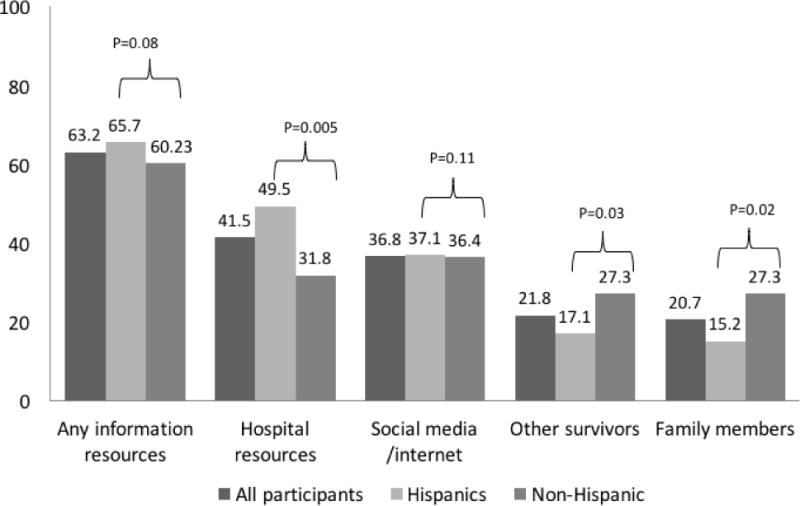
Results: Hospital resources were the most commonly accessed information domain (65.3%), and CCS of Hispanic ethnicity (vs. non-Hispanic) were more likely to access this source. Seeking information from other cancer survivors was positively associated with follow-up care and post-traumatic growth. Hispanic CCS were marginally less likely to seek information from other survivors and family than non-Hispanics.
Conclusions: While CCS obtain information from a variety of sources, hospital resources are an important site for access, particularly for individuals of Hispanic ethnicity. Information sharing between survivors may promote positive health care engagement; however, Hispanic CCS may be less likely to utilize this resource and may face barriers in information sharing with other cancer survivors.
Keywords: Adolescent; Cancer; Child; Health information-seeking; Hispanic ethnicity; Survivorship; Young adult.
Conflict of interest statement
Conflict of Interest: Kimberly A. Miller declares that she has no conflict of interest. Cynthia N. Ramirez declares that she has no conflict of interest. Katherine Y. Wojcik declares that she has no conflict of interest. Anamara Ritt-Olson declares that she has no conflict of interest. Lourdes Baezconde-Garbanati declares that she has no conflict of interest. Stefanie M. Thomas declares that she has no conflict of interest. David R. Freyer declares that he has no conflict of interest. Ann S. Hamilton declares that she has no conflict of interest. Joel E. Milam declares that he has no conflict of interest.
Figures
References
MeSH terms
Grants and funding
LinkOut - more resources
Full Text Sources
Other Literature Sources
Medical
