


Proximity labeling: spatially resolved proteomic mapping for neurobiology
- PMID: 29125959
- PMCID: PMC6726430
- DOI: 10.1016/j.conb.2017.10.015
Proximity labeling: spatially resolved proteomic mapping for neurobiology
Abstract
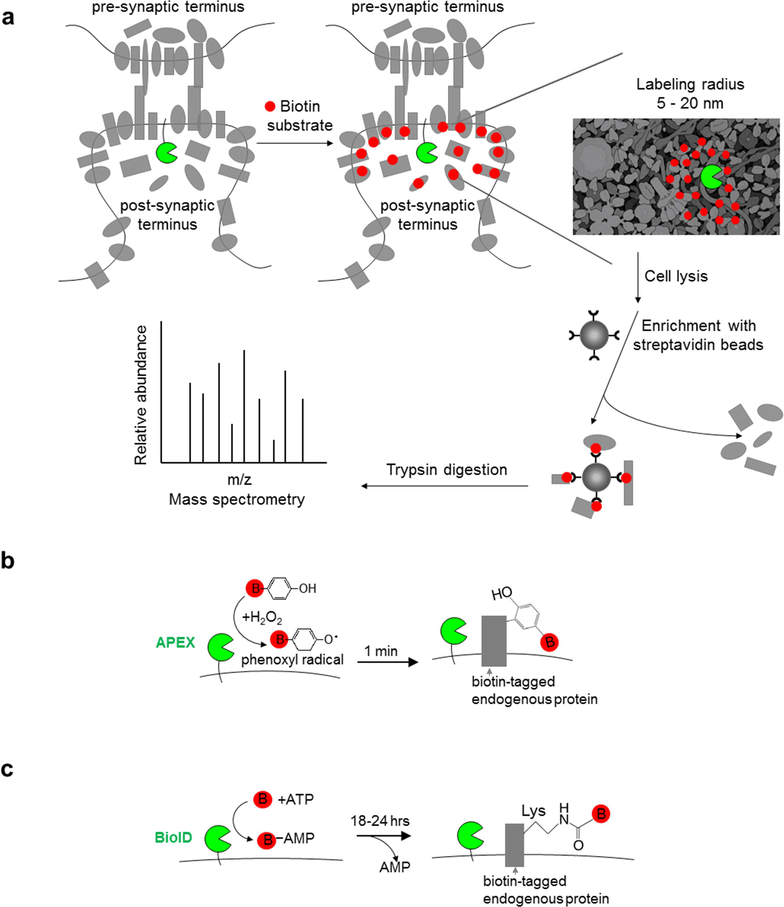
Understanding signaling pathways in neuroscience requires high-resolution maps of the underlying protein networks. Proximity-dependent biotinylation with engineered enzymes, in combination with mass spectrometry-based quantitative proteomics, has emerged as a powerful method to dissect molecular interactions and the localizations of endogenous proteins. Recent applications to neuroscience have provided insights into the composition of sub-synaptic structures, including the synaptic cleft and inhibitory post-synaptic density. Here we compare the different enzymes and small-molecule probes for proximity labeling in the context of cultured neurons and tissue, review existing studies, and provide technical suggestions for the in vivo application of proximity labeling.
Copyright © 2017 Elsevier Ltd. All rights reserved.
Conflict of interest statement
Conflict of interest statement
A.Y.T. is an author of a patent application on the peroxidase technology.
Figures
References
-
-
Rhee H, Zou P, Udeshi ND, Martell JD, Mootha VK, Carr SA, Ting AY: Proteomic mapping of mitochondria in living cells via spatially restricted enzymatic tagging. Science 2013, 339:1328–31.
•• This paper establishes the use of an engineered ascorbate peroxidase, APEX, and its biotin-phenol substrate for proteomic mapping of membrane-bound organelles. APEX is targeted to the mitochondria in HEK 293T cells to identify 495 proteins in the mitochondria matrix with high specificity (>94%) and high coverage (>85%).
-
-
-
Roux KJ, Kim DI, Raida M, Burke B: A promiscuous biotin ligase fusion protein identifies proximal and interacting proteins in mammalian cells. J. Cell Biol 2012, 196:801–810.
•• This paper utilizes the promiscuous biotin ligase mutant for proximity-dependent labeling and developed the BioID method. The authors apply BioID to study the nuclear lamina by fusing the biotin ligase mutant to the protein lamin-A. A novel nuclear lamina-associated protein, SLAP75, is discovered and validated.
-
-
-
Hung V, Zou P, Rhee HW, Udeshi ND, Cracan V, Svinkina T, Carr SA, Mootha VK, Ting AY: Proteomic Mapping of the Human Mitochondrial Intermembrane Space in Live Cells via Ratiometric APEX Tagging. Mol. Cell 2014, 55:332–341.
• The paper describes a ratiometric approach based on quantitative proteomics to reduce background and achieve nanometer resolution for APEX labeling.
-
Publication types
MeSH terms
Substances
Grants and funding
LinkOut - more resources
Full Text Sources
Other Literature Sources
