. 2018 Mar 8;39(3):407-417.
doi: 10.1093/carcin/bgx122.

Identification of cancer biomarkers of prognostic value using specific gene regulatory networks (GRN): a novel role of RAD51AP1 for ovarian and lung cancers

Affiliations

Identification of cancer biomarkers of prognostic value using specific gene regulatory networks (GRN): a novel role of RAD51AP1 for ovarian and lung cancers

Dimple Chudasama et al. Carcinogenesis. .

Abstract

To date, microarray analyses have led to the discovery of numerous individual 'molecular signatures' associated with specific cancers. However, there are serious limitations for the adoption of these multi-gene signatures in the clinical environment for diagnostic or prognostic testing as studies with more power need to be carried out. This may involve larger richer cohorts and more advanced analyses. In this study, we conduct analyses-based on gene regulatory network-to reveal distinct and common biomarkers across cancer types. Using microarray data of triple-negative and medullary breast, ovarian and lung cancers applied to a combination of glasso and Bayesian networks (BNs), we derived a unique network-containing genes that are uniquely involved: small proline-rich protein 1A (SPRR1A), follistatin like 1 (FSTL1), collagen type XII alpha 1 (COL12A1) and RAD51 associated protein 1 (RAD51AP1). RAD51AP1 and FSTL1 are significantly overexpressed in ovarian cancer patients but only RAD51AP1 is upregulated in lung cancer patients compared with healthy controls. The upregulation of RAD51AP1 was mirrored in the bloods of both ovarian and lung cancer patients, and Kaplan-Meier (KM) plots predicted poorer overall survival (OS) in patients with high expression of RAD51AP1. Suppression of RAD51AP1 by RNA interference reduced cell proliferation in vitro in ovarian (SKOV3) and lung (A549) cancer cells. This effect appears to be modulated by a decrease in the expression of mTOR-related genes and pro-metastatic candidate genes. Our data describe how an initial in silico approach can generate novel biomarkers that could potentially support current clinical practice and improve long-term outcomes.


Figures
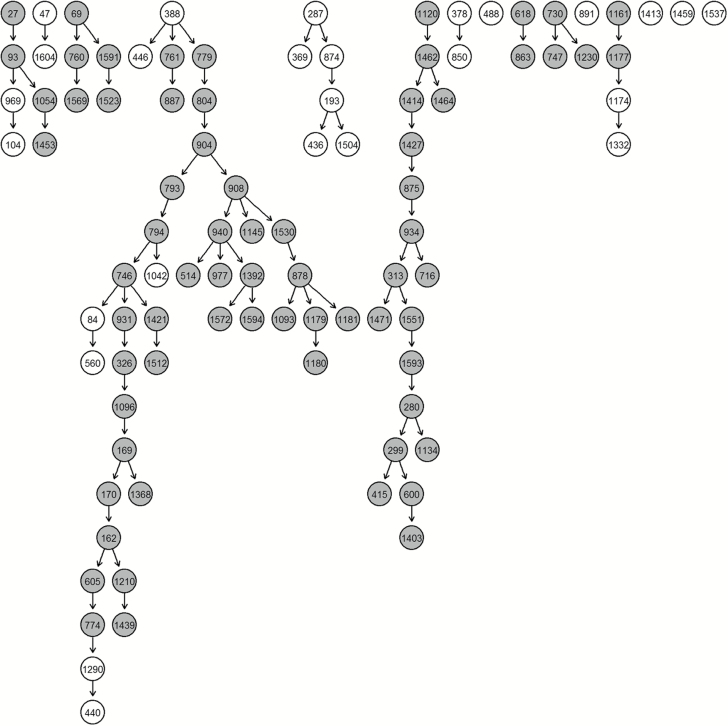
Figure 1.
Figure 1.
Unique network for ovarian cancer. Grey nodes indicate highly predictive (average correct-prediction level higher or equal to 0.6) genes.
Figure 2.
Figure 2.
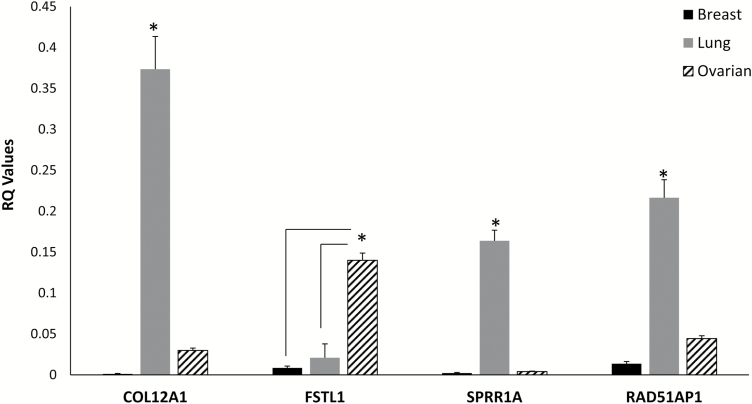
Gene expression of SPRR1A, FSTL1, COL12A1 and RAD51AP1 in breast (Br), lung and ovarian cancer (OC) patients. *P < 0.05.
Figure 3.
Figure 3.
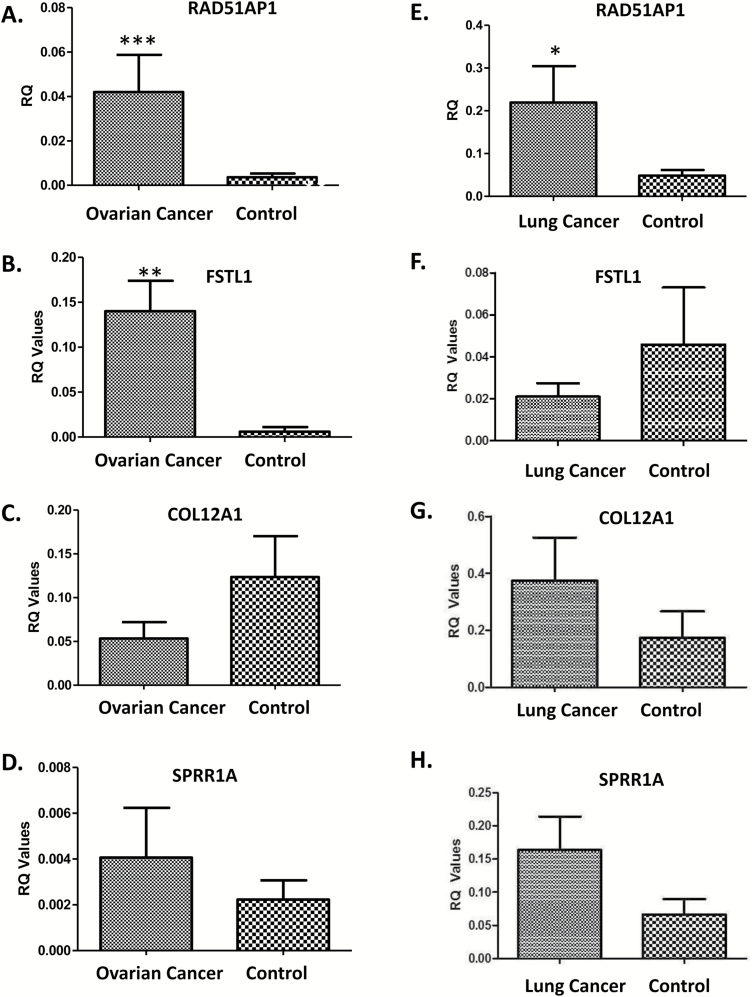
Expression of RAD51AP1 (panels A and E), FSTL1 (panels B and F), COL12A1 (panels C and G), SPRR1A (panels D and H) in ovarian (A-D) and lung (E-H) cancers compared with healthy controls. *P < 0.05, **P < 0.01 and ***P < 0.001.
Figure 4.
Figure 4.
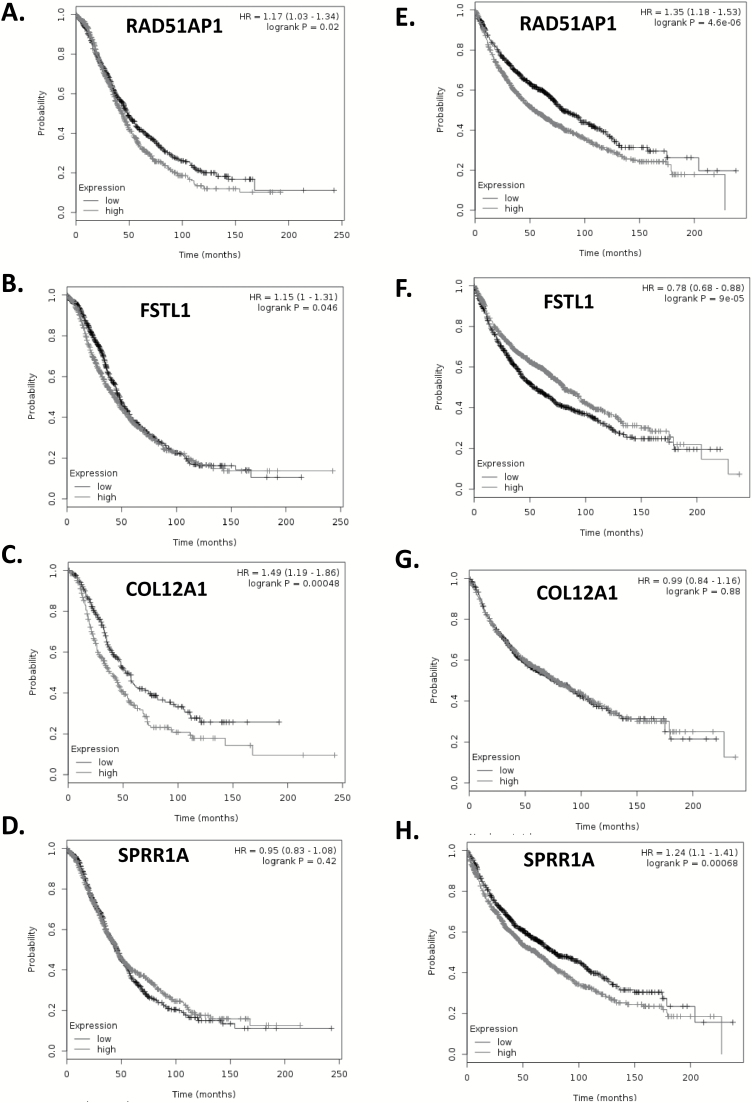
KM plotter predicted poorer OS of ovarian cancer patients patients with high expression of RAD51AP1 (A), FSTL1 (B) and COL12A1 (C) but not SPRR1A (D). When KM plots were applied for lung cancer patients, poorer OS was predicted with high expression of RAD51AP1 (E), and SPRR1A (H), and with low expression of FSTL1 (F), whereas COL12A1 was not a predictor (G).
Figure 5.
Figure 5.
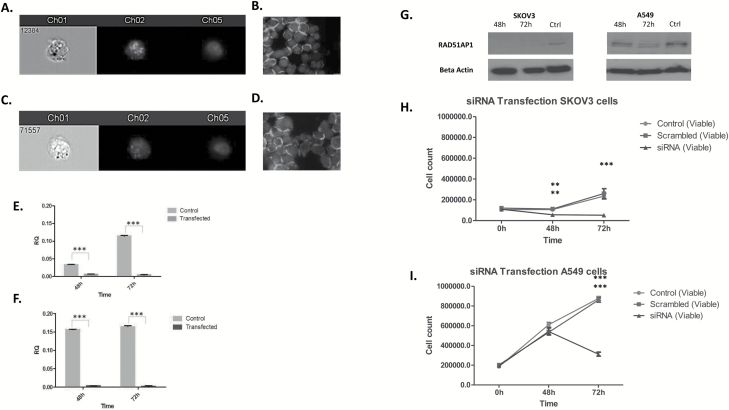
RAD51AP1 was aberrantly expressed—primarily in the nucleus—in both SKOV3 (A, B) and A549 cells (C, D), as it was evident by ImageStream (A, C) and immunofluorescent analyses (B, D). Using siRNA for RAD51AP1, a substantial and significant downregulation of the gene was evident at both 48 and 72 h post transfection for both SKOV3 (E) and A549 (F) cells compared with scrambled control. The downregulation was mirrored at protein level with maximal downregulation at 72 h post transfection (G). Silencing of RAD51AP1 resulted in significant inhibition of cell growth at 48 and 72 h for SKOV3 cells compared with control untransfected and scrambled siRNA cells (H), whereas in A549 cells a significant decrease in cell proliferation was also evident only at 72 h (I). **P < 0.01, ***P < 0.001. Magnification ×40.
Figure 6.
Figure 6.
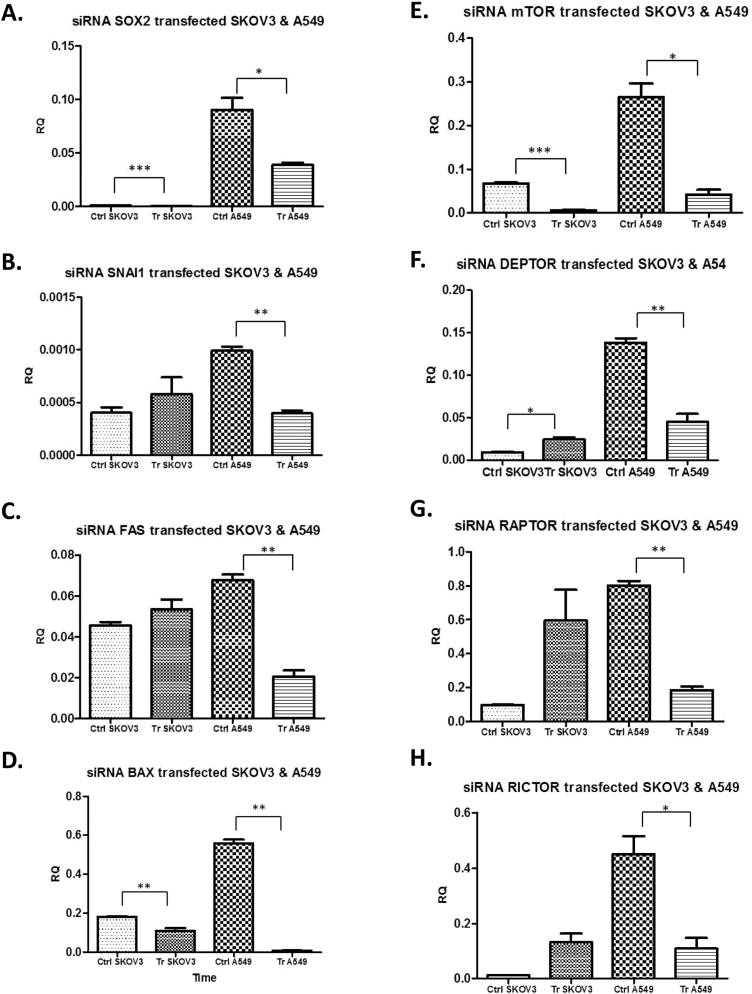
Treatment of SKOV3 and A549 cells with siRNA for RAD51AP1 for 72 h reduced significantly the pro-metastatic gene Sox2 compared with scrambled/non-targeting siRNA controls (A), whereas siRNA did not alter the gene expression of SNAI1 in SKOV3 cells but was significantly reduced in A549 cells (B). Similarly, Fas was only downregulated in A549 but not SKOV3 cells following siRNA transfection (C). On the contrary, expression of Bax (D) and mTOR (E) was significantly decreased in both cell lines. DEPTOR was upregulated in SKOV3 and downregulated in A549 compared with untransfected controls (F), whereas the expression raptor and rictor remained unaltered in SKOV3 but downregulated in A549 cells (G-H). *P < 0.05, **P < 0.01, ***P <0.001.

References

    1. Heim D., et al. (2014)Cancer beyond organ and tissue specificity: next-generation-sequencing gene mutation data reveal complex genetic similarities across major cancers. Int. J. Cancer, 135, 2362–2369. - PubMed
    1. Koboldt D.C., et al. (2012)Comprehensive molecular portraits of human breast tumours. Nature, 490, 61–70. - PMC - PubMed
    1. Bell D., et al. (2011)Integrated genomic analyses of ovarian carcinoma. Nature, 474, 609–615. - PMC - PubMed
    1. Klein C.A. (2013)Selection and adaptation during metastatic cancer progression. Nature, 501, 365–372. - PubMed
    1. Bo V., et al. (2014)Discovering study-specific gene regulatory networks. PLoS One, 9, e106524. - PMC - PubMed

MeSH terms