


The functional role of ventral anterior cingulate cortex in social evaluation: disentangling valence from subjectively rewarding opportunities
- PMID: 29126210
- PMCID: PMC5755235
- DOI: 10.1093/scan/nsx132
The functional role of ventral anterior cingulate cortex in social evaluation: disentangling valence from subjectively rewarding opportunities
Abstract
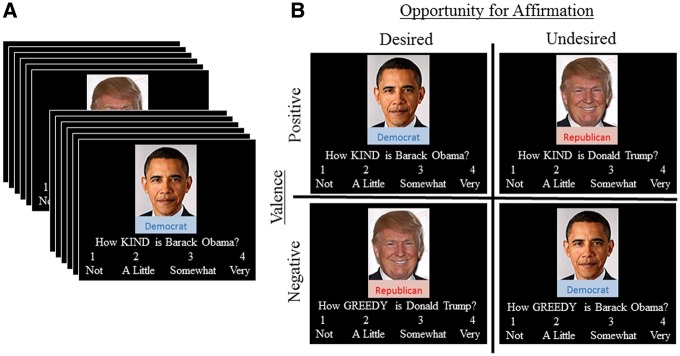
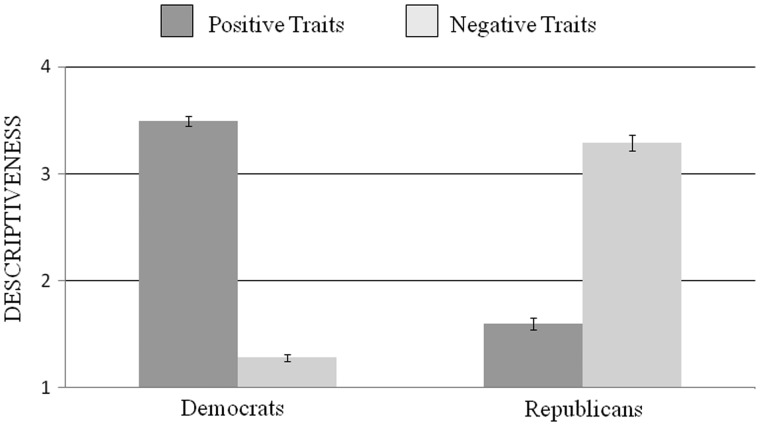
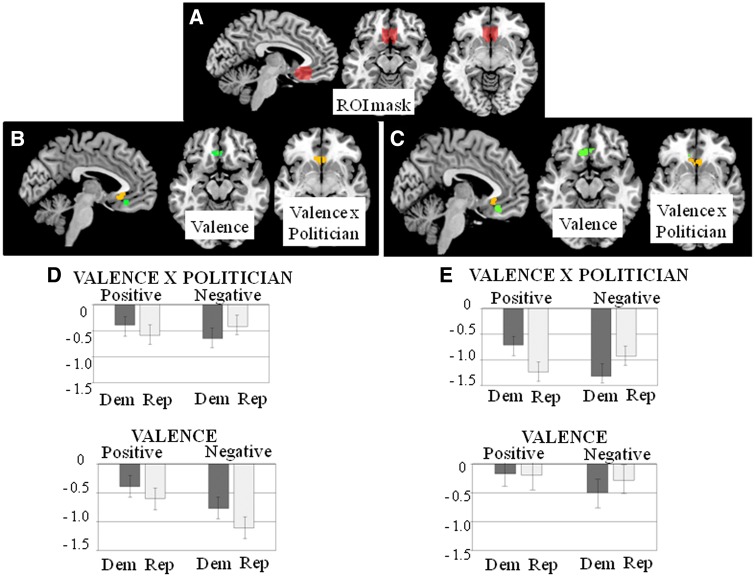
Despite robust associations between the ventral anterior cingulate cortex (vACC) and social evaluation, the role of vACC in social evaluation remains poorly understood. Two hypotheses have emerged from existing research: detection of positive valence and detection of opportunities for subjective reward. It has been difficult to understand whether one or both hypotheses are supported because previous research conflated positive valence with subjective reward. Therefore, the current functional magnetic resonance imaging study drew on a social evaluation paradigm that disentangled positive valence and subjective reward. Participants evaluated in-group and out-group politicians in a social evaluation paradigm that crossed trait valence with opportunity for subjectively rewarding affirmation (i.e. a chance to affirm positive traits about in-group politicians and affirm negative traits about out-group politicians). Participants rated in-group politicians more positively and out-group politicians more negatively. One subregion of vACC was modulated by positive valence and another relatively posterior region of vACC was modulated by opportunity for subjective reward (i.e. a politician × valence interaction). The current findings demonstrate the importance of incorporating vACC function into models of social cognition and provide new avenues for sharpening our understanding of the psychological significance of vACC function in social evaluation and related domains such as reward and affect.
Keywords: motivation; vACC; valence.
© The Author (2017). Published by Oxford University Press.
Figures
References
-
- Alicke M.D. (1985). Global self-evaluation as determined by the desirability and controllability of trait adjectives. Journal of Personality and Social Psychology, 49(6), 1621–30.http://dx.doi.org/10.1037/0022-3514.49.6.1621 - DOI
-
- Alicke M.D., Sedikides C. (2009). Self-enhancement and self-protection: what they are and what they do. European Review of Social Psychology, 20(1), 1–48.http://dx.doi.org/10.1080/10463280802613866 - DOI
-
- Amodio D.M. (2014). The neuroscience of prejudice and stereotyping. Nature Reviews. Neuroscience, 15(10), 670–82.http://dx.doi.org/10.1038/nrn3800 - DOI - PubMed
-
- Anderson N.H. (1968). Likableness ratings of 555 personality-trait words. Journal of Personality and Social Psychology, 9(3), 272..http://dx.doi.org/10.1037/h0025907 - DOI - PubMed
Publication types
MeSH terms
LinkOut - more resources
Full Text Sources
Other Literature Sources
