Review
. 2018 Feb:48:51-56.
doi: 10.1016/j.gde.2017.10.009. Epub 2017 Nov 8.

The role of A-to-I RNA editing in cancer development

Affiliations
Review

The role of A-to-I RNA editing in cancer development

Xiaoyan Xu et al. Curr Opin Genet Dev. 2018 Feb.

Abstract

Adenosine-to-inosine (A-to-I) RNA editing is the most common type of post-transcriptional nucleotide modification in humans, which is catalyzed in ADAR enzymes. Recent genomic studies have revealed thousands of altered RNA editing events in various cancer tissues, leading to diverse functional consequences. A critical role of individual A-to-I RNA editing events in cancer has been reported. Here, we review the current state of our knowledge on key A-to-I RNA editing events in coding and non-coding regions for their roles in cancer development and discuss their potential clinical utility. A better understanding of A-to-I RNA editing and its oncogenic mechanisms may facilitate the development of novel cancer therapeutic strategies.


Figures

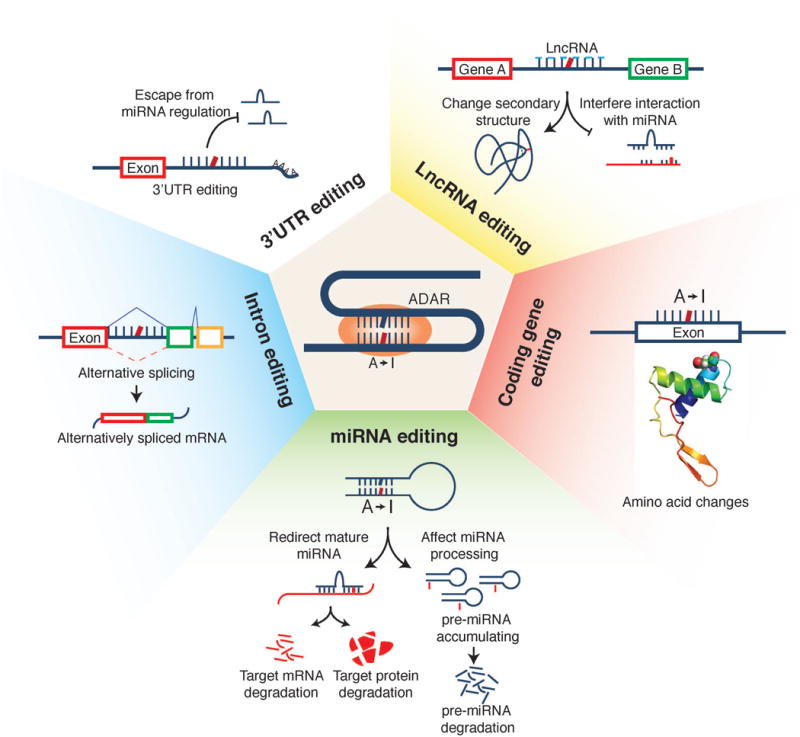
Figure 1
Figure 1
Schematic representation of functional consequences of A-to-I RNA editing.
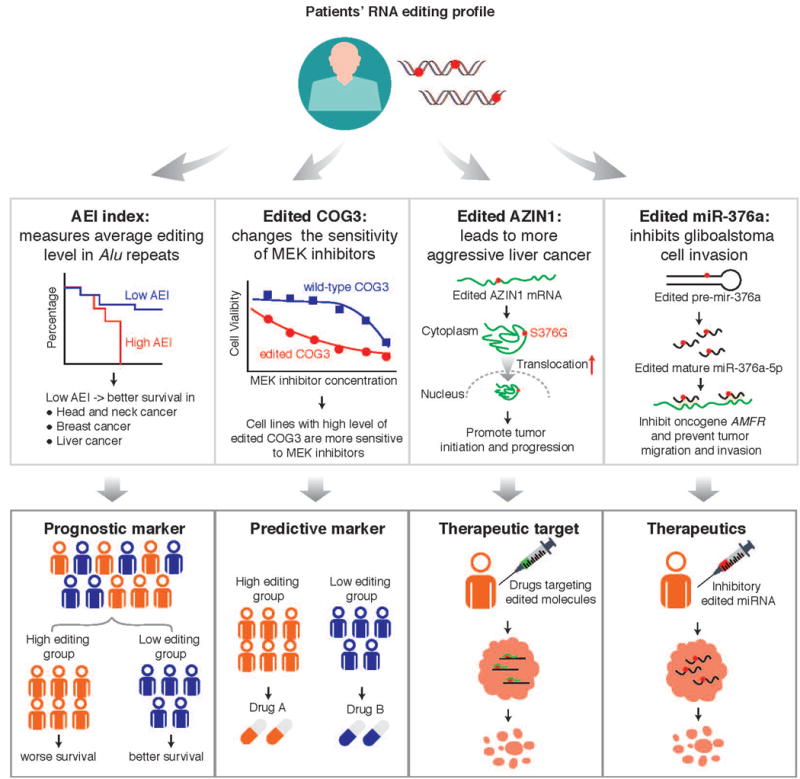
Figure 2
Figure 2. Potential clinical utility of A-to-I RNA editing in cancer
The Alu editing index (AEI) is used to show that the RNA editing profile correlates with patient survival time, suggesting the utility of prognostic markers; COG3 editing is used to show how RNA editing affects drug sensitivity, suggesting the utility of predictive markers; AZIN1 editing is an example of RNA editing driving tumor initiation and growth, thereby representing potential therapeutic targets; and edited miR-376a is used to show that edited miRNA can inhibit tor migration and invasion, thereby representing potential therapeutics.

References

    1. Nishikura K. Functions and regulation of RNA editing by ADAR deaminases. Annu Rev Biochem. 2010;79:321–349. - PMC - PubMed
    1. Riedmann EM, Schopoff S, Hartner JC, Jantsch MF. Specificity of ADAR-mediated RNA editing in newly identified targets. RNA. 2008;14:1110–1118. - PMC - PubMed
    1. Nishikura K. A-to-I editing of coding and non-coding RNAs by ADARs. Nat Rev Mol Cell Biol. 2016;17:83–96. - PMC - PubMed
    1. Song C, Sakurai M, Shiromoto Y, Nishikura K. Functions of the RNA Editing Enzyme ADAR1 and Their Relevance to Human Diseases. Genes (Basel) 2016;7 - PMC - PubMed
    1. Thomas JM, Beal PA. How do ADARs bind RNA? New protein-RNA structures illuminate substrate recognition by the RNA editing ADARs. Bioessays. 2017;39 - PMC - PubMed

Publication types

LinkOut - more resources