


Psoriasis and the risk of diabetes: A prospective population-based cohort study
- PMID: 29128465
- PMCID: PMC5768452
- DOI: 10.1016/j.jaad.2017.10.050
Psoriasis and the risk of diabetes: A prospective population-based cohort study
Abstract
Background: Data evaluating the impact of objectively measured psoriasis severity on type 2 diabetes mellitus (T2DM) risk are lacking.
Objective: To determine the risk for T2DM in patients with psoriasis compared with that in adults without psoriasis, stratified by categories of directly assessed body surface area (BSA) affected by psoriasis.
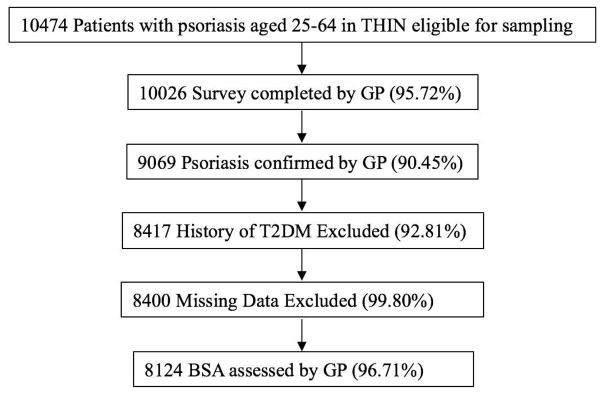
Methods: A prospective, population-based, cohort study from the United Kingdom in which 8124 adults with psoriasis and 76,599 adults without psoriasis were followed prospectively for approximately 4 years.
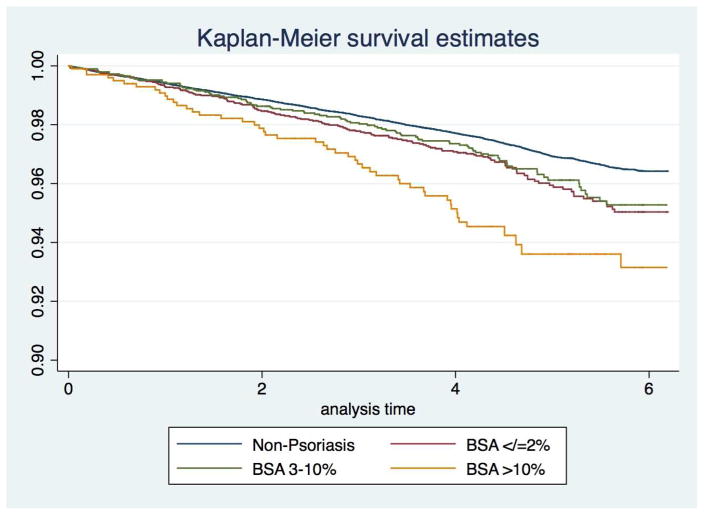
Results: There were 280 incident cases of diabetes in the psoriasis group (3.44%) and 1867 incident cases of diabetes in those without psoriasis (2.44%). After adjustment for age, sex and body mass index, the hazard ratios for development of incident diabetes were 1.21 (95% confidence interval [CI], 1.01-1.44), 1.01 (95% CI, 0.81-1.26), and 1.64 (95% CI, 1.23-2.18) in the groups with 2% or less of their BSA affected, 3% to 10% of their BSA affected, and 10% or more of their BSA affected compared with in the groups without psoriasis, respectively (P = .004 for trend). Worldwide, we estimate an additional 125,650 new diagnoses of T2DM per year in patients with psoriasis as compared with in those without psoriasis.
Limitations: Relatively short-term follow-up and exclusion of prevalence cases, which may have masked associations in patients with less extensive psoriasis.
Conclusion: Clinicians may measure BSA affected by psoriasis to target diabetes prevention efforts for patients with psoriasis.
Keywords: body surface area; cohort study; diabetes; epidemiology; psoriasis.
Copyright © 2017 American Academy of Dermatology, Inc. All rights reserved.
Conflict of interest statement
In the previous 12 months, Dr. Gelfand served as a consultant for BMS, Coherus (DSMB), Dermira, GSK, Janssen Biologics, Menlo Therapeutics, Novartis Corp, Regeneron, Dr Reddy’s labs, Sanofi and Pfizer Inc., receiving honoraria; and receives research grants (to the Trustees of the University of Pennsylvania) from Abbvie, Janssen, Novartis Corp, Regeneron, Sanofi, Celgene, and Pfizer Inc.; and received payment for continuing medical education work related to psoriasis that was supported indirectly by Lilly, Valeant, and Abbvie. Dr. Gelfand is a co-patent holder of resiquimod for treatment of cutaneous T cell lymphoma
Dr. Mehta is a full-time US government employee and has received research grants to NIH from Abbvie, Celgene, Novartis and Janssen.
We confirm that this manuscript has not been published elsewhere and is not under consideration by another journal. Supported in part by a grant (K24 AR064310) from NIH/NIAMS (JMG) and a medical dermatology fellowship from the National Psoriasis Foundation (MTW). This study does not require IRB review.
Figures
Comment in
-
Psoriasis steigert das Diabetesrisiko.MMW Fortschr Med. 2018 May;160(9):33. doi: 10.1007/s15006-018-0524-y. MMW Fortschr Med. 2018. PMID: 29754349 Review. German. No abstract available.
References
-
- Gelfand JM, Weinstein R, Porter SB, Neimann AL, Berlin JA, Margolis DJ. Prevalence and treatment of psoriasis in the United Kingdom: a population-based study. Arch Dermatol. 2005;141(12):1537–1541. - PubMed
-
- (WHO). WHO. Global Report on Psoriasis. Geneva: World Health Organization;
-
- Gelfand JM, Troxel AB, Lewis JD, et al. The risk of mortality in patients with psoriasis: results from a population-based study. Arch Dermatol. 2007;143(12):1493–1499. - PubMed
-
- Armstrong AW, Harskamp CT, Armstrong EJ. Psoriasis and the risk of diabetes mellitus: a systematic review and meta-analysis. JAMA Dermatol. 2013;149(1):84–91. - PubMed
Publication types
MeSH terms
Grants and funding
LinkOut - more resources
Full Text Sources
Other Literature Sources
Medical
