


Eosinophilic esophagitis (EoE) genetic susceptibility is mediated by synergistic interactions between EoE-specific and general atopic disease loci
- PMID: 29129581
- PMCID: PMC6016040
- DOI: 10.1016/j.jaci.2017.09.046
Eosinophilic esophagitis (EoE) genetic susceptibility is mediated by synergistic interactions between EoE-specific and general atopic disease loci
Abstract
Background: Eosinophilic esophagitis (EoE) is an esophageal inflammatory disease associated with atopic diseases. Thymic stromal lymphopoietin (TSLP) and calpain 14 (CAPN14) genetic variations contribute to EoE, but how this relates to atopy is unclear.
Objective: The purpose of this study was to explore the relationship between EoE, atopy, and genetic risk.
Methods: EoE-atopy enrichment was tested by using 700 patients with EoE and 801 community control subjects. Probing 372 single nucleotide polymorphisms (SNPs) in 63 atopy genes, we evaluated EoE associations using 412 nonatopic and 868 atopic disease control subjects. Interaction and stratified analyses of EoE-specific and atopy-related SNPs were performed.
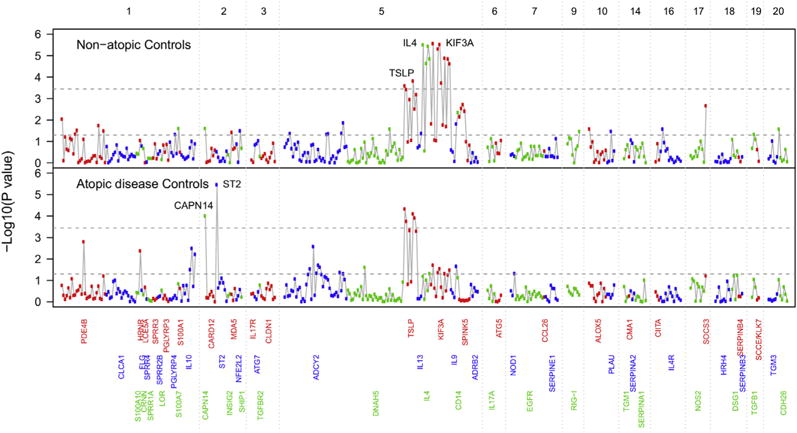
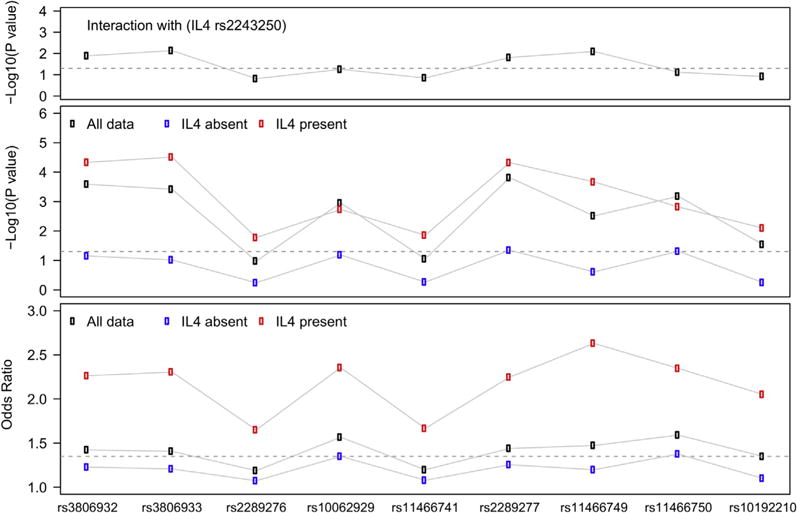
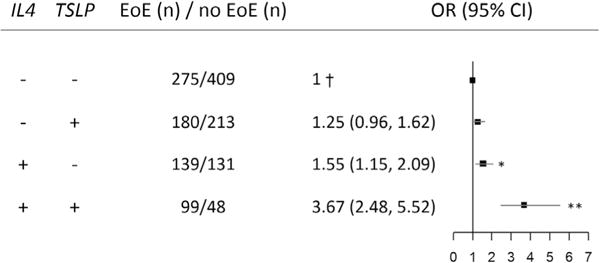
Results: Atopic disease was enriched in patients with EoE (P < .0001). Comparing patients with EoE and nonatopic control subjects, EoE associated strongly with IL-4/kinesin family member 3A (IL4/KIF3A) (P = 2.8 × 10⁻⁶; odds ratio [OR], 1.87), moderately with TSLP (P = 1.5 × 10⁻⁴; OR, 1.43), and nominally with CAPN14 (P = .029; OR, 1.35). Comparing patients with EoE with atopic disease control subjects, EoE associated strongly with ST2 (P = 3.5 × 10⁻⁶; OR, 1.77) and nominally with IL4/KIF3A (P = .019; OR, 1.25); TSLP's association persisted (P = 4.7 × 10⁻⁵; OR, 1.37), and CAPN14's association strengthened (P = .0001; OR, 1.71). Notably, there was gene-gene interaction between TSLP and IL4 SNPs (P = .0074). Children with risk alleles for both genes were at higher risk for EoE (P = 2.0 × 10⁻¹⁰; OR, 3.67).
Conclusions: EoE genetic susceptibility is mediated by EoE-specific and general atopic disease loci, which can have synergistic effects. These results might aid in identifying potential therapeutics and predicting EoE susceptibility.
Keywords: Genetic association; atopy; eosinophilic esophagitis.
Copyright © 2017. Published by Elsevier Inc.
Figures
References
-
- Collins MH. Histopathology of eosinophilic esophagitis. Dig Dis. 2014;32:68–73. - PubMed
-
- Spergel JM, Andrews T, Brown-Whitehorn TF, Beausoleil JL, Liacouras CA. Treatment of eosinophilic esophagitis with specific food elimination diet directed by a combination of skin prick and patch tests. Ann Allergy Asthma Immunol. 2005;95:336–43. - PubMed
Publication types
MeSH terms
Substances
Grants and funding
LinkOut - more resources
Full Text Sources
Other Literature Sources
Medical
