. 2019 Jan;33(1):96-102.
doi: 10.1016/j.jvoice.2017.10.002. Epub 2017 Nov 10.

Compensation Strategies in Voice Production With Glottal Insufficiency

Affiliations

Compensation Strategies in Voice Production With Glottal Insufficiency

Zhaoyan Zhang. J Voice. 2019 Jan.

Abstract

Objectives: This study evaluates potential compensation strategies under conditions of glottal insufficiency.

Methods: Using a numerical respiratory-laryngeal model of voice production, voice production under conditions of glottal insufficiency is investigated across a large range of voice conditions, and compared with normal voice production.

Results: This study shows that glottal insufficiency leads to increased noise production, reduced fundamental frequency range, and inability to produce very low-intensity voice. Glottal insufficiency also leads to significantly increased respiratory effort of phonation and difficulty in maintaining a normal breath group duration, which restricts high-intensity voice production and falsetto-like voice production. Although compensation strategies exist to alleviate these undesirable voice changes, they often require hyperfunctional laryngeal and respiratory muscle activities and thus are more likely to result in vocal fatigue.

Conclusions: The laryngeal and respiratory subsystems need to be considered as a whole to fully understand the effect of glottal insufficiency on voice production. Strategies that compensate for laryngeal weakness at the cost of compromising the normal function of the respiratory subsystem are undesirable and may impose additional constraints on voice production and the effectiveness of available compensation strategies.

Keywords: Aging; Compensation strategies; Glottal insufficiency; Respiratory-laryngeal coordination; Voice production.


Figures

Fig. 1
Fig. 1
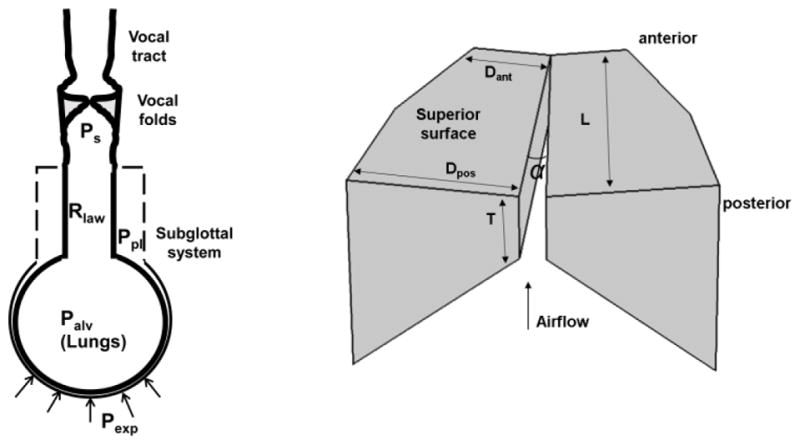
a) A sketch of the computational model used in this study; b) the three-dimensional vocal fold model and its primary geometric controls. L = 17 mm. More details of the geometry can be found in [4].
Fig. 2
Fig. 2
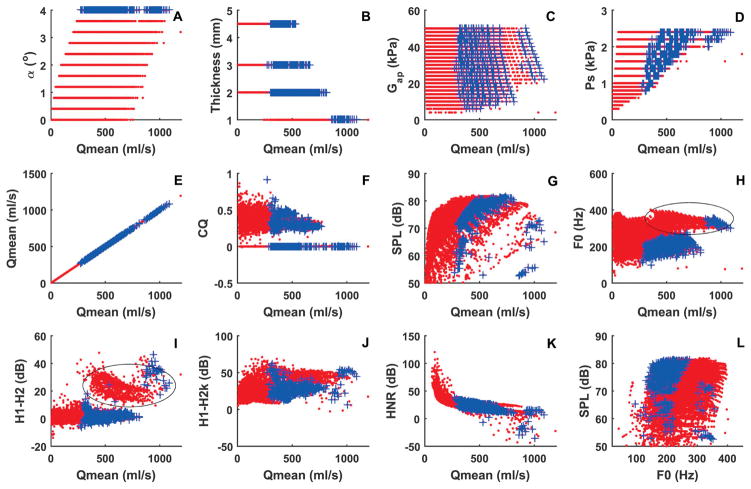
Comparison between normal voice production (dotted symbols in red) and voice production with glottal insufficiency (with a constant α = 4 °; symbols + in blue). Panels a-k show the four control parameters (initial glottal angle, vocal fold vertical thickness, shear modulus along the anterior-posterior direction, and subglottal pressure) and selected measures of voice production as a function of the mean glottal flow rate Qmean. Panel l shows the vocal intensity as a function of F0 or the vocal range profile. Inspiratory muscular pressure is −1.5 kPa, which provides an initial lung volume at 62% of the vital capacity. The ellipse in panels h and I indicates conditions with a falsetto-like phonation.
Fig. 3
Fig. 3
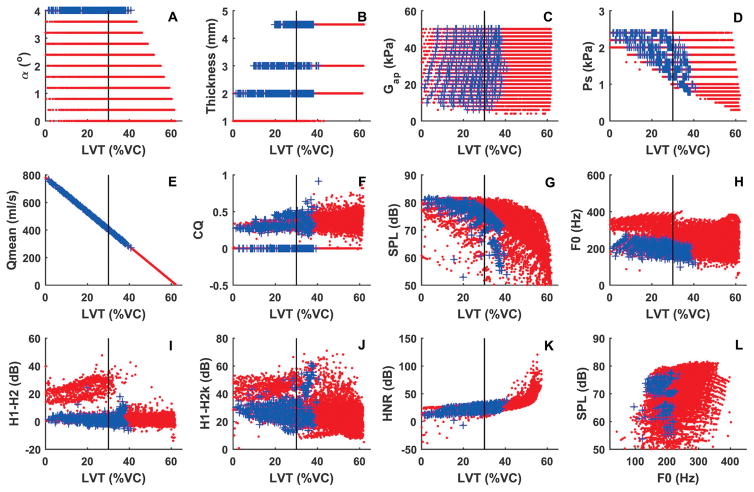
Respiratory requirement of normal voice production (dotted symbols in red) and voice production with glottal insufficiency (symbols + in blue). Panels a-k show the four control parameters (initial glottal angle, vocal fold vertical thickness, AP shear modulus, and subglottal pressure) and selected measures of voice production as a function of the termination lung volume (LVT) after 4-second phonation as a percentage of the lung vital capacity. Panel l shows the vocal intensity as a function of F0 for conditions with LVT>30%VC. The vertical lines in all panels indicate LVT=30%VC. Inspiratory muscular pressure is −1.5 kPa, which provides an initial lung volume at 62% of the vital capacity.
Fig. 4
Fig. 4
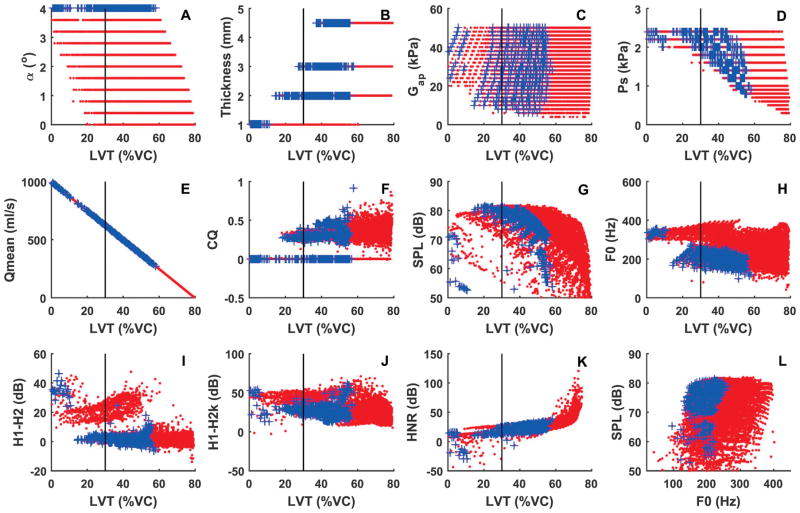
Comparison between normal voice production (dotted symbols in red) and voice production with glottal insufficiency (symbols + in blue) with deep inspiration (with an inspiratory muscular pressure of -2.4 kPa, which provides an initial lung volume at 80% of the vital capacity). Panels a-k show the four control parameters (initial glottal angle, vocal fold vertical thickness, AP shear modulus, and subglottal pressure) and selected measures of voice production as a function of the termination lung volume (LVT) after 4-second phonation as a percentage of the lung vital capacity. Panel l shows the vocal intensity as a function of F0 for conditions with LVT>30%VC. The vertical lines in all panels indicate LVT=30%VC.

References

    1. Rubin A, Sataloff R. Vocal fold paresis and paralysis. Otolaryngol Clin N Am. 2007;40:1109–1131. - PubMed
    1. Kendall K. Presbyphonia: a review. Current opinion in otolaryngology & head and neck surgery. 2007;15(3):137–140. - PubMed
    1. Awan SN. The aging female voice: Acoustic and respiratory data. Clinical Linguistics & Phonetics. 2006;20:171–180. - PubMed
    1. Zhang Z. Cause-effect relationship between vocal fold physiology and voice production in a three-dimensional phonation model. J Acoust Soc Am. 2016;139(4):1493–1507. - PMC - PubMed
    1. Zhang Z. Respiratory laryngeal coordination in airflow conservation and reduction of respiratory effort of phonation. J Voice. 2016;30(6):760.e7–760.e13. - PMC - PubMed