


Episodic Future Thinking: Mechanisms and Functions
- PMID: 29130061
- PMCID: PMC5675579
- DOI: 10.1016/j.cobeha.2017.06.002
Episodic Future Thinking: Mechanisms and Functions
Abstract
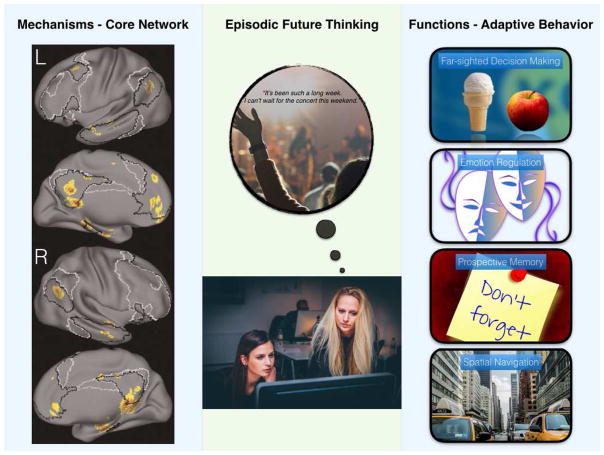
Episodic future thinking refers to the capacity to imagine or simulate experiences that might occur in one's personal future. Cognitive, neuropsychological, and neuroimaging research concerning episodic future thinking has accelerated during recent years. This article discusses research that has delineated cognitive and neural mechanisms that support episodic future thinking as well as the functions that episodic future thinking serves. Studies focused on mechanisms have identified a core brain network that underlies episodic future thinking and have begun to tease apart the relative contributions of particular regions in this network, and the specific cognitive processes that they support. Studies concerned with functions have identified several domains in which episodic future thinking produces performance benefits, including decision making, emotion regulation, prospective memory, and spatial navigation.
Conflict of interest statement
Conflict of interest statement None declared.
Figures
References
-
- Atance CM, O’Neill D. Episodic future thinking. Trends Cogn Sci. 2001;5:533–539. - PubMed
-
- Schacter DL, Addis DR, Buckner RL. Episodic simulation of future events: concepts, data, and applications. The Year in Cognitive Neuroscience. Ann NY Acad Sci. 2008;1124:39–60. - PubMed
-
- Szpunar KK. Episodic future thought: an emerging concept. Perspect Psychol Sci. 2010;5:142–162. - PubMed
-
- Abram M, Picard L, Navarro B, Piolino P. Mechanisms of remembering the past and imagining the future: new data from autobiographical memory tasks in a lifespan approach. Conscious Cogn. 2014;29:76–89. - PubMed
Grants and funding
LinkOut - more resources
Full Text Sources
Other Literature Sources