. 2017 Nov 22;139(46):16688-16695.
doi: 10.1021/jacs.7b08417. Epub 2017 Nov 13.

Thioamide Substitution Selectively Modulates Proteolysis and Receptor Activity of Therapeutic Peptide Hormones

Affiliations

Thioamide Substitution Selectively Modulates Proteolysis and Receptor Activity of Therapeutic Peptide Hormones

Xing Chen et al. J Am Chem Soc. .

Abstract

Peptide hormones are attractive as injectable therapeutics and imaging agents, but they often require extensive modification by mutagenesis and/or chemical synthesis to prevent rapid in vivo degradation. Alternatively, the single-atom, O-to-S modification of peptide backbone thioamidation has the potential to selectively perturb interactions with proteases while preserving interactions with other proteins, such as target receptors. Here, we use the validated diabetes therapeutic, glucagon-like peptide-1 (GLP-1), and the target of clinical investigation, gastric inhibitory polypeptide (GIP), as proof-of-principle peptides to demonstrate the value of thioamide substitution. In GLP-1 and GIP, a single thioamide near the scissile bond renders these peptides up to 750-fold more stable than the corresponding oxopeptides toward cleavage by dipeptidyl peptidase 4, the principal regulator of their in vivo stability. These stabilized analogues are nearly equipotent with their parent peptide in cyclic AMP activation assays, but the GLP-1 thiopeptides have much lower β-arrestin potency, making them novel agonists with altered signaling bias. Initial tests show that a thioamide GLP-1 analogue is biologically active in rats, with an in vivo potency for glycemic control surpassing that of native GLP-1. Taken together, these experiments demonstrate the potential for thioamides to modulate specific protein interactions to increase proteolytic stability or tune activation of different signaling pathways.


Figures
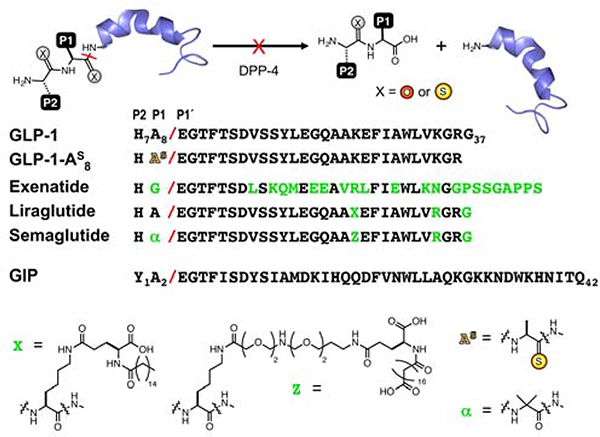
Figure 1.
Figure 1.
Thioamides Prevent Peptide Inactivation by Proteolysis. Native peptides are inactivated by DPP-4 cleavage at the scissile bond, indicated with a red slash (P2, P1 and P1’ positions are numbered relative to the scissile bond, by convention). Sequences of GLP-1, GLP-1 analogs, and GIP are shown. GLP-1 analogs exenatide, liraglutide, and semaglutide are stabilized by extensive mutation, sidechain fatty acid modification (X or Z), or a combination of fatty acid modification and aminoisobutyric acid (α) incorporation, respectively. Other GLP-1 stabilization strategies are described in the text. Thioamide substitution is indicated by an “S” superscript.
Figure 2.
Figure 2.
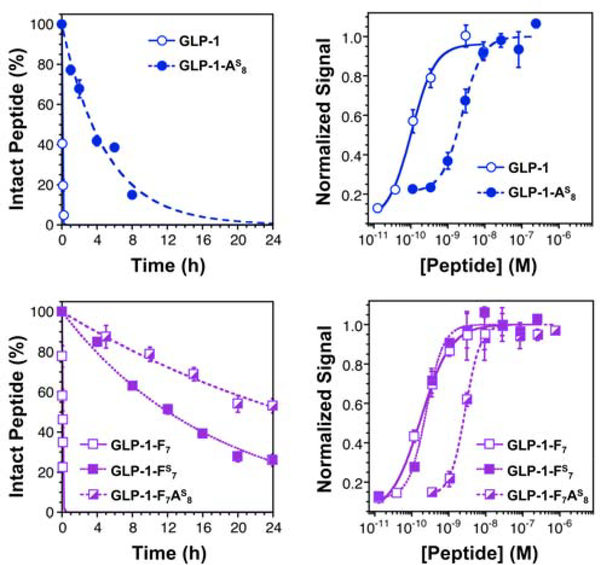
Thioamide Substitution Stabilizes GLP-1 Analogs Without Disrupting Activity. Top Left: In vitro proteolysis data demonstrating that GLP-1-AS8 is cleaved by 2.5 ng/mL DPP-4 more slowly than the respective oxopeptide (GLP-1). Top Right: Dose response curves for GLP-1 and GLP-1-AS8. Bottom Left: In vitro proteolysis data demonstrating that GLP-1-F7AS8 and GLP-1-FS7 are cleaved by 2.5 ng/mL DPP-4 more slowly than their respective oxopeptide (GLP-1-F7). Bottom Right: Dose response curves for GLP-1-F7, GLP-1-F7AS8, and GLP-1-FS7. All cellular responses were determined using DiscoveRx GLP-1R reporter cells, which detect cAMP production following GLP-1R activation in an enzyme-coupled assay. See Supporting Information for details of both assays, see a list of half-lives and EC50 values in Table 1. Bars represent standard error.
Figure 3.
Figure 3.
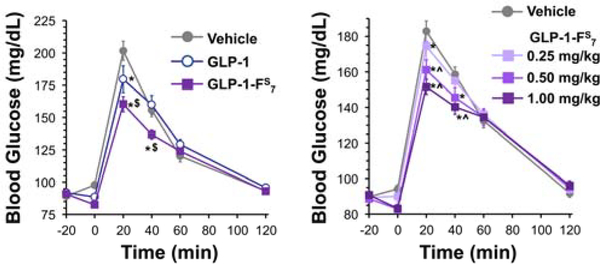
Thioamide-Modified GLP-1 Improves Glycemic Control in Rats. Left: In an oral glucose tolerance test (OGTT), intraperitoneal injection of native GLP-1 (0.5 mg/kg) or GLP-1-FS7 (0.5 mg/kg) suppresses blood glucose levels in rats (n=16) after an oral glucose load (main effect of drug, F2,30=8.11, p<0.01; drug x time interaction, F10,150=5.93, p<0.0001). GLP-1-FS7 more potently and durably reduces blood glucose compared to GLP-1. Right: In a dose-response study of the effects of GLP-1-FS7 on glycemic control (n=16), intraperitoneal injection of compound doses ranging from 0.25–1.0 mg/kg are effective to suppress blood glucose levels (main effect of dose, F3,45=3.61, p<0.03; dose x time interaction, F15,225=4.77, p<0.0001). Higher doses (0.5–1.0 mg/kg) produced greater improvement in glycemic control compared to the lowest dose (0.25 mg/kg). *, p<0.05 compared to vehicle; $, p<0.05 compared to GLP-1; ^, p<0.05 compared to 0.25 mg/kg GLP-1-FS7. Bars represent standard error.
Figure 4.
Figure 4.
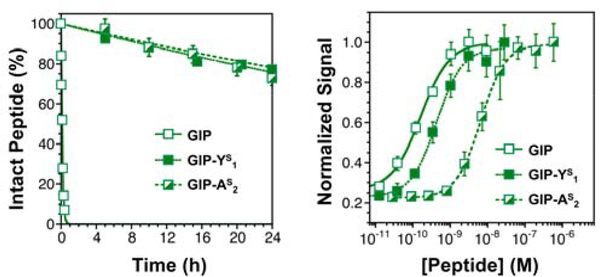
Thioamide Substitution Stabilizes GIP Without Disrupting Activity. Left: Proteolysis data demonstrating that GIP-YS1 and GIP-AS2 are cleaved by 2.5 ng/mL DPP-4 more slowly than GIP. Right: Dose response curves for GIP, GIP-YS1, and GIP-AS2, obtained using DiscoveRx GIPR reporter cells, which detect cAMP production following GIPR activation in an enzyme-coupled assay. See Supporting Information for details of both assays, see a list of half-lives and EC50 values in Table 1. Bars represent standard error.
Figure 5.
Figure 5.
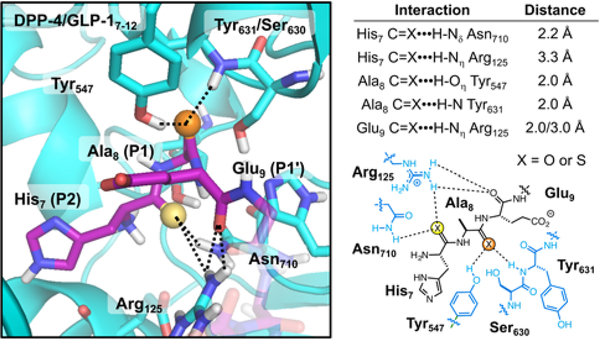
Structural Analysis of the Impact of Thioamide Substitution on DPP-4 Substrate Recognition. Left: An image of the DPP-4 (cyan) active site with a GLP-1 N-terminal fragment (purple) bound, modeled based on the neuropeptide Y bound DPP-4 structure in PDB entry 1R9N. The P2 and P1 carbonyl oxygens are highlighted as yellow and orange spheres, respectively. Key interactions with DPP-4 are shown as dashed lines. Right: Distances for the interactions shown at left with a schematic representation of the P2 and P1 binding site. See Supporting Information for a detailed discussion of DPP-4 active site modeling results.

References

    1. Mullard A, Nat. Rev. Drug Discov. 2013, 12 (5), 329–332. - PubMed
    1. Projan SJ; Gill D; Lu Z; Herrmann SH, Expert Opin. Biol. Ther. 2004, 4 (8), 1345–1350. - PubMed
    1. Verdine GL; Walensky LD, Clin. Cancer Res. 2007, 13 (24), 7264–7270. - PubMed
    1. Buse JB; Rosenstock J; Sesti G; Schmidt WE; Montanya E; Brett JH; Zychma M; Blonde L, Lancet 2009, 374 (9683), 39–47. - PubMed
    1. Kreymann B; Ghatei M; Williams G; Bloom S, Lancet 1987, 330 (8571), 1300–1304. - PubMed

Publication types

MeSH terms

LinkOut - more resources