. 2017 Dec;35(12):1179-1187.
doi: 10.1038/nbt.4005. Epub 2017 Nov 13.

Structure-guided chemical modification of guide RNA enables potent non-viral in vivo genome editing

Affiliations

Structure-guided chemical modification of guide RNA enables potent non-viral in vivo genome editing

Hao Yin et al. Nat Biotechnol. 2017 Dec.

Abstract

Efficient genome editing with Cas9-sgRNA in vivo has required the use of viral delivery systems, which have limitations for clinical applications. Translational efforts to develop other RNA therapeutics have shown that judicious chemical modification of RNAs can improve therapeutic efficacy by reducing susceptibility to nuclease degradation. Guided by the structure of the Cas9-sgRNA complex, we identify regions of sgRNA that can be modified while maintaining or enhancing genome-editing activity, and we develop an optimal set of chemical modifications for in vivo applications. Using lipid nanoparticle formulations of these enhanced sgRNAs (e-sgRNA) and mRNA encoding Cas9, we show that a single intravenous injection into mice induces >80% editing of Pcsk9 in the liver. Serum Pcsk9 is reduced to undetectable levels, and cholesterol levels are significantly lowered about 35% to 40% in animals. This strategy may enable non-viral, Cas9-based genome editing in the liver in clinical settings.


Conflict of interest statement

COMPETING FINANCIAL INTERESTS

The authors declare competing financial interests: details are available in the online version of the paper.

Figures
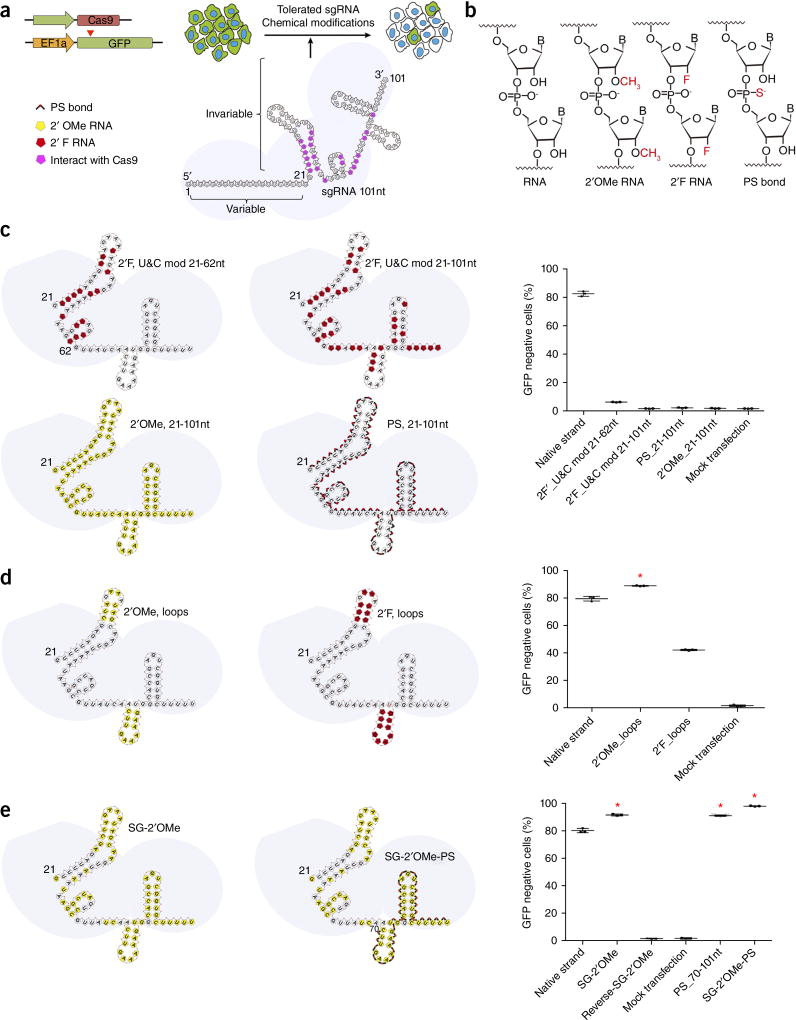
Figure 1
Figure 1
Chemical modifications of invariable part of sgRNA. (a) HEK293 cells stably expressing both EF1a promoter-GFP and EFs promoter-spCas9 were incubated with a GFP-targeting sgRNA. Cas9–sgRNA-mediated frameshift NHEJ will yield GFP cells. When a pattern of chemical modification is tolerated by Cas9–sgRNA, the % of GFP cells will be retained. The pink highlighted nucleotides in the invariable region of sgRNA that interact with the Cas9 protein at the 2′ hydroxyl (OH) group. (b) Chemical modifications of RNA used in the study. (c–e) Left: Illustration of full or “U” and “C” chemical modification (c), loops modification (d) and structure-guided modification (e) in the invariable region (Cas9 binding and tail region) of sgRNA. Right: FACS analysis of HEK293 cells described in a incubated with sgRNAs with various modifications and without modification (native strand). *P < 0.05. (n = 3), error bars as s.d.
Figure 2
Figure 2
Chemical modifications of guide sequences. (a) crRNAs with 2′OMe modifications and without modifications (native strand). The pink highlighted nucleotides in the guide sequences that interact with Cas9 protein at the 2′ OH group. (b–d) crRNA with various patterns of modifications using 2′OMe (b) or 2′F (c) or PS (d). (e) Combination of structure-guided (SG) chemical modification of 2′OMe or 2′F with PS in the guide sequences. HEK293 cells described in Figure 1a were incubated with crRNA in (b–e) and an unmodified tracrRNA. FACS was performed to determine the ratio of GFP cells. (f) crRNAs targeting HBB and EMX-1 were chemically modified with patterns described in e (5′-PS-2′OMe_SG-PS-2′F), and TIDE analysis was performed to determine indels at the HBB and EMX-1 loci, respectively. (g) crRNAs targeting GFP with modifications of single or multiple 2′OH in the guide region. TIDE analysis was performed to measure indels at GFP locus. *P < 0.05. (n = 4 in f and g, and n = 3 in others), error bars as s.d.
Figure 3
Figure 3
Chemical modifications of sgRNA and its application in human cells. (a) Illustration of the conventional 5′ and 3′ end modification (5′&3′-sgRNA) and our new e-sgRNA design. (b) Co-delivery of Cas9 mRNA and sgRNAs targeting GFP into HEK293 cells expressing GFP. FACS analysis was done to determine the number of GFP cells. (c) Co-delivery of Cas9 mRNA and sgRNA targeting HBB into HEK293 cells. NHEJ events were determined by deep sequencing analysis. (d) The editing frequencies of three top off-target sites of HBB sgRNA were determined by deep sequencing of amplicon. *P < 0.05. #P < 0.05 compared to the 5′&3′ sgRNA treated group (n = 3), error bars as s.d.
Figure 4
Figure 4
In vivo delivery of chemically modified sgRNAs and Cas9 mRNA induced knockout of targeted gene in the mouse liver. (a) Cas9-2A-GFP transgenic mice were injected with one or two doses of sgRNA encapsulated in lipid nanoparticles (LNP). For mice treated with two doses, the second dose was given 5 d after the first dose. (b) Liver were taken 10 d after first dose. Indels at GFP locus in total DNA from liver were measured by TIDE analysis. (c) C57BL/6 mice were i.v. injected with two e-sgRNAs targeting Pcsk9 and Cas9 mRNA encapsulated in LNP. (d) The serum Pcsk9 levels. (e) The serum cholesterol levels. (f) The gene editing events at Pcsk9 locus in total liver DNA, illustrated by deep sequencing. (g–j) C57BL/6 (g,h,j) and FAHmut/mut (i) mice were i.v. injected with one of native, 5′&3′ and e-sgRNA targeting Pcsk9 (g,h) or Fah (i) or ROSA26 (j) and Cas9 mRNA encapsulated in LNP. Indels at Pcsk9 (g,h), Fah (i) and ROSA26 (j) loci in total DNA from liver were measured by TIDE analysis. (n = 6 mice in the e-sgRNA/one dose group of b, n = 5 in Fig. 4j and n = 4 mice in others) *P < 0.05, #P < 0.05 compared to the one dose e-sgRNA-treated group, error bars as s.e.m.
Figure 5
Figure 5
GUIDE-seq genome-wide off-target analysis of nuclease activity for SpCas9 programmed with PCSK9-1 or PCSK-2 sgRNA expressed from a U6 promoter (plasmid), unmodified, end-modified (5′&3′) or e-sgRNA. (a) The bar chart indicates the number of off-target peaks detected in the GUIDE-seq data for each type of sgRNA. (b) The bar chart indicates the fold improvement in Specificity Ratio (SR) (number of unique reads at the target site/sum of the unique reads at all off-target sites) for each sample relative to the plasmid expressed sgRNA. (c) The Venn diagram displays the distribution of the number of GUIDE-seq identified off-target sites that are common or unique for each given treatment group for PCSK-2. For the ten off-target sites unique to the e-sgRNA, nine of these sites have peak scores less than 16, which indicates that they are either weak sites or false positives. For reference the target site score is 9,484 (Supplementary Table 3). (d) Off-target sites obtained from GUIDE-seq were amplified using liver samples from mice treated with LNP-encapsulated Cas9 mRNA, PCSK9-1 and PCSK9-2 sgRNA. Deep-seq was performed to determine mutation frequency. The bars indicate total indel frequencies at the off-target sites. n = 3 mice, error bars as s.e.m.

References

    1. Cox DB, Platt RJ, Zhang F. Therapeutic genome editing: prospects and challenges. Nat. Med. 2015;21:121–131. - PMC - PubMed
    1. Jinek M, et al. A programmable dual-RNA-guided DNA endonuclease in adaptive bacterial immunity. Science. 2012;337:816–821. - PMC - PubMed
    1. Cong L, et al. Multiplex genome engineering using CRISPR/Cas systems. Science. 2013;339:819–823. - PMC - PubMed
    1. Mali P, et al. RNA-guided human genome engineering via Cas9. Science. 2013;339:823–826. - PMC - PubMed
    1. Doudna JA, Charpentier E. Genome editing. The new frontier of genome engineering with CRISPR-Cas9. Science. 2014;346:1258096. - PubMed

Substances
