


Fifteen-year Weight and Disordered Eating Patterns Among Community-based Adolescents
- PMID: 29132950
- PMCID: PMC5736404
- DOI: 10.1016/j.amepre.2017.09.005
Fifteen-year Weight and Disordered Eating Patterns Among Community-based Adolescents
Abstract
Introduction: The current study aims to characterize weight-change trajectories and their concomitant associations with prospectively measured dieting and other disordered eating behaviors among initially nonoverweight adolescents during the transition to adulthood.
Methods: A population-based sample (n=1,091) self-reported their height/weight, dieting, unhealthy weight-control behaviors, and binge eating at 5-year intervals between 1998/1999 and 2013/2014, spanning early/middle adolescence through middle/late young adulthood. Data were analyzed in 2016/2017.
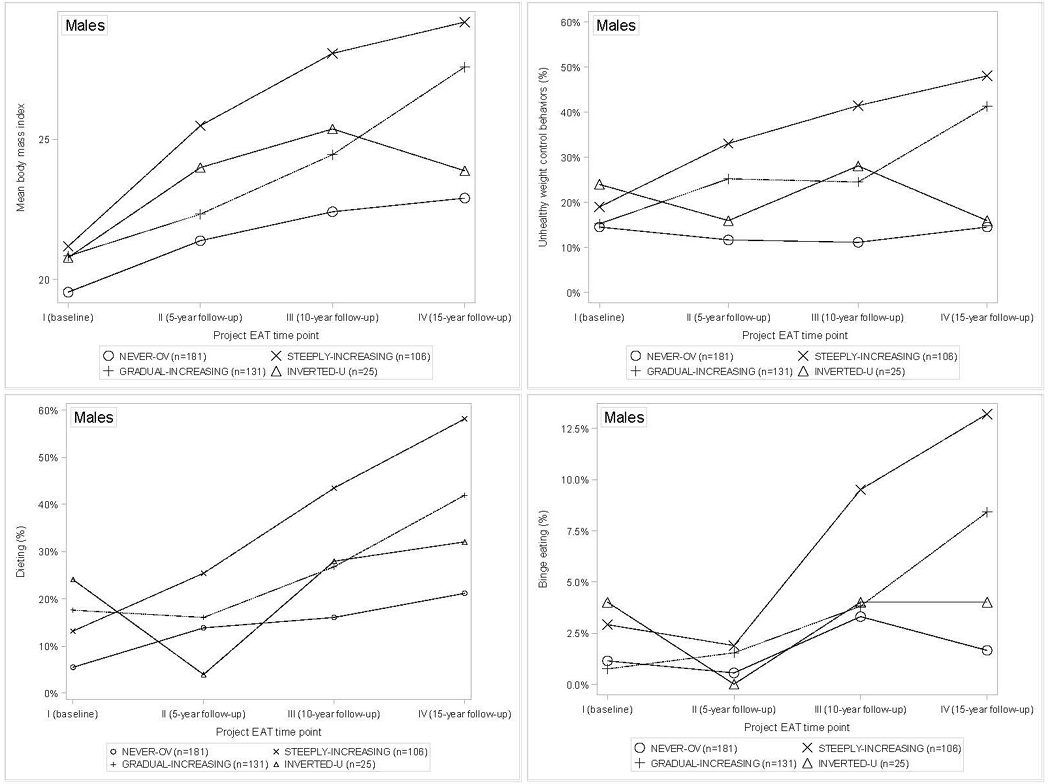
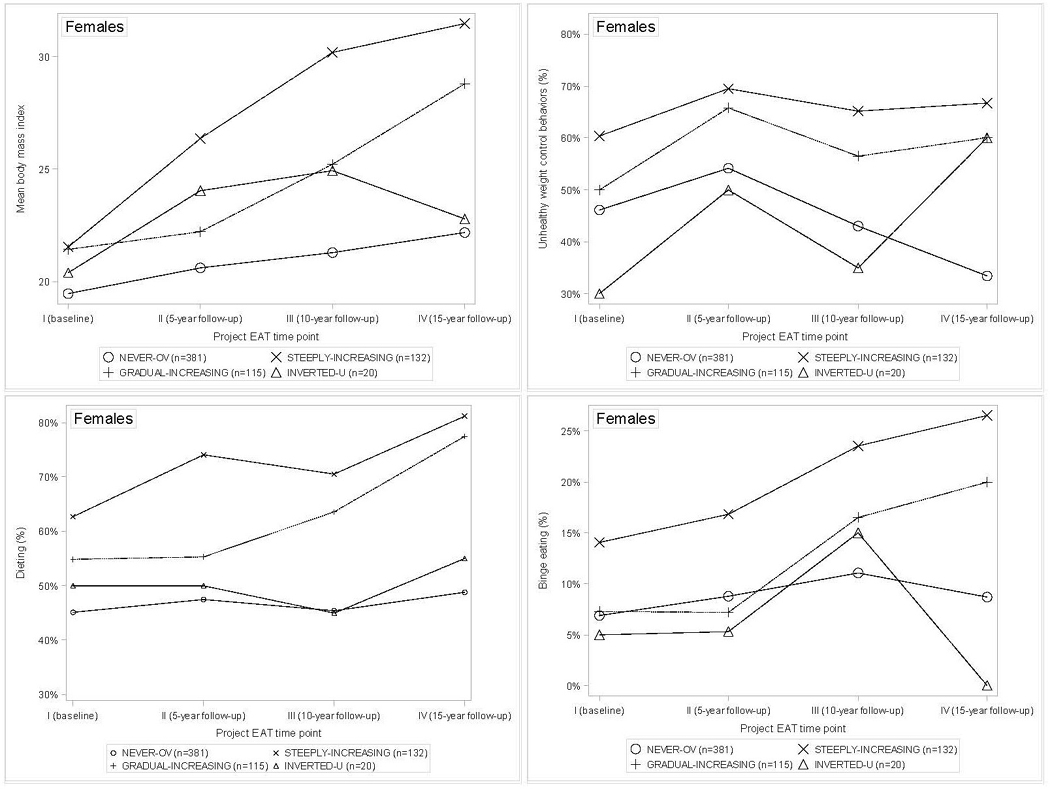
Results: Groups were categorized as those who were never overweight (n=562), were overweight during at least one measurement point and gained weight more rapidly (n=246) or gradually (n=238) than their peers, or were overweight during at least one measurement point but returned to nonoverweight status by middle/late young adulthood (n=45). Thus, nearly half of adolescents became overweight during the transition to adulthood. Those who were never overweight had the lowest rates of dieting (males: F[9, 1,314]=2.54, p=0.0069, females: F[9, 1,927]=3.02, p=0.0014) and unhealthy weight-control behaviors (males: F[9, 1,313]=3.30, p=0.0005, females: F[9, 1,927]=3.02, p=0.0014), whereas some of these behaviors tended to track with weight gain in rapid and gradual weight gainers.
Conclusions: Although adolescents who are already overweight are most frequently targeted for weight-gain prevention and early intervention programs, results suggest that healthy lifestyle interventions could also benefit individuals who may be perceived as low risk for overweight in adulthood by nature of being nonoverweight in adolescence. Dieting and unhealthy weight-control behaviors tended to be associated with weight gain, suggesting that they are ineffective in addition to being potentially harmful.
Copyright © 2018 American Journal of Preventive Medicine. Published by Elsevier Inc. All rights reserved.
Figures
References
-
- Guo SS, Wu W, Chumlea WC, Roche AF. Predicting overweight and obesity in adulthood from body mass index values in childhood and adolescence. Am J Clin Nutr. 2002;76(3):653–658. - PubMed
-
- Freedman DS, Khan LK, Serdula MK, et al. Inter-relationships among childhood BMI, childhood height, and adult obesity: the Bogalusa Heart Study. Int J Obes Relat Metab Disord. 2004;28(1):10–16. https://doi.org/10.1038/sj.ijo.0802544. - DOI - PubMed
-
- Freedman DS, Dietz WH, Srinivasan SR, Berenson GS. Risk factors and adult body mass index among overweight children: the Bogalusa Heart Study. Pediatrics. 2009;123(3):750–757. https://doi.org/10.1542/peds.2008-1284. - DOI - PubMed
-
- Willers SM, Brunekreef B, Smit HA, et al. BMI Development of Normal Weight and Overweight Children in the PIAMA Study. PLoS ONE. 2012;7(6):e39517. https://doi.org/10.1371/journal.pone.0039517. - DOI - PMC - PubMed
-
- Stuart B, Panico L. Early-childhood BMI trajectories: Evidence from a prospective, nationally representative British cohort study. Nutr Diabetes. 2016;6(3):e198. https://doi.org/10.1038/nutd.2016.6. - DOI - PMC - PubMed
MeSH terms
Grants and funding
LinkOut - more resources
Full Text Sources
Other Literature Sources
Medical
