


Dietary Fatty Acid Modification for the Treatment of Aspirin-Exacerbated Respiratory Disease: A Prospective Pilot Trial
- PMID: 29133219
- PMCID: PMC5945343
- DOI: 10.1016/j.jaip.2017.10.011
Dietary Fatty Acid Modification for the Treatment of Aspirin-Exacerbated Respiratory Disease: A Prospective Pilot Trial
Abstract
Background: The high levels of eicosanoid production and the clinical efficacy of leukotriene-modifying pharmacotherapies for patients with aspirin-exacerbated respiratory disease (AERD) suggest that other interventions targeting arachidonic acid dysregulation may also improve disease control.
Objective: To assess the utility of a high omega-3/low omega-6 diet for the treatment of AERD.
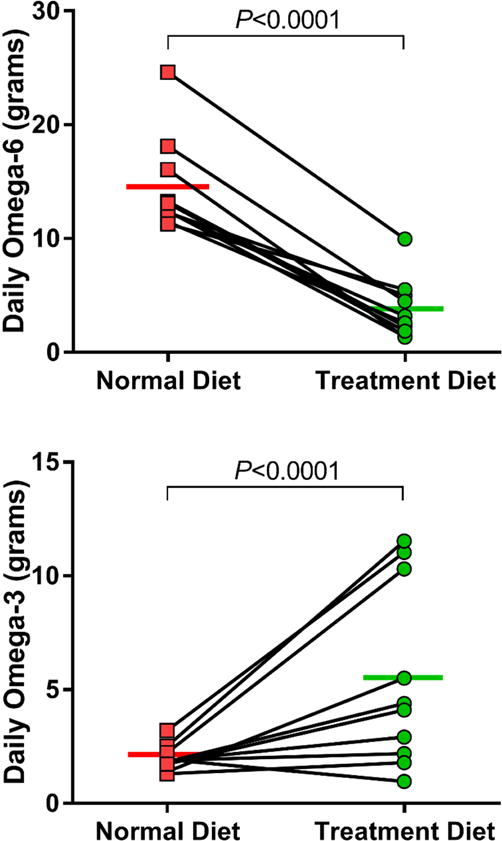
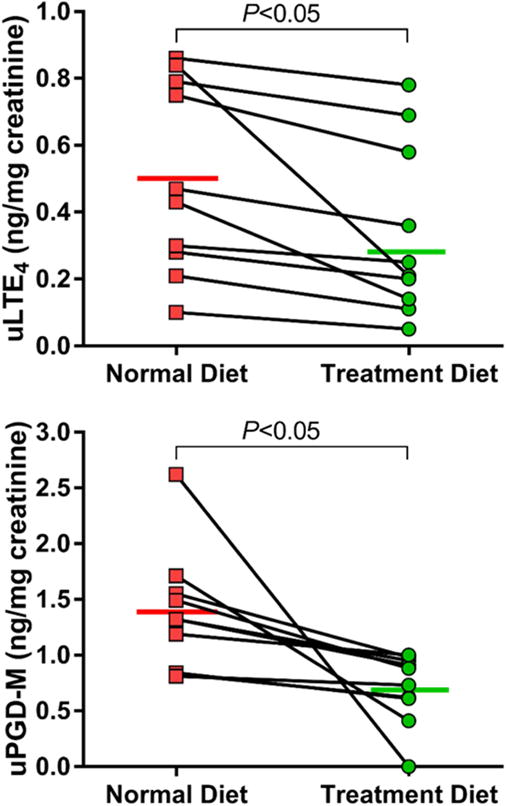
Methods: Prospective, nonblinded dietary intervention in 10 adult patients with AERD at Brigham and Women's Hospital in Boston, MA. The primary objective was for subjects to reduce dietary omega-6 fatty acid consumption to less than 4 g/d and increase omega-3 intake to more than 3 g/d. The primary outcome was change in urinary leukotriene E4, with changes in other eicosanoids, platelet activation, lung function, and patient-reported questionnaires also assessed.
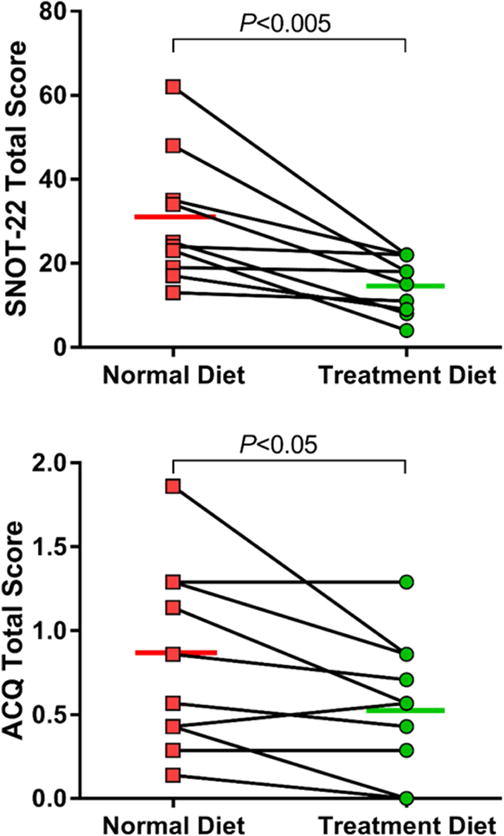
Results: Of the 10 subjects who screened for the study, all 10 completed the dietary intervention. Urinary leukotriene E4 decreased by 0.17 ng/mg (95% CI, -0.29 to -0.04; P = .02) and tetranor prostaglandin D-M decreased by 0.66 ng/mg creatinine (95% CI, -1.21 to -0.11; P = .02). There was a 15.1-point reduction in the 22-item Sino-Nasal Outcome Test score (95% CI, -24.3 to -6.0; P = .01), a 0.27-point reduction in the 7-item Asthma Control Questionnaire score (95% CI, -0.52 to -0.03; P = .03), and no change in FEV1 % predicted (P = .92) or forced vital capacity % predicted (P = .74). All patients lost some weight over the 2-week intervention period, and there were no diet-associated adverse events.
Conclusions: A high omega-3/low omega-6 diet may be an appropriate adjunct treatment option for patients with AERD.
Keywords: AERD; Aspirin; Aspirin-exacerbated respiratory disease; Asthma; Diet; Fatty acids; LTE(4); NSAIDs; Nasal polyps; Omega-3; Omega-6; Samter's Triad.
Copyright © 2017 American Academy of Allergy, Asthma & Immunology. Published by Elsevier Inc. All rights reserved.
Figures
Comment in
-
Can Diet Modification Be an Effective Treatment in Aspirin-Exacerbated Respiratory Disease?J Allergy Clin Immunol Pract. 2018 May-Jun;6(3):832-833. doi: 10.1016/j.jaip.2017.11.043. J Allergy Clin Immunol Pract. 2018. PMID: 29747986 Free PMC article. No abstract available.
-
Possible contribution of decreased phytoprostanes to diet-induced improvements in aspirin exacerbated respiratory disease.J Allergy Clin Immunol Pract. 2018 Sep-Oct;6(5):1808. doi: 10.1016/j.jaip.2018.05.033. J Allergy Clin Immunol Pract. 2018. PMID: 30197077 No abstract available.
References
-
- Laidlaw TM, Boyce JA. Aspirin-Exacerbated Respiratory Disease–New Prime Suspects. The New England journal of medicine. 2016;374(5):484–488. - PubMed
-
- Thies F, Nebe-von-Caron G, Powell JR, Yaqoob P, Newsholme EA, Calder PC. Dietary supplementation with gamma-linolenic acid or fish oil decreases T lymphocyte proliferation in healthy older humans. J Nutr. 2001;131(7):1918–1927. - PubMed
-
- Kelley DS, Taylor PC, Nelson GJ, Mackey BE. Arachidonic acid supplementation enhances synthesis of eicosanoids without suppressing immune functions in young healthy men. Lipids. 1998;33(2):125–130. - PubMed
-
- Lee TH, Hoover RL, Williams JD, Sperling RI, Ravalese J, Spur BW, et al. Effect of dietary enrichment with eicosapentaenoic and docosahexaenoic acids on in vitro neutrophil and monocyte leukotriene generation and neutrophil function. The New England journal of medicine. 1985;312(19):1217–1224. - PubMed
-
- von Schacky C, Kiefl R, Jendraschak E, Kaminski WE. n-3 fatty acids and cysteinyl-leukotriene formation in humans in vitro, ex vivo, and in vivo. J Lab Clin Med. 1993;121(2):302–309. - PubMed
Publication types
MeSH terms
Substances
Grants and funding
LinkOut - more resources
Full Text Sources
Other Literature Sources
