


Open-Source Electronic Health Record Systems for Low-Resource Settings: Systematic Review
- PMID: 29133283
- PMCID: PMC5703976
- DOI: 10.2196/medinform.8131
Open-Source Electronic Health Record Systems for Low-Resource Settings: Systematic Review
Abstract
Background: Despite the great impact of information and communication technologies on clinical practice and on the quality of health services, this trend has been almost exclusive to developed countries, whereas countries with poor resources suffer from many economic and social issues that have hindered the real benefits of electronic health (eHealth) tools. As a component of eHealth systems, electronic health records (EHRs) play a fundamental role in patient management and effective medical care services. Thus, the adoption of EHRs in regions with a lack of infrastructure, untrained staff, and ill-equipped health care providers is an important task. However, the main barrier to adopting EHR software in low- and middle-income countries is the cost of its purchase and maintenance, which highlights the open-source approach as a good solution for these underserved areas.
Objective: The aim of this study was to conduct a systematic review of open-source EHR systems based on the requirements and limitations of low-resource settings.
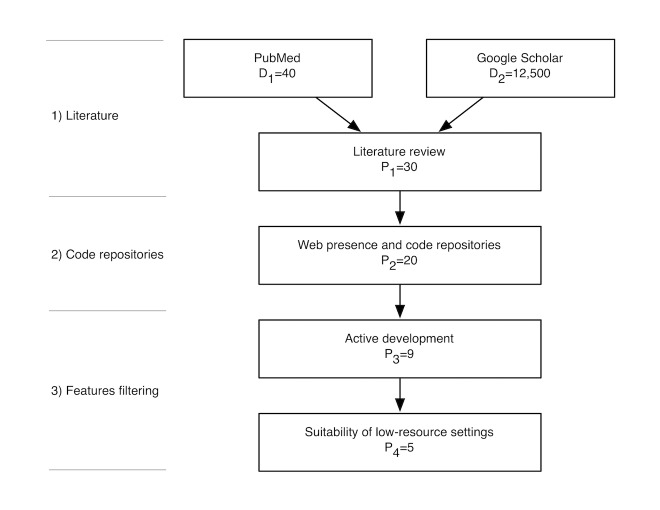
Methods: First, we reviewed existing literature on the comparison of available open-source solutions. In close collaboration with the University of Gondar Hospital, Ethiopia, we identified common limitations in poor resource environments and also the main requirements that EHRs should support. Then, we extensively evaluated the current open-source EHR solutions, discussing their strengths and weaknesses, and their appropriateness to fulfill a predefined set of features relevant for low-resource settings.
Results: The evaluation methodology allowed assessment of several key aspects of available solutions that are as follows: (1) integrated applications, (2) configurable reports, (3) custom reports, (4) custom forms, (5) interoperability, (6) coding systems, (7) authentication methods, (8) patient portal, (9) access control model, (10) cryptographic features, (11) flexible data model, (12) offline support, (13) native client, (14) Web client,(15) other clients, (16) code-based language, (17) development activity, (18) modularity, (19) user interface, (20) community support, and (21) customization. The quality of each feature is discussed for each of the evaluated solutions and a final comparison is presented.
Conclusions: There is a clear demand for open-source, reliable, and flexible EHR systems in low-resource settings. In this study, we have evaluated and compared five open-source EHR systems following a multidimensional methodology that can provide informed recommendations to other implementers, developers, and health care professionals. We hope that the results of this comparison can guide decision making when needing to adopt, install, and maintain an open-source EHR solution in low-resource settings.
Keywords: EHR; eHealth; electronic health record; open source; software.
©Assel Syzdykova, André Malta, Maria Zolfo, Ermias Diro, José Luis Oliveira. Originally published in JMIR Medical Informatics (http://medinform.jmir.org), 13.11.2017.
Conflict of interest statement
Conflicts of Interest: None declared.
Figures
References
-
- Who.int. 1978. Sep 12, [2017-11-03]. Declaration of Alma-Ata http://www.who.int/publications/almaata_declaration_en.pdf .
-
- UN. United Nations; 2010. [2017-11-01]. News on millennium development goals http://www.un.org/millenniumgoals/
-
- Sustainabledevelopment.un. Citeseer; [2017-11-01]. Sustainable development goals https://sustainabledevelopment.un.org/?menu=1300 .
Publication types
LinkOut - more resources
Full Text Sources
Other Literature Sources
Medical
