. 2018 Jan 22;86(2):e00779-17.
doi: 10.1128/IAI.00779-17. Print 2018 Feb.

Role of Calprotectin in Withholding Zinc and Copper from Candida albicans

Affiliations

Role of Calprotectin in Withholding Zinc and Copper from Candida albicans

Angelique N Besold et al. Infect Immun. .

Abstract

The opportunistic fungal pathogen Candida albicans acquires essential metals from the host, yet the host can sequester these micronutrients through a process known as nutritional immunity. How the host withholds metals from C. albicans has been poorly understood; here we examine the role of calprotectin (CP), a transition metal binding protein. When CP depletes bioavailable Zn from the extracellular environment, C. albicans strongly upregulates ZRT1 and PRA1 for Zn import and maintains constant intracellular Zn through numerous cell divisions. We show for the first time that CP can also sequester Cu by binding Cu(II) with subpicomolar affinity. CP blocks fungal acquisition of Cu from serum and induces a Cu starvation stress response involving SOD1 and SOD3 superoxide dismutases. These transcriptional changes are mirrored when C. albicans invades kidneys in a mouse model of disseminated candidiasis, although the responses to Cu and Zn limitations are temporally distinct. The Cu response progresses throughout 72 h, while the Zn response is short-lived. Notably, these stress responses were attenuated in CP null mice, but only at initial stages of infection. Thus, Zn and Cu pools are dynamic at the host-pathogen interface and CP acts early in infection to restrict metal nutrients from C. albicans.

Keywords: Candida albicans; calprotectin; copper; nutritional immunity; zinc.


Figures

FIG 1
FIG 1
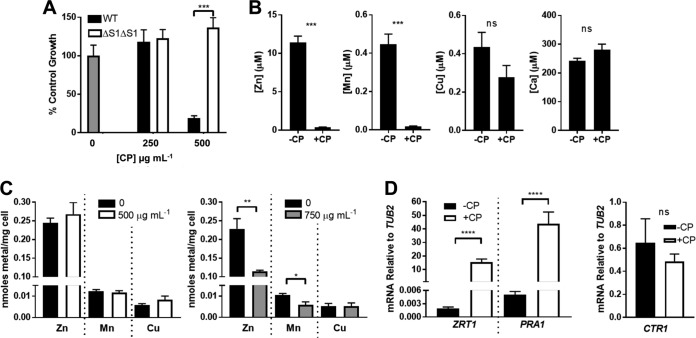
Evidence of CP-induced metal withholding from C. albicans in YPD medium. C. albicans strain SC5314 was cultured in YPD medium as described in Materials and Methods. (A) Total growth was monitored at OD600 for cells grown for 16 h (∼12 doubling times) with the indicated concentration of WT or ΔS1ΔS2 CP and is shown as a percentage of untreated control growth (gray bar). Results are averages from four biological replicates over three experimental trials; error bars are standard errors. (B) Metals retained in YPD (no cells) following 7-h treatment with 500 μg ml−1 CP were measured as described in Materials and Methods. Error bars represent standard errors from four replicates over two experimental trials. (C) Intracellular levels of the indicated metals were determined as described in Materials and Methods from cells grown for 7 h (∼five doublings) with the indicated concentration of WT CP. Error bars are standard errors from 10 (left panel) or four (right panel) biological replicates. There is no significant difference between samples lacking CP (−CP) and those with 500 μg/ml CP for any metal tested or with Cu at 750 μg/ml CP. (D) qRT-PCR analysis of ZRT1, PRA1, and CTR1 mRNA levels relative to TUB2 (2−ΔCT) is shown with cells grown as described for panel C with 500 μg ml−1 of WT CP. Error bars are standard errors from 12 (left panel) or 3 (right panel) biological replicates. Significance was determined using a two-tailed t test. ****, P < 0.0001; ***, P ≤ 0.0002; **, P = 0.006; *, P = 0.024; ns, not significant.
FIG 2
FIG 2
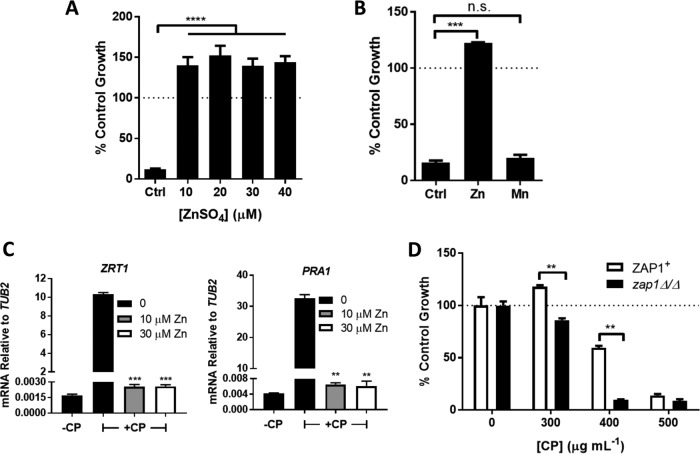
Zn starvation stress and growth inhibition mediated by CP. (A and B) Growth of C. albicans SC5314 was carried out and monitored as described for Fig. 1A with 500 μg ml−1 CP (20 μM) in YPD medium supplemented with the indicated concentrations of ZnSO4 (A) or 40 μM ZnSO4 or MnSO4 (B). Error bars are standard errors from two to four biological replicates. (C) ZRT1 and PRA1 mRNA was analyzed as described for Fig. 1D in C. albicans SC5314 grown with 500 μg ml−1 CP and the indicated concentration of ZnSO4. Error bars are standard errors for biological duplicates representative of two experimental trials; Zn-treated samples were compared to no-Zn, +CP samples for statistical analysis. (D) C. albicans strain SN152 (ZAP1+) or the isogenic zap1Δ/Δ strain was grown, and data were plotted as described for Fig. 1A. Error bars are standard errors for biological duplicates representative of two experimental trials. Significance was assessed using a two-tailed t test. ****, P < 0.0001; ***, P < 0.0003; **, P < 0.005; *, P < 0.05.
FIG 3
FIG 3
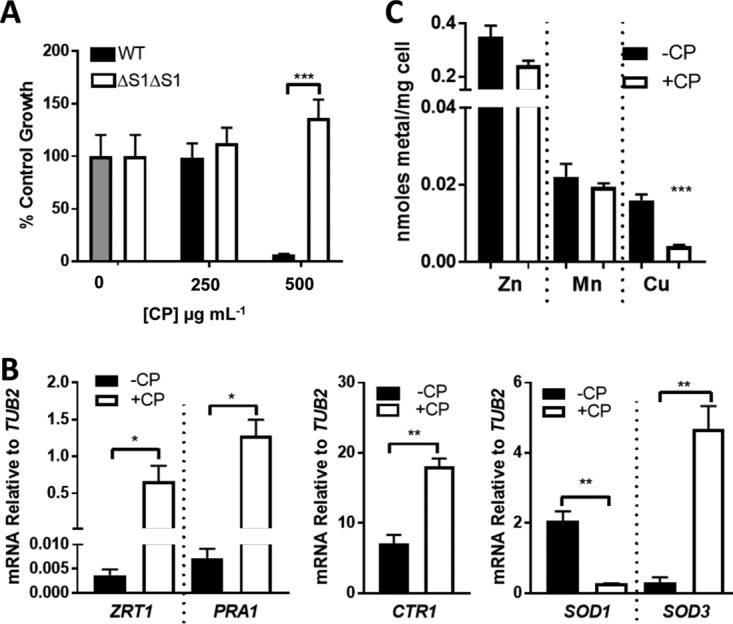
Evidence for CP withholding of Cu from C. albicans. C. albicans SC5314 was cultured in a medium containing 50% fetal bovine serum based in a low-Cu SC medium (see Materials and Methods). (A) Cell growth in the presence of WT or ΔS1ΔS2 CP was tested as described for Fig. 1A. Error bars are standard errors for four biological replicates. (B and C) Cells cultured where indicated with 500 μg ml−1 CP were subjected to mRNA analysis by qRT-PCR (B) or intracellular metals (C) as described for Fig. 1D and C, respectively. Error bars are standard errors from two or three (B) or four (C) biological replicates. Significance was assessed using a two-tailed t test. ***, P = 0.0003; **, P < 0.005; *, P < 0.05.
FIG 4
FIG 4
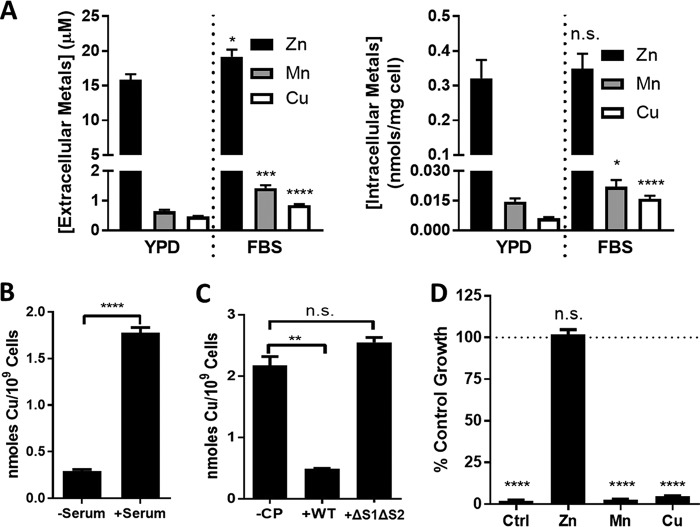
CP and C. albicans grown in serum. (A) Shown are the levels of metals in YPD medium versus the serum-based medium (FBS) as described for Fig. 3 (“extracellular metals”) or the metal levels of C. albicans cells cultured in YPD and in FBS medium determined as described for Fig. 1C and 3B (“intracellular metals”). Error bars are standard errors for 4 to 12 biological replicates measured over two to six experimental trials. For each metal, statistical comparisons were made between FBS and YPD samples. (B and C) Total cellular Cu following 1 h of incubation with the serum-based medium or the control SC medium (−serum) (B) was analyzed as described in Materials and Methods. Where indicated (C), serum was pretreated with 1 mg ml−1 WT or ΔS1ΔS2 CP. Error bars are standard errors for six biological replicates (B) or biological duplicates representative of two experimental trials (C). (D) Cell growth in serum as described for Fig. 3A was carried out in the presence of 500 μg ml−1 CP (20 μM) and 40 μM ZnSO4, MnSO4, or CuSO4. Error bars are standard errors for six biological replicates over three experimental trials. Statistical analyses represent comparisons to no-CP samples (dotted line).****, P < 0.0001; ***, P = 0.004; **, P < 0.0076; *, P = 0.044.
FIG 5
FIG 5
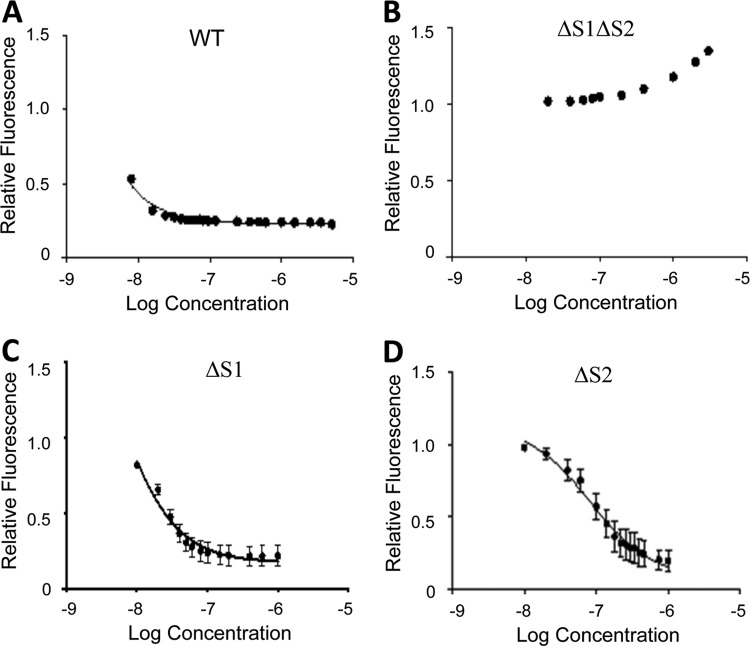
CP binds Cu with high affinity. Chelator competition experiments to estimate the affinity of CP for Cu were performed in triplicate as described in Materials and Methods. The binding of Cu2+ to WT CP-CS (A), ΔS1ΔS2 (B), ΔS1 (C), and ΔS2 (D) was assessed by tracking the change in fluorescence of Cu2+-bound fluorescent chelator fluozin-3 as protein was titrated into the solution.
FIG 6
FIG 6
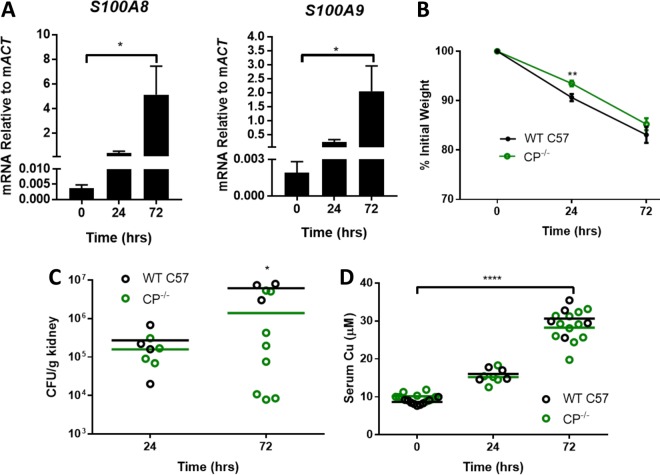
Disseminated candidiasis in WT C57 and CP−/− mice. WT C57 (black) and CP−/− male mice (green) were infected with C. albicans SC5314 via a lateral tail vein injection as described in Materials and Methods. (A) Total mRNA from uninfected and infected kidneys of WT C57 mice was subjected to qRT-PCR analysis of mouse S100A8 and S100A9 mRNA normalized to ActB mRNA. Results are the averages for four or five WT mice per time point. Expression levels increased significantly over time as determined by a one-way ANOVA with a Tukey posttest (*, P < 0.05). (B) Weight loss was monitored daily; results are the averages for 14 and 22 WT and CP−/− mice, respectively; error bars represent standard errors. CP−/− mice have a statistically significant lower weight loss at 24 h (**, P = 0.004) but not at 72 h. (C) Kidney fungal burden was determined by CFU; shown are results from three to eight independent mice per group. Bars represent averages. At 72 h postinfection, WT C57 mice have a higher fungal burden as determined by two-tailed t test (*, P < 0.05). (D) Analysis of serum Cu from 4 to 11 independent mice per group. Using a two-tailed t test, there was no statistical difference between WT C57 and CP−/− mice, but Cu levels did rise significantly during infection in both groups, as determined by a one-way ANOVA with a Tukey posttest (****, P < 0.0001). Bars represent averages.
FIG 7
FIG 7
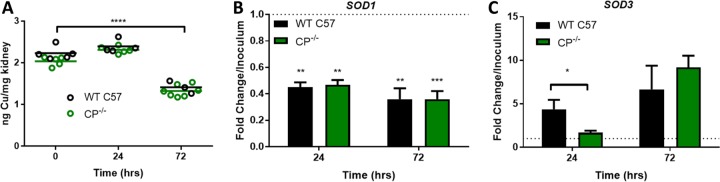
Host and fungal Cu responses during infection of WT and CP−/− mice. (A) Total kidney Cu is shown for three to seven independent mice per group. Bars represent averages. The loss in Cu at 72 h is significant (****, P < 0.0001), but there is no significant difference between WT and CP−/− mice. (B and C) Total mRNA from infected kidneys was subjected to qRT-PCR analysis of C. albicans SOD1 (B) and SOD3 (C). mRNA was normalized to TUB2 and is shown as fold change over the inoculum. Results are the averages for 4 WT mice per time point and 4 or 11 CP−/− mice at 24 and 72 h, respectively. SOD1 levels decreased significantly compared to the inoculum (dashed line); error bars are standard errors. The difference in SOD3 expression between WT and CP−/− mice at 24 h is statistically significant. Significance was determined by one-way ANOVA with Tukey posttest (A, B) or by a two-tailed t test (C). **, P < 0.01; *, P = 0.027.
FIG 8
FIG 8
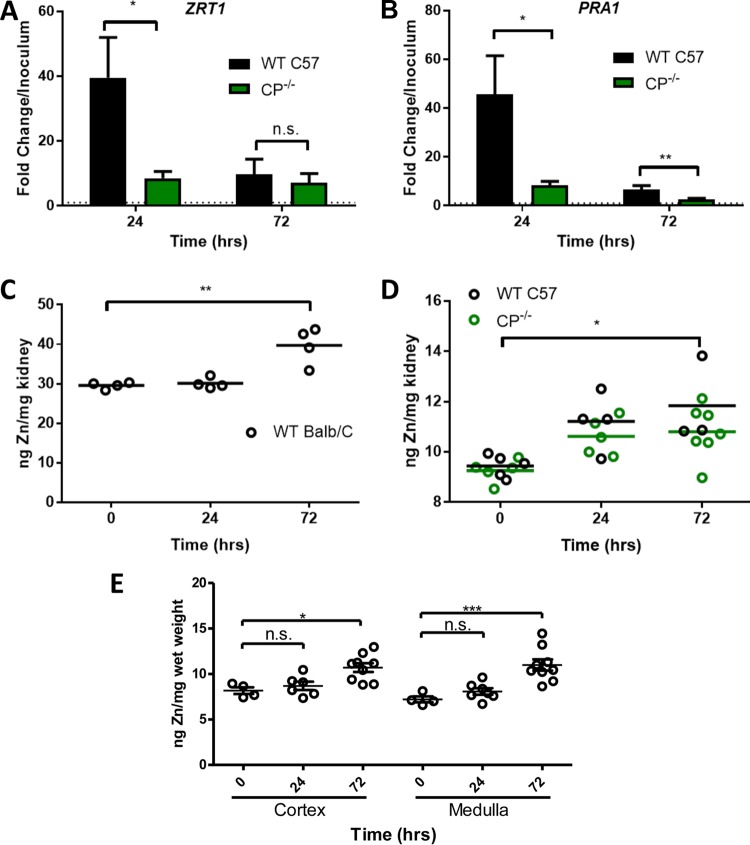
Host and fungal Zn responses during infection of WT and CP−/− mice. (A and B) Expression of C. albicans ZRT1 (A) and PRA1 (B) in infected kidneys was determined as described for Fig. 7B and C. Error bars represent standard errors. Significant differences between WT and CP−/− were determined using a two-tailed t test (*, P < 0.05). (C and D) Total Zn was measured in kidneys from uninfected mice as well as BALB/c (C) or C57 WT and CP−/− mice (D) at 24 h or 72 h postinfection. The increases in Zn at 72 h postinfection are statistically significant, but there is no significant difference between C57 WT and CP−/− mice as determined using one-way ANOVA with Tukey's posttest or a two-tailed t test. (E) Kidneys were dissected into cortex and medulla prior to analysis of total Zn from four uninfected and seven (24 h) or nine (72 h) infected BALB/c mice. Significance was determined by a two-tailed t test (A, B) or one-way ANOVA with Tukey's posttest (C to E). ***, P < 0.001; **, P < 0.0074; *, P < 0.05.

References

    1. Lionakis MS. 2014. New insights into innate immune control of systemic candidiasis. Med Mycol 52:555–564. doi: 10.1093/mmy/myu029. - DOI - PMC - PubMed
    1. Besold AN, Culbertson EM, Culotta VC. 2016. The Yin and Yang of copper during infection. J Biol Inorg Chem 21:137–144. doi: 10.1007/s00775-016-1335-1. - DOI - PMC - PubMed
    1. Cassat JE, Skaar EP. 2013. Iron in infection and immunity. Cell Host Microbe 13:509–519. doi: 10.1016/j.chom.2013.04.010. - DOI - PMC - PubMed
    1. Crawford A, Wilson D. 2015. Essential metals at the host-pathogen interface: nutritional immunity and micronutrient assimilation by human fungal pathogens. FEMS Yeast Res 15(7):fov071. doi: 10.1093/femsyr/fov071. - DOI - PMC - PubMed
    1. Kehl-Fie TE, Skaar EP. 2010. Nutritional immunity beyond iron: a role for manganese and zinc. Curr Opin Chem Biol 14:218–224. doi: 10.1016/j.cbpa.2009.11.008. - DOI - PMC - PubMed

Publication types