


Atrial Substrate and Triggers of Paroxysmal Atrial Fibrillation in Patients With Obstructive Sleep Apnea
- PMID: 29133380
- PMCID: PMC5726812
- DOI: 10.1161/CIRCEP.117.005407
Atrial Substrate and Triggers of Paroxysmal Atrial Fibrillation in Patients With Obstructive Sleep Apnea
Abstract
Background: Obstructive sleep apnea (OSA) is associated with atrial remodeling, atrial fibrillation (AF), and increased incidence of arrhythmia recurrence after pulmonary vein (PV) isolation. We aimed to characterize the atrial substrate, including AF triggers in patients with paroxysmal AF and OSA.
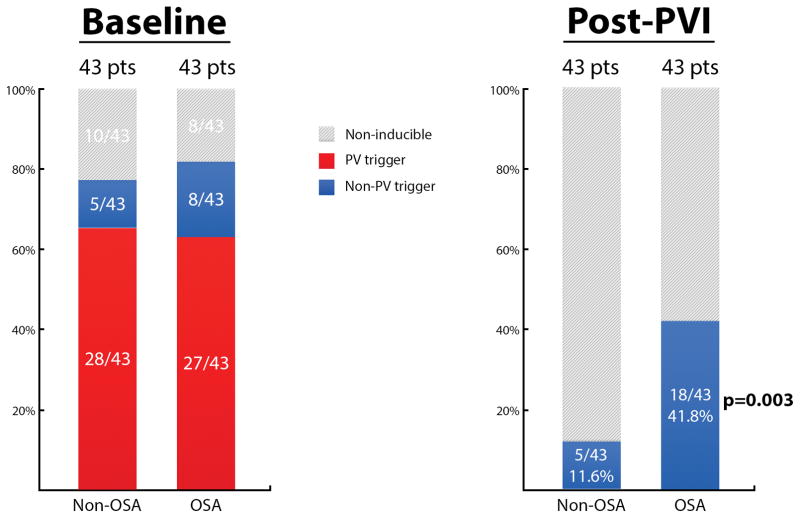
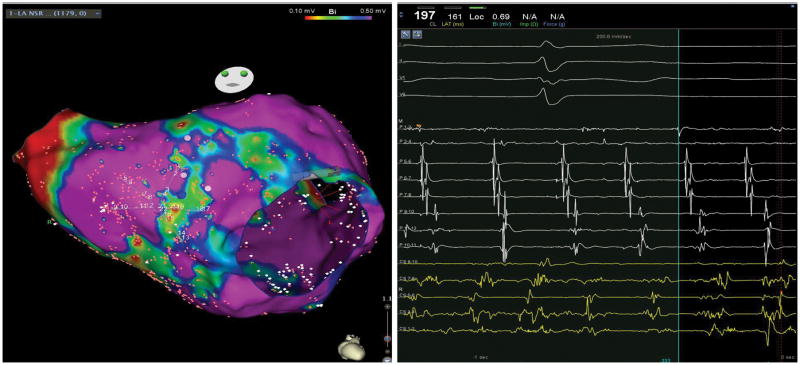
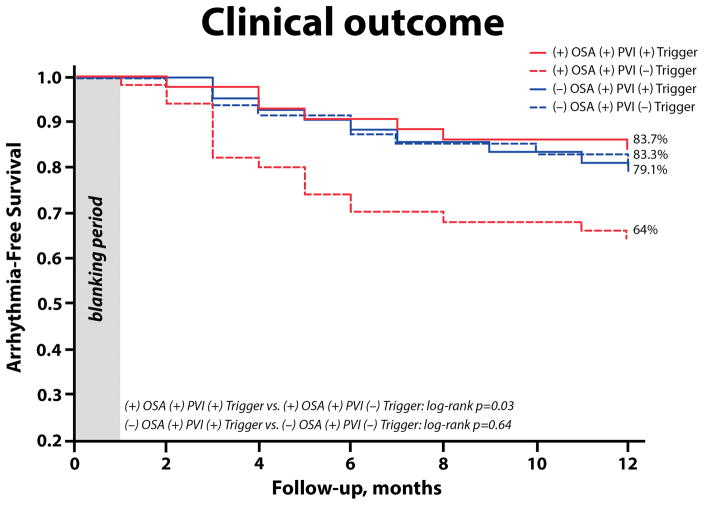
Methods and results: In 86 patients with paroxysmal AF (43 with ≥moderate OSA [apnea-hypopnea index ≥15] and 43 without OSA [apnea-hypopnea index <5]), right atrial and left atrial voltage distribution, conduction velocities, and electrogram characteristics were analyzed during atrial pacing. AF triggers were examined before and after PV isolation and targeted for ablation. Patients with OSA had lower atrial voltage amplitude (right atrial, P=0.0005; left atrial, P=0.0001), slower conduction velocities (right atrial, P=0.02; left atrial, P=0.0002), and higher prevalence of electrogram fractionation (P=0.0001). The areas of atrial abnormality were consistent among patients, most commonly involving the left atrial septum (32/43; 74.4%). At baseline, the PVs were the most frequent triggers for AF in both groups; however, after PV isolation patients with OSA had increased incidence of additional extra-PV triggers (41.8% versus 11.6%; P=0.003). The 1-year arrhythmia-free survival was similar between patients with and without OSA (83.7% and 81.4%, respectively; P=0.59). In comparison, control patients with paroxysmal AF and OSA who underwent PV isolation alone without ablation on extra-PV triggers had increased risk of arrhythmia recurrence (83.7% versus 64.0%; P=0.003).
Conclusions: OSA is associated with structural and functional atrial remodeling and increased incidence of extra-PV triggers. Elimination of these triggers resulted in improved arrhythmia-free survival.
Keywords: atrial fibrillation; atrial remodeling; catheter ablation; incidence; prevalence.
© 2017 American Heart Association, Inc.
Figures
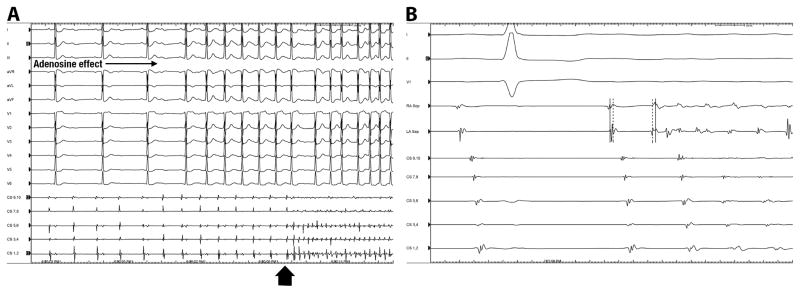
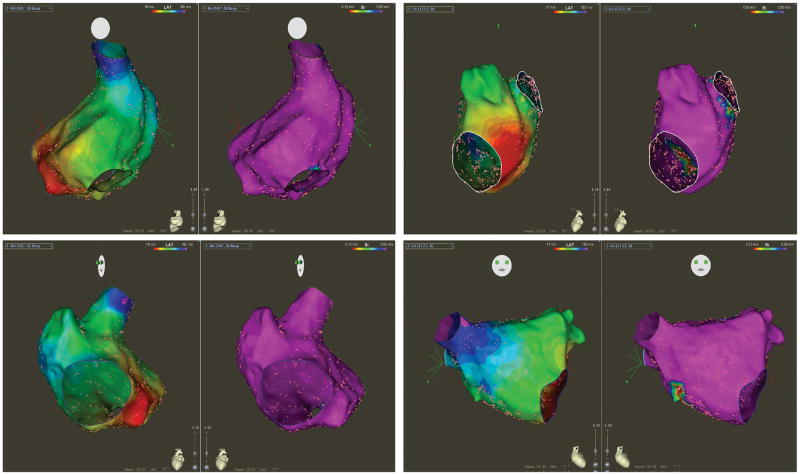
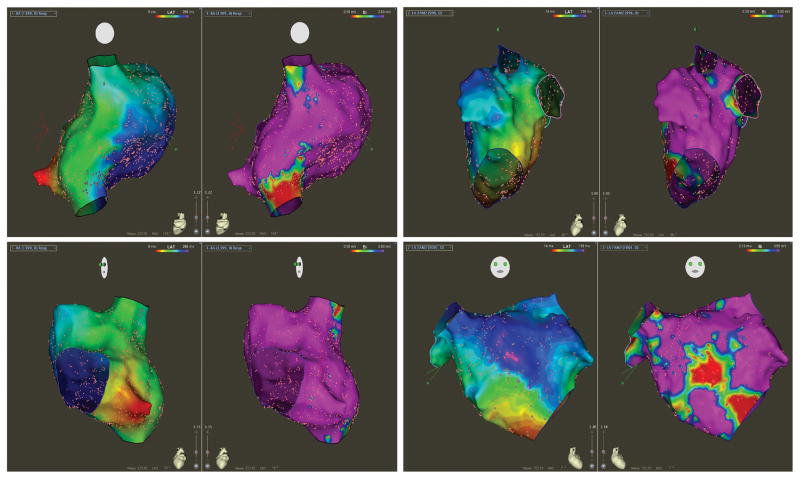
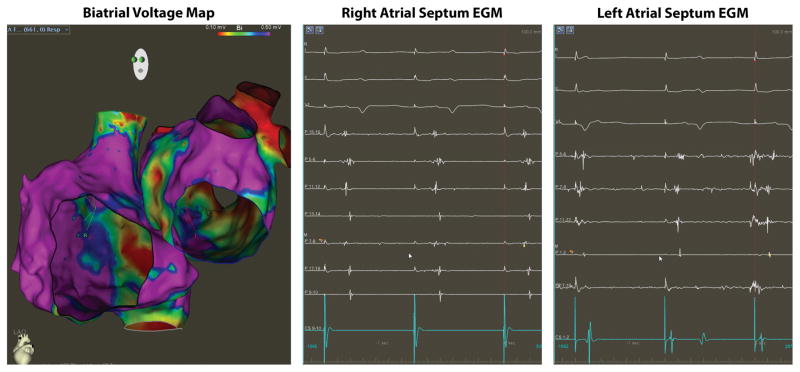
Comment in
-
Atrial Fibrillation and Obstructive Sleep Apnea: Beyond the Pulmonary Veins.Circ Arrhythm Electrophysiol. 2017 Nov;10(11):e005890. doi: 10.1161/CIRCEP.117.005890. Circ Arrhythm Electrophysiol. 2017. PMID: 29133382 No abstract available.
References
-
- Gami AS, Pressman G, Caples SM, Kanagala R, Gard JJ, Davison DE, Malouf JF, Ammash NM, Friedman PA, Somers VK. Association of atrial fibrillation and obstructive sleep apnea. Circulation. 2004;110:364–7. - PubMed
-
- Gami AS, Hodge DO, Herges RM, Olson EJ, Nykodym J, Kara T, Somers VK. Obstructive sleep apnea, obesity, and the risk of incident atrial fibrillation. Journal of the American College of Cardiology. 2007;49:565–71. - PubMed
-
- Force ESCT, Gorenek B, Pelliccia A, Benjamin EJ, Boriani G, Crijns HJ, Fogel RI, Van Gelder IC, Halle M, Kudaiberdieva G, Lane DA, Larsen TB, Lip GY, Lochen ML, Marin F, Niebauer J, Sanders P, Tokgozoglu L, Vos MA, Van Wagoner DR, Document r, Fauchier L, Savelieva I, Goette A, Agewall S, Chiang CE, Figueiredo M, Stiles M, Dickfeld T, Patton K, Piepoli M, Corra U, Marques-Vidal PM, Faggiano P, Schmid JP, Abreu A. European Heart Rhythm Association (EHRA)/European Association of Cardiovascular Prevention and Rehabilitation (EACPR) position paper on how to prevent atrial fibrillation endorsed by the Heart Rhythm Society (HRS) and Asia Pacific Heart Rhythm Society (APHRS) Europace : European pacing, arrhythmias, and cardiac electrophysiology : journal of the working groups on cardiac pacing, arrhythmias, and cardiac cellular electrophysiology of the European Society of Cardiology. 2016 - PMC - PubMed
-
- Iwasaki YK, Kato T, Xiong F, Shi YF, Naud P, Maguy A, Mizuno K, Tardif JC, Comtois P, Nattel S. Atrial fibrillation promotion with long-term repetitive obstructive sleep apnea in a rat model. Journal of the American College of Cardiology. 2014;64:2013–23. - PubMed
-
- Linz D, Schotten U, Neuberger HR, Bohm M, Wirth K. Negative tracheal pressure during obstructive respiratory events promotes atrial fibrillation by vagal activation. Heart rhythm : the official journal of the Heart Rhythm Society. 2011;8:1436–43. - PubMed
Publication types
MeSH terms
Grants and funding
LinkOut - more resources
Full Text Sources
Other Literature Sources
Medical
Research Materials
