. 2017 Nov 28;114(48):E10446-E10454.
doi: 10.1073/pnas.1708553114. Epub 2017 Nov 13.

Multiple Legionella pneumophila effector virulence phenotypes revealed through high-throughput analysis of targeted mutant libraries

Affiliations

Multiple Legionella pneumophila effector virulence phenotypes revealed through high-throughput analysis of targeted mutant libraries

Stephanie R Shames et al. Proc Natl Acad Sci U S A. .

Abstract

Legionella pneumophila is the causative agent of a severe pneumonia called Legionnaires' disease. A single strain of L. pneumophila encodes a repertoire of over 300 different effector proteins that are delivered into host cells by the Dot/Icm type IV secretion system during infection. The large number of L. pneumophila effectors has been a limiting factor in assessing the importance of individual effectors for virulence. Here, a transposon insertion sequencing technology called INSeq was used to analyze replication of a pool of effector mutants in parallel both in a mouse model of infection and in cultured host cells. Loss-of-function mutations in genes encoding effector proteins resulted in host-specific or broad virulence phenotypes. Screen results were validated for several effector mutants displaying different virulence phenotypes using genetic complementation studies and infection assays. Specifically, loss-of-function mutations in the gene encoding LegC4 resulted in enhanced L. pneumophila in the lungs of infected mice but not within cultured host cells, which indicates LegC4 augments bacterial clearance by the host immune system. The effector proteins RavY and Lpg2505 were important for efficient replication within both mammalian and protozoan hosts. Further analysis of Lpg2505 revealed that this protein functions as a metaeffector that counteracts host cytotoxicity displayed by the effector protein SidI. Thus, this study identified a large cohort of effectors that contribute to L. pneumophila virulence positively or negatively and has demonstrated regulation of effector protein activities by cognate metaeffectors as being critical for host pathogenesis.

Keywords: bacterial effectors; transposon insertion sequencing; type IV secretion.


Conflict of interest statement

The authors declare no conflict of interest.

Figures
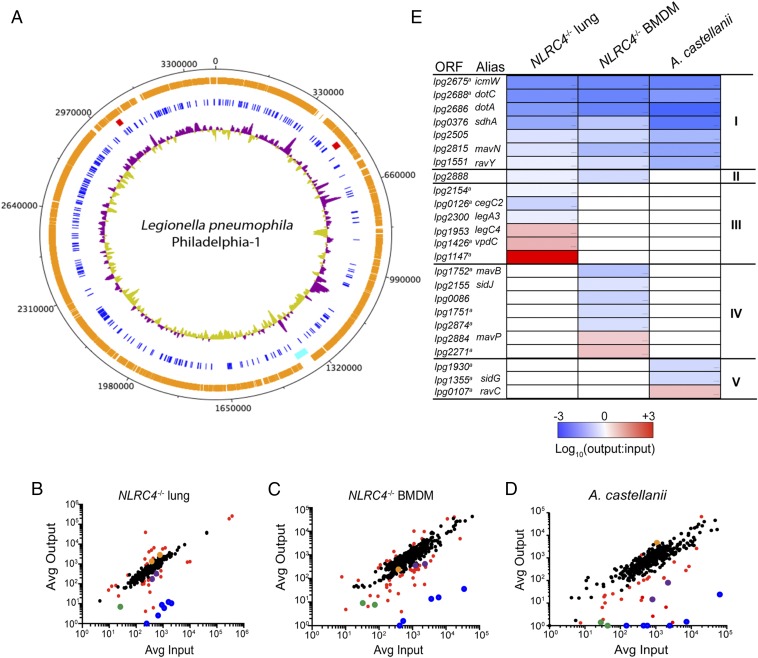
Fig. 1.
Fig. 1.
Generation and screening of a Dot/Icm EMP. (A) Schematic diagram of the L. pneumophila genome (black). Arrayed library Tn insertions (orange) and Dot/Icm effector Tn insertions (blue) are indicated by tick marks. The lvh locus (cyan) and dot/icm loci (red) are shown. GC skewing (G−C/G+C) is shown in purple (>0) and mustard (<0). (B–D) Average normalized read counts for each insertion from INSeq analysis from input and output EMP libraries obtained from NLRC4−/− mice (n = 10) (B), NLRC4−/− BMDMs (n = 8) (C), and A. castellanii (n = 8) (D). Tn mutants with significant fitness differences are shown in red (q ≤ 0.05), dot/icm::Tn mutants are blue, lpg2505::Tn mutants are green, ravY::Tn mutants are cyan, and legC4::Tn mutants are orange. (E) Heat map showing log output:input ratios >1 (red), <1 (blue), and nonsignificant (white) of mutants with significant (q ≤ 0.05) fitness differences in NLRC4−/− lung, NLRC4−/− BMDMs, and A. castellanii. Mutants were categorized into universal defect (I), mammalian-specific defect (II), lung-specific phenotypes (III), BMDM-specific phenotypes (IV), and amoeba-specific phenotypes (V). aGenes with only one representative mutant in the EMP. Statistical analyses were performed as described in SI Materials and Methods.
Fig. 2.
Fig. 2.
LegC4 function attenuates L. pneumophila replication in the mouse lung. (A) Enumeration of WT, legC4::Tn, or ∆legC4 from lungs of NLRC4−/− mice. (B) CI of legC4::Tn versus WT from the lungs of NLRC4−/− mice. (C) CI of legC4::Tn (pV) or legC4::Tn (plegC4) versus WT (pV) in the lungs of NLRC4−/− mice. Each symbol represents an individual animal, and asterisks denote statistical significance by Mann–Whitney U test (*P < 0.05, **P < 0.01). (D) ELISA for IL-12 p40 secretion from NLRC4−/− BMDMs infected with the indicated strains. Data are presented as mean ± SD, and asterisks denote statistical significance (**P < 0.01; n.s., not significant). Data are representative of at least two independent experiments.
Fig. 3.
Fig. 3.
Lpg2505 and RavY are effectors important for intracellular replication. (A) Growth of WT, lpg2505::Tn, ravY::Tn, and dotA::Tn mutant strains in NLRC4−/− BMDM. (B) Growth of WT, ∆lpg2505 (pV), ∆lpg2505 (plpg2505), and dotA::Tn in NLRC4−/− BMDM. (C) Growth of WT ∆ravY (pV), ∆ravY (pravY), or dotA::Tn in NLRC4−/− BMDM. Asterisks denote statistical significance by Student’s t test (**P < 0.01). (D) CI of ∆lpg2505 (pV) or ∆lpg2505 (plpg2505) versus WT in the lungs of NLRC4−/− mice at 48 h postinfection. (E) CI of WT versus ∆ravY (pV) or ∆ravY (pravY) in the lungs of NLRC4−/− mice at 48 h postinfection. Each point represents a single mouse and data shown are mean ± SD. Asterisks denote statistical significance by Mann–Whitney U test (**P < 0.01). Data are representative of at least two independent experiments.
Fig. 4.
Fig. 4.
Lpg2505 is a metaeffector that inhibits SidI toxicity. (A) Schematic diagram of the putative operon encoding sidI and lpg2505. (B) Growth of WT, ∆lpg2505, ∆operon, and dotA::Tn in NLRC4−/− BMDM over 72 h. (C) Growth of WT, ∆lpg2505, ∆operon::sidIR453P, and dotA::Tn in NLRC4−/− BMDM over 72 h. Data shown are mean ± SD, and asterisks denote statistical significance by Student’s t test (**P < 0.05). (D) Yeast expressing vector, lpg2498, lpg2505, lpg2508, or lpg2509 were transformed with vector, sidI, lpg2505, lpg2508, or left untransformed, and growth was assessed on selective media. Data are representative of at least two independent experiments.

Comment in

References

    1. Newton HJ, Ang DKY, van Driel IR, Hartland EL. Molecular pathogenesis of infections caused by Legionella pneumophila. Clin Microbiol Rev. 2010;23:274–298. - PMC - PubMed
    1. Swanson MS, Isberg RR. Association of Legionella pneumophila with the macrophage endoplasmic reticulum. Infect Immun. 1995;63:3609–3620. - PMC - PubMed
    1. Horwitz MA. Formation of a novel phagosome by the Legionnaires’ disease bacterium (Legionella pneumophila) in human monocytes. J Exp Med. 1983;158:1319–1331. - PMC - PubMed
    1. Vogel JP, Andrews HL, Wong SK, Isberg RR. Conjugative transfer by the virulence system of Legionella pneumophila. Science. 1998;279:873–876. - PubMed
    1. Segal G, Purcell M, Shuman HA. Host cell killing and bacterial conjugation require overlapping sets of genes within a 22-kb region of the Legionella pneumophila genome. Proc Natl Acad Sci USA. 1998;95:1669–1674. - PMC - PubMed

Publication types

MeSH terms

Substances
