


Mechanism of SOA formation determines magnitude of radiative effects
- PMID: 29133426
- PMCID: PMC5715767
- DOI: 10.1073/pnas.1712273114
Mechanism of SOA formation determines magnitude of radiative effects
Abstract
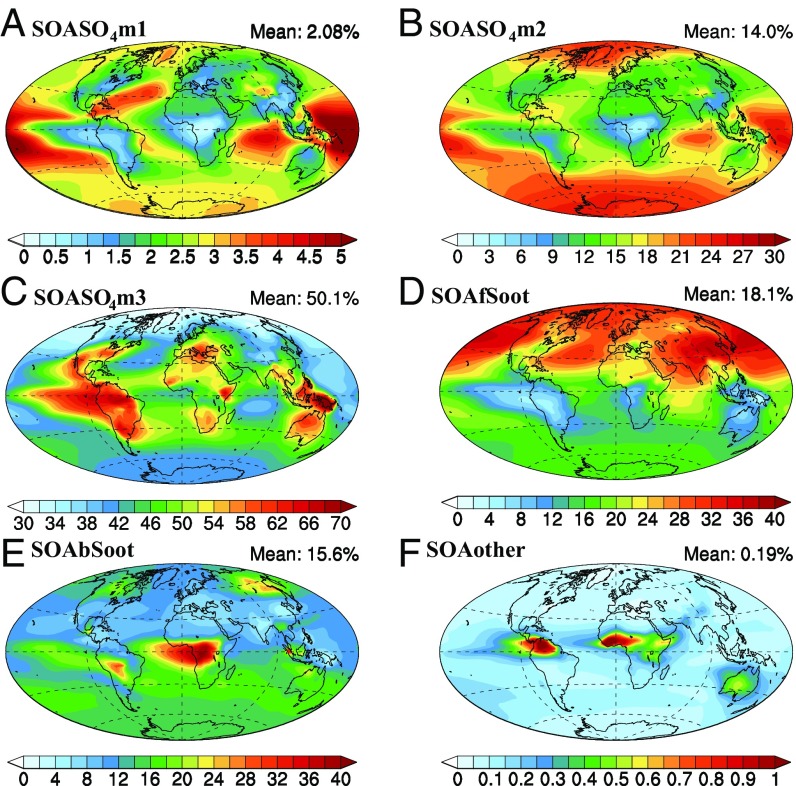
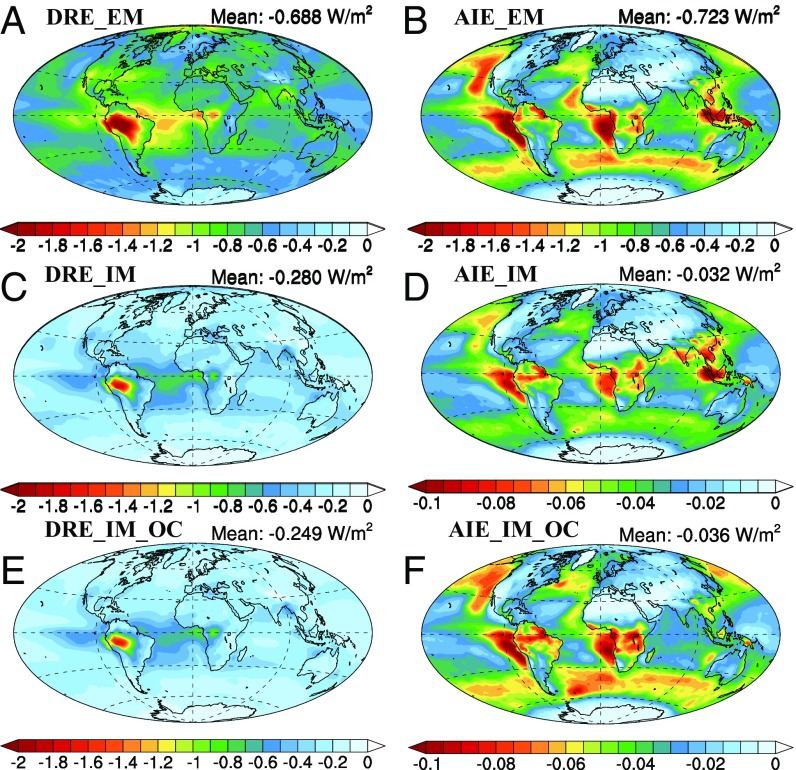
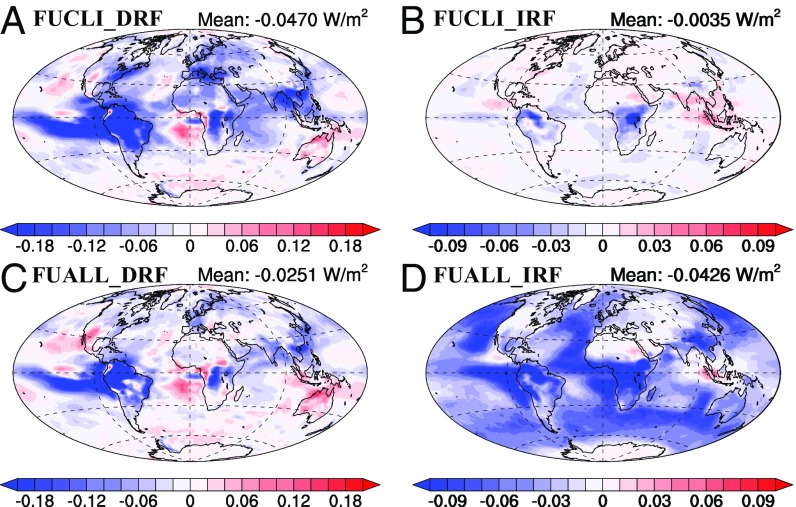
Secondary organic aerosol (SOA) nearly always exists as an internal mixture, and the distribution of this mixture depends on the formation mechanism of SOA. A model is developed to examine the influence of using an internal mixing state based on the mechanism of formation and to estimate the radiative forcing of SOA in the future. For the present day, 66% of SOA is internally mixed with sulfate, while 34% is internally mixed with primary soot. Compared with using an external mixture, the direct effect of SOA is decreased due to the decrease in total aerosol surface area and the increase of absorption efficiency. Aerosol number concentrations are sharply reduced, and this is responsible for a large decrease in the cloud albedo effect. Internal mixing decreases the radiative effect of SOA by a factor of >4 compared with treating SOA as an external mixture. The future SOA burden increases by 24% due to CO2 increases and climate change, leading to a total (direct plus cloud albedo) radiative forcing of -0.05 W m-2 When the combined effects of changes in climate, anthropogenic emissions, and land use are included, the SOA forcing is -0.07 W m-2, even though the SOA burden only increases by 6.8%. This is caused by the substantial increase of SOA associated with sulfate in the Aitken mode. The Aitken mode increase contributes to the enhancement of first indirect radiative forcing, which dominates the total radiative forcing.
Keywords: SOA; future climate; mixing state; radiative effects.
Copyright © 2017 the Author(s). Published by PNAS.
Conflict of interest statement
The authors declare no conflict of interest.
Figures
References
-
- Hallquist M, et al. The formation, properties and impact of secondary organic aerosol: Current and emerging issues. Atmos Chem Phys. 2009;9:5155–5236.
-
- Jimenez JL, et al. Evolution of organic aerosols in the atmosphere. Science. 2009;326:1525–1529. - PubMed
-
- Scott CE, et al. The direct and indirect radiative effects of biogenic secondary organic aerosol. Atmos Chem Phys. 2014;14:447–470.
-
- Tsigaridis K, et al. The AeroCom evaluation and intercomparison of organic aerosol in global models. Atmos Chem Phys. 2014;14:10845–10895.
-
- Jacobson MZ. Strong radiative heating due to the mixing state of black carbon in atmospheric aerosols. Nature. 2001;409:695–697. - PubMed
Publication types
LinkOut - more resources
Full Text Sources
Other Literature Sources
