General Practitioner-Performed Compression Ultrasonography for Diagnosis of Deep Vein Thrombosis of the Leg: A Multicenter, Prospective Cohort Study
- PMID: 29133492
- PMCID: PMC5683865
- DOI: 10.1370/afm.2109
General Practitioner-Performed Compression Ultrasonography for Diagnosis of Deep Vein Thrombosis of the Leg: A Multicenter, Prospective Cohort Study
Abstract
Background: Patients with suspected deep vein thrombosis (DVT) of the lower limb represent a diagnostic dilemma for general practitioners. Compression ultrasonography (US) is universally recognized as the best test of choice. We assessed the diagnostic accuracy of compression US performed by general practitioners given short training in the management of symptomatic proximal DVT.
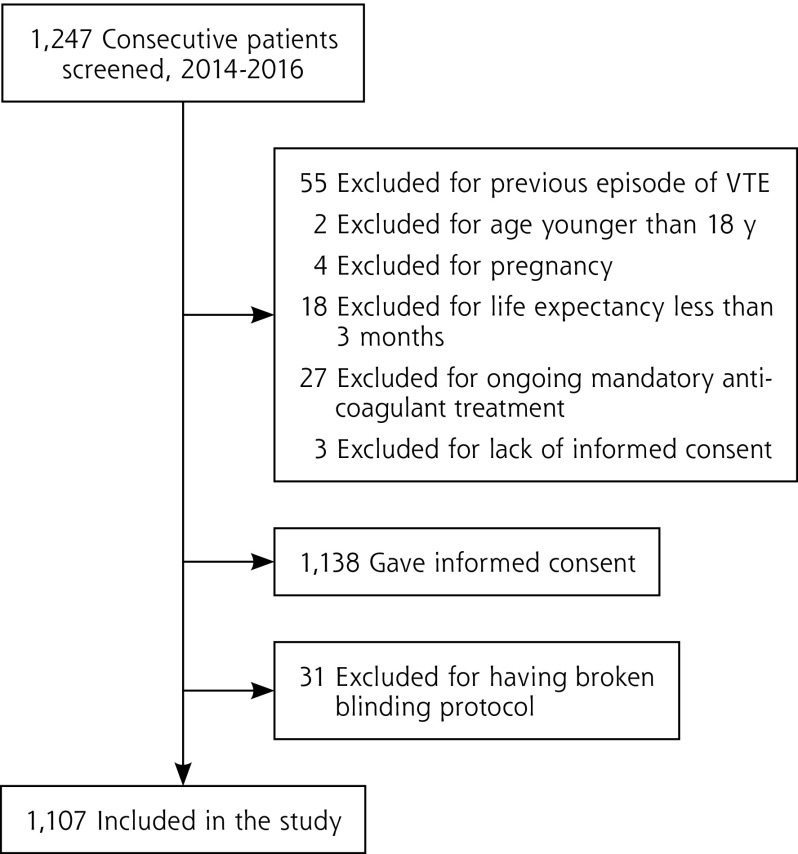
Methods: From May 2014 to May 2016, we evaluated in a multicenter, prospective cohort study all consecutive outpatients with suspected DVT; bilateral proximal lower limb compression US was performed by general practitioners and by physicians expert in vascular US, each group blinded to the other's findings. In all examinations with a negative or nondiagnostic result, compression US was repeated by the same operator after 5 to 7 days. Inter-observer agreement and accuracy were calculated.
Results: We enrolled a total of 1,107 patients. The expert physicians diagnosed DVT in 200 patients, corresponding to an overall prevalence of 18.1% (95% CI, 15.8%-20.3%). The agreement between the trained general practitioners and the experts was excellent (Cohen κ = 0.86; 95% CI, 0.84-0.88). Compression US performed by general practitioners had a sensitivity of 90.0% (95% CI, 88.2%-91.8%) and a specificity of 97.1% (95% CI, 96.2%-98.1%) with a diagnostic accuracy for DVT of 95.8% (95% CI, 94.7%-97.0%).
Conclusions: Our results suggest that, even in hands of physicians not expert in vascular US, compression US can be a reliable tool in the diagnosis of DVT. We found that the sensitivity achieved by general practitioners appeared suboptimal, however, so future studies should evaluate the implementation of proper training strategies to maximize skill.
Keywords: accuracy; compression ultrasound; deep vein thrombosis; diagnosis; general practitioner; practice-based research; primary care.
© 2017 Annals of Family Medicine, Inc.
Conflict of interest statement
Conflicts of interest: authors report none.
Figures
References
-
- Qaseem A, Snow V, Barry P, et al. Joint American Academy of Family Physicians/American College of Physicians Panel on Deep Venous Thrombosis/Pulmonary Embolism. Current diagnosis of venous thromboembolism in primary care: a clinical practice guideline from the American Academy of Family Physicians and the American College of Physicians. Ann Intern Med. 2007;146(6):454–458. - PubMed
-
- Kearon C. Natural history of venous thromboembolism. Circulation. 2003;107(23)(Suppl 1):I22–I30. - PubMed
-
- Oudega R, Hoes AW, Moons KGM. The Wells rule does not adequately rule out deep venous thrombosis in primary care patients. Ann Intern Med. 2005;143(2):100–107. - PubMed
-
- Büller HR, Ten Cate-Hoek AJ, Hoes AW, et al. AMUSE (Amsterdam Maastricht Utrecht Study on thromboEmbolism) Investigators. Safely ruling out deep venous thrombosis in primary care. Ann Intern Med. 2009;150(4):229–235. - PubMed
Publication types
MeSH terms
LinkOut - more resources
Full Text Sources
Other Literature Sources
Medical