


The optimization of fermentation conditions for producing cellulase of Bacillus amyloliquefaciens and its application to goose feed
- PMID: 29134097
- PMCID: PMC5666280
- DOI: 10.1098/rsos.171012
The optimization of fermentation conditions for producing cellulase of Bacillus amyloliquefaciens and its application to goose feed
Abstract
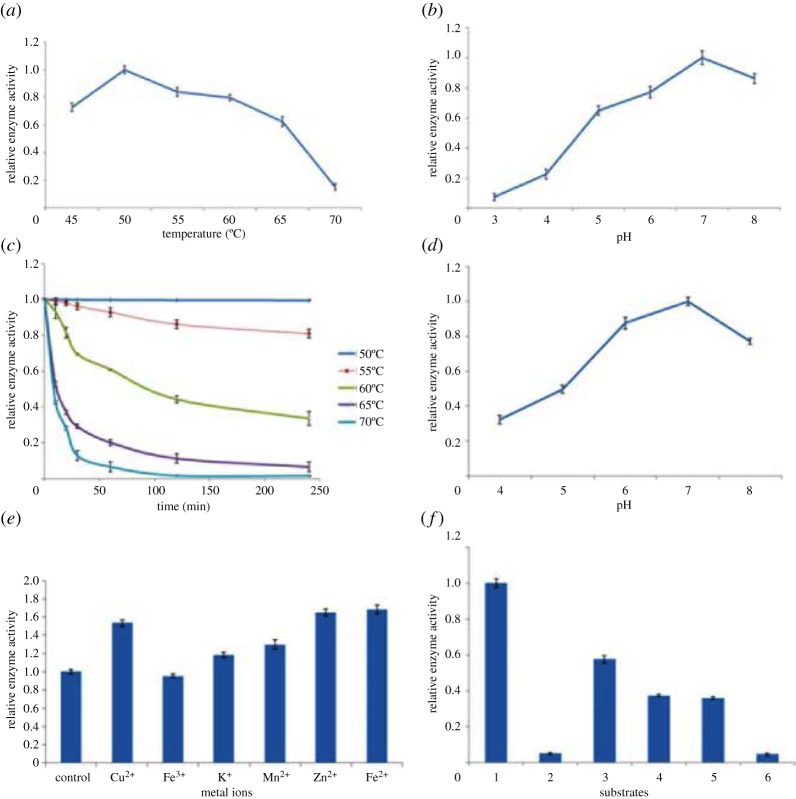
The proper culture conditions for producing cellulase of Bacillus amyloliquefaciens S1, isolated from the cecum of goose was optimized by single-factor experiment combined with orthogonal test. The properties of the cellulase were investigated by DNS method. The appropriate doses of B. amyloliquefaciens S1 were obtained by adding them to goose feed. It indicated that the suitable culture conditions of producing cellulase were the culture temperature of 37°C, the initial pH of 7.0, the incubation time of 72 h and the loaded liquid volume of 75 ml per 250 ml. The effects of each factor on producing cellulase by B. amyloliquefaciens S1 were as follows: initial pH > incubation time = culture temperature > loaded liquid volume. The optimum reaction temperature and pH were 50°C and 7.0, respectively. This enzyme is a kind of neutral cellulase that possesses resistance to heat and acidity. It showed high activity to absorbent cotton, soya bean meal and filter paper. By adding different doses of B. amyloliquefaciens S1 to the goose feed, it was found that the egg production, average egg weight, fertilization rate and the hatching rate were promoted both in experiment 1 (1.5 g kg-1) and experiment 2 (3 g kg-1). Also the difference of egg production, fertilization rate and hatching rate between experiment 1 and control group was obvious (p < 0.05), and the average egg weight was significantly increased in experiment 2 (p < 0.05).
Keywords: Bacillus amyloliquefaciens S1; cecum of goose; cellulase; culture conditions; enzyme properties; goose feed.
Conflict of interest statement
We declare we have no competing interests.
Figures

References
-
- Mohite BV, Patil SV. 2014. A novel biomaterial: bacterial cellulose and its new era applications. Biotechnol. Appl. Biochem. 61, 101–110. (doi:10.1002/bab.1148) - DOI - PubMed
-
- Romling U. 2002. Molecular biology of cellulose production in bacteria. Res. Microbiol. 153, 205–212. (doi:10.1016/S0923-2508(02)01316-5) - DOI - PubMed
-
- Keegstra K. 2010. Plant cell walls. Plant. Physiol. 154, 483–486. (doi:10.1104/pp.110.161240) - DOI - PMC - PubMed
-
- Kimura S, Ohshima C, Hirose E, Nishikawa J, Itoh T. 2001. Cellulose in the house of the appendicularian Oikopleura rufescens. Protoplasma. 216, 71–74. (doi:10.1007/BF02680133) - DOI - PubMed
Associated data
LinkOut - more resources
Full Text Sources
Other Literature Sources
