Ecological restoration success is higher for natural regeneration than for active restoration in tropical forests
- PMID: 29134195
- PMCID: PMC5677348
- DOI: 10.1126/sciadv.1701345
Ecological restoration success is higher for natural regeneration than for active restoration in tropical forests
Abstract
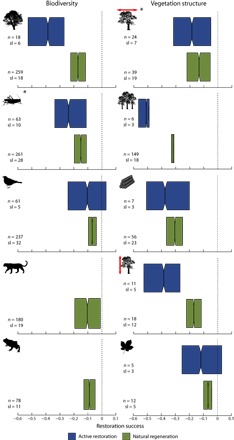
Is active restoration the best approach to achieve ecological restoration success (the return to a reference condition, that is, old-growth forest) when compared to natural regeneration in tropical forests? Our meta-analysis of 133 studies demonstrated that natural regeneration surpasses active restoration in achieving tropical forest restoration success for all three biodiversity groups (plants, birds, and invertebrates) and five measures of vegetation structure (cover, density, litter, biomass, and height) tested. Restoration success for biodiversity and vegetation structure was 34 to 56% and 19 to 56% higher in natural regeneration than in active restoration systems, respectively, after controlling for key biotic and abiotic factors (forest cover, precipitation, time elapsed since restoration started, and past disturbance). Biodiversity responses were based primarily on ecological metrics of abundance and species richness (74%), both of which take far less time to achieve restoration success than similarity and composition. This finding challenges the widely held notion that natural forest regeneration has limited conservation value and that active restoration should be the default ecological restoration strategy. The proposition that active restoration achieves greater restoration success than natural regeneration may have arisen because previous comparisons lacked controls for biotic and abiotic factors; we also did not find any difference between active restoration and natural regeneration outcomes for vegetation structure when we did not control for these factors. Future policy priorities should align the identified patterns of biophysical and ecological conditions where each or both restoration approaches are more successful, cost-effective, and compatible with socioeconomic incentives for tropical forest restoration.
Figures
References
-
- Menz M. H. M., Dixon K. W., Hobbs R. J., Hurdles and opportunities for landscape-scale restoration. Science 339, 526–527 (2013). - PubMed
-
- Bonn Challenge, www.bonnchallenge.org.
-
- D. Conway, P. Keenylside, S. Roe, C. Streck, G. Vargas-Victoria, T. Varns, Progress on the New York declaration on forests – An assessment framework and initial report (2015).
-
- Initiative 20x20, www.wri.org/our-work/project/initiative-20x20/about-initiative-20x20#pro....
-
- African Forest Landscape Restoration Initiative (AFR100), www.wri.org/our-work/project/african-restoration-100.
Publication types
MeSH terms
LinkOut - more resources
Full Text Sources
Other Literature Sources
Miscellaneous