


The effect of long-term confinement and the efficacy of exercise countermeasures on muscle strength during a simulated mission to Mars: data from the Mars500 study
- PMID: 29134470
- PMCID: PMC5684057
- DOI: 10.1186/s40798-017-0107-y
The effect of long-term confinement and the efficacy of exercise countermeasures on muscle strength during a simulated mission to Mars: data from the Mars500 study
Abstract
Background: Isolation and long duration spaceflight are associated with musculoskeletal deconditioning. Mars500 was a unique, high-fidelity analogue of the psychological challenges of a 520-day manned mission to Mars. We aimed to explore the effect of musculoskeletal deconditioning on three outcome measures: (1) if lower limb muscle strength was reduced during the 520-day isolation; (2) if type I or II muscle fibres were differentially affected; and (3) whether any 70-day exercise interventions prevented any isolation-induced loss of strength.
Methods: Six healthy male subjects (mean ± SEM) (34 ± 3 years; 1.76 ± 0.02 metres; 83.7 ± 4.8 kg) provided written, informed consent to participate. The subjects' maximal voluntary contraction (MVC) was assessed isometrically in the calf (predominantly type I fibres), and maximal voluntary isokinetic force (MVIF) was assessed in the quadriceps/hamstrings (predominantly type II fibres) at 0.2 and 0.4 ms-1 using the Multifunctional Dynamometer for Space (MDS) at 35-day intervals throughout Mars500. Exercise interventions were completed 3-7 days/week throughout the 520-day isolation in a counterbalanced design excluding 142-177 days (rest period) and 251-284 days (simulated Mars landing). Exercise interventions included motorized treadmill running, non-motorized treadmill running, cycle ergometry, elastomer-based resistance exercise, whole-body vibration (WBV), and resistance exercise using MDS.
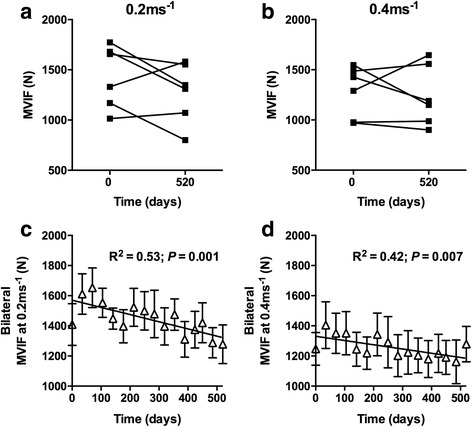
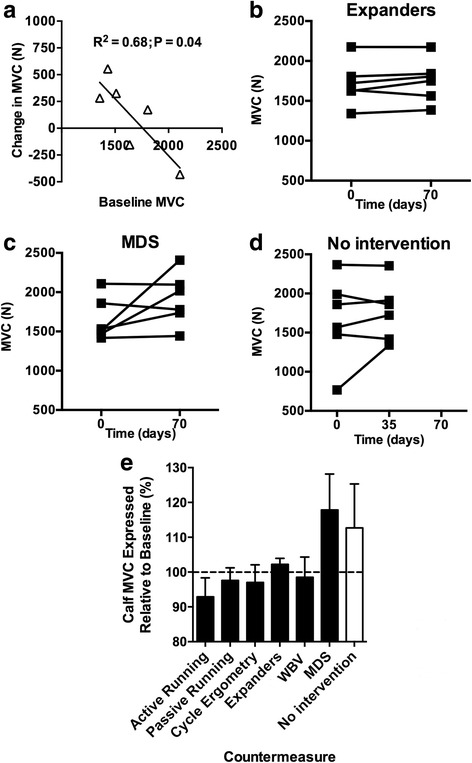
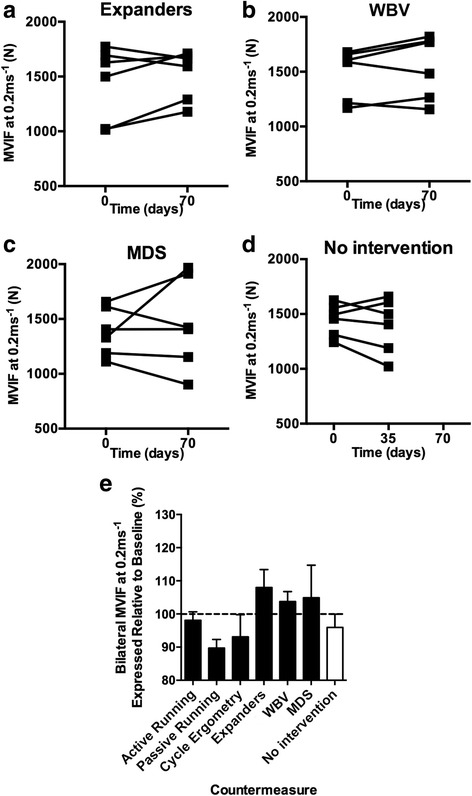
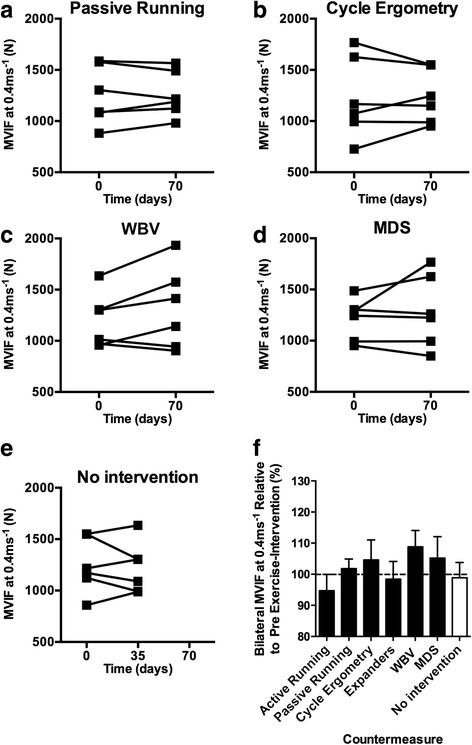
Results: Calf MVC did not reduce across the 520-day isolation and MDS increased strength by 18% compared to before that of 70-day exercise intervention. In contrast, there was a significant bilateral loss of MVIF across the 520 days at both 0.2 ms-1 (R 2 = 0.53; P = 0.001) and 0.4 ms-1 (0.4 ms-1; R 2 = 0.42; P = 0.007). WBV (+ 3.7 and 8.8%) and MDS (+ 4.9 and 5.2%) afforded the best protection against isolation-induced loss of MVIF, although MDS was the only intervention to prevent bilateral loss of calf MVC and leg MVIF at 0.2 and 0.4 ms-1.
Conclusions: Mars500 induced significant loss of quadriceps/hamstrings MVIF but not calf MVC. Collectively, these data suggest that muscles with predominantly type I fibres were affected less by isolation compared to type II dominant muscles. MDS and WBV afforded the best protection against isolation-induced loss of strength and thus may have virtue in exploration class missions.
Keywords: Confinement; Ground-based analogue; Intervention; Mars500; Muscle strength; Spaceflight; Spaceflight analogue.
Conflict of interest statement
Authors’ information
Christopher J. Gaffney is currently a postdoctoral research fellow at the University of Exeter, UK. Elena Fomina, Dennis Babich, Vladimir Kitov, and Konstantin Uskov are researchers at the Institute of Biomedical Problems of the Russian Federal Space Agency, Moscow. David A. Green is a senior lecturer at King’s College London and a member of staff at the European Astronaut Centre, Cologne, Germany.
Ethics approval and consent to participate
Written informed consent to participate in the study conformed to the 6th revision of the
Consent for publication
Not applicable
Competing interests
Christopher J. Gaffney, Elena Fomina, Dennis Babich, Vladimir Kitov, Konstantin Uskov, and David A. Green declare that they have no conflict of interest.
Publisher’s Note
Springer Nature remains neutral with regard to jurisdictional claims in published maps and institutional affiliations.
Figures
References
-
- Basner M, Dinges DF, Mollicone D, Ecker A, Jones CW, Hyder EC, et al. Mars 520-d mission simulation reveals protracted crew hypokinesis and alterations of sleep duration and timing. Proc. Natl. Acad. Sci. U. S. A. [Internet]. National Academy of Sciences; 2013 [cited 2017 Jan 15];110:2635–40. Available from: http://www.ncbi.nlm.nih.gov/pubmed/23297197 - PMC - PubMed
-
- Grigoriev AI, Kozlovskaya IB, Potapov AN. Goals of biomedical support of a mission to Mars and possible approaches to achieving them. Aviat. Space. Environ. Med. [Internet]. 2002 [cited 2016 Feb 21];73:379–84. Available from: http://www.ncbi.nlm.nih.gov/pubmed/11952060 - PubMed
-
- Dorais GA. An artificial-gravity space-settlement ground-analogue design concept. AIAA Sp. 2016 [Internet]. Reston, Virginia: American Institute of Aeronautics and Astronautics; 2016 [cited 2017 Jan 13]. Available from: http://arc.aiaa.org/doi/10.2514/6.2016-5388 - DOI
-
- Carpenter R, Lang T, Bloomfield S. Effects of long-duration spaceflight, microgravity, and radiation on the neuromuscular, sensorimotor, and skeletal systems. J. [Internet]. 2010 [cited 2017 Jan 15]; Available from: http://journalofcosmology.com/Mars147.html
-
- Berger MJ, Doherty TJ. Sarcopenia: prevalence, mechanisms, and functional consequences. Interdiscip. Top. Gerontol. [Internet]. 2010 [cited 2016 Feb 20];37:94–114. Available from: http://www.ncbi.nlm.nih.gov/pubmed/20703058 - PubMed
LinkOut - more resources
Full Text Sources
Other Literature Sources
Research Materials
Miscellaneous
