


Is BMI a valid measure of obesity in postmenopausal women?
- PMID: 29135897
- PMCID: PMC5821529
- DOI: 10.1097/GME.0000000000000989
Is BMI a valid measure of obesity in postmenopausal women?
Abstract
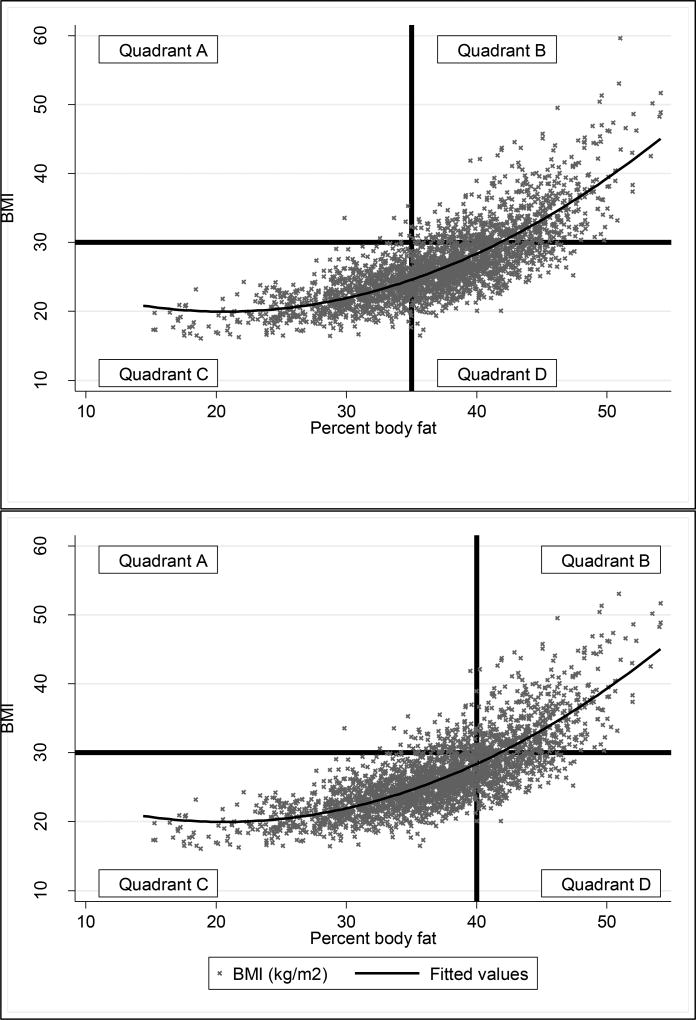
Objective: Body mass index (BMI) is a widely used indicator of obesity status in clinical settings and population health research. However, there are concerns about the validity of BMI as a measure of obesity in postmenopausal women. Unlike BMI, which is an indirect measure of obesity and does not distinguish lean from fat mass, dual-energy x-ray absorptiometry (DXA) provides a direct measure of body fat and is considered a gold standard of adiposity measurement. The goal of this study is to examine the validity of using BMI to identify obesity in postmenopausal women relative to total body fat percent measured by DXA scan.
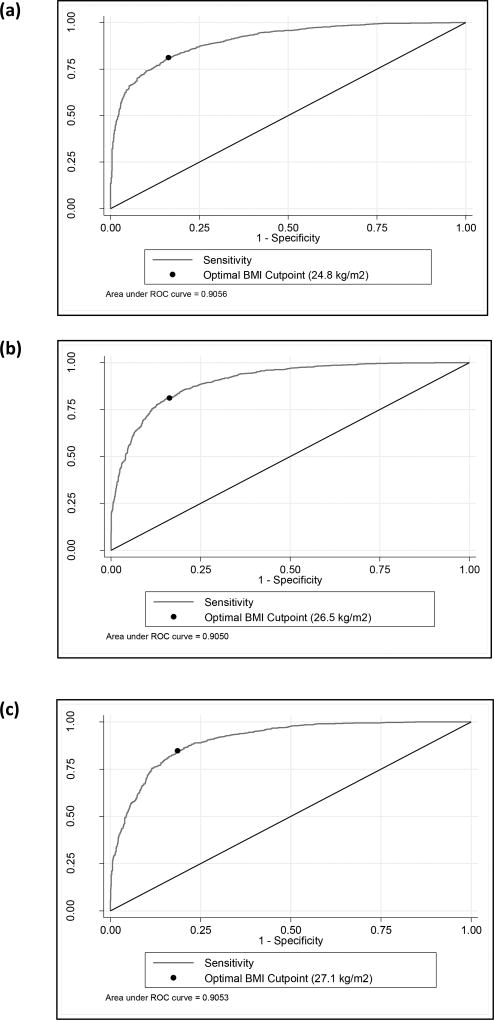
Methods: Data from 1,329 postmenopausal women participating in the Buffalo OsteoPerio Study were used in this analysis. At baseline, women ranged in age from 53 to 85 years. Obesity was defined as BMI ≥ 30 kg/m and body fat percent (BF%) greater than 35%, 38%, or 40%. We calculated sensitivity, specificity, positive predictive value, and negative predictive value to evaluate the validity of BMI-defined obesity relative BF%. We further explored the validity of BMI relative to BF% using graphical tools, such as scatterplots and receiver-operating characteristic curves. Youden's J index was used to determine the empirical optimal BMI cut-point for each level of BF% defined obesity.
Results: The sensitivity of BMI-defined obesity was 32.4% for 35% body fat, 44.6% for 38% body fat, and 55.2% for 40% body fat. Corresponding specificity values were 99.3%, 97.1%, and 94.6%, respectively. The empirical optimal BMI cut-point to define obesity is 24.9 kg/m for 35% BF, 26.49 kg/m for 38% BF, and 27.05 kg/m for 40% BF according to the Youden's index.
Conclusions: Results demonstrate that a BMI cut-point of 30 kg/m does not appear to be an appropriate indicator of true obesity status in postmenopausal women. Empirical estimates of the validity of BMI from this study may be used by other investigators to account for BMI-related misclassification in older women.
Conflict of interest statement
Figures
References
-
- Flegal KM, Carroll MD, Kit BK, Ogden CL. Prevalence of obesity and trends in the distribution of body mass index among US adults, 1999–2010. JAMA. 2012;307(5):491–7. - PubMed
-
- Hardy R, Kuh D. BMI and mortality in the elderly—a life course perspective. International Journal of Epidemiology. 2006;35(1):179–180. - PubMed
-
- Simmonds M, Burch J, Llewellyn A, Griffiths C, Yang H, Owen C, Duffy S, Woolacott N. The use of measures of obesity in childhood for predicting obesity and the development of obesity-related diseases in adulthood: a systematic review and meta-analysis. Health Technol Assess. 2015;19(43) - PMC - PubMed
Publication types
MeSH terms
Grants and funding
LinkOut - more resources
Full Text Sources
Other Literature Sources
Medical
Miscellaneous
